Forever Young: Living in an Age of Agelessness
Jan1

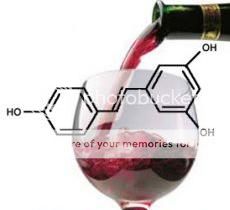
The chemical compound resveratrol, a component of red wine that has been linked to anti-aging properties in laboratory experiments.
During a recent trip to New York City, I had the pleasure of befriending exciting new author Ernesto Robles, whose debut novel The Malthusian Catastrophe is a ScriptPhD.com recommended pick. Smart, topical, fast-paced and decidedly engrossing, this biomedical thriller drives at the roots of our cultural obsession with the “fountain of youth” and the perilous socioeconomic repercussions of actually finding and disseminating it. In a year when the Nobel Prize for Medicine and Physiology went to a team of researchers for their discovery of how chromosomes are protected by telomeres and the enzyme telomerase, essential biological components of the human aging machinery, and a cultural era that has anointed juvenescence as sacrosanct, Malthusian’s overarching themes are especially germane. ScriptPhD.com’s discussion includes a review of the book, the biology and ethics of current aging research, and a one-on-one interview with Mr. Robles. For full content, please click “continue reading.”
GUEST POST: On Chemistry, Movies and Making Science Entertaining
Jan2

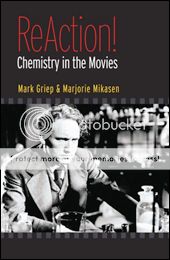
Reaction! Chemistry in the Movies is an Oxford University Press title. ©2009, all rights reserved.
One of my favorite movies as a kid, and now, as a professional scientist, is Andromeda Strain. The heroes are mostly older, professorial types who work feverishly to understand an alien organism and save the planet. After being asked to review ReAction! Chemistry in the Movies for ScriptPhD.com, I was so curious to consume (with relish) the book’s guesswork about the chemistry found in Andromeda Strain. After returning to the beginning of the book and giving it a read, I was thrilled to find that ReAction! is a detailed, thoughtful exploration of the representation of chemistry in film. The book addresses, first and foremost, the fact that chemistry can play a lead role in film. The authors also discuss the dichotomy between the “dark” and “bright” sides of chemistry (and science) as illustrated by films in which chemistry or chemists play a central role. Also included are several playful explorations of the real science behind some famous examples of fictional chemistry in film. After the break is a full review of the book along with an in-depth interview with authors Mark Griep and Majorie Mikasen on the process of working together as chemist and artist, portrayal of chemists in film and how film can change public perception in science.
From the Annals of Psychology: Fear and Loathing in a Modern Age
Dec4

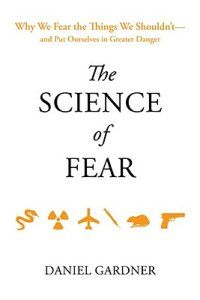
“First of all, let me assert my firm belief that the only thing we have to fear is fear itself—nameless, unreasoning, unjustified terror which paralyzes needed efforts to convert retreat into advance.” These inspiring words, borrowed from scribes Henry David Thoreau and Michel de Montaigne, were spoken by President Franklin Delano Roosevelt at his first inauguration during the only era more perilous than the one we currently face. But FDR had it easy. All he had to face was 25% unemployment and 2 million homeless Americans. We have, among other things, climate change, carcinogens, leaky breast implants, the obesity epidemic, the West Nile virus, SARS, avian/swine flu, flesh-eating disease, pedophiles, predators, herpes, satanic cults, mad cow disease, crack cocaine, and let’s not forget that paragon of Malthusian-like fatalism—terror. In his brilliant book The Science of Fear, journalist Daniel Gardner delves into the psychology and physiology of fear and the incendiary factors that drive it, including media, advertising, government, business and our own evolutionary mold. For our final blog post of 2009, ScriptPhD.com extends the science into a personal reflection, a discussion of why, despite there never having been a better time to be alive, we are more afraid than ever, and how we can turn a more rational leaf in the year 2010.
Why Science is the Ultimate Blue-Chip Investment
Dec1
The famous French scientist Louis Pasteur once said, “There are no such things as applied sciences, only applications of science.” As a nation we are continuing to find ourselves in increasingly difficult economic times. Our state and federally elected leaders are constantly under pressure to make difficult appropriations decisions at all levels of their budgets. At the federal level, the National Institutes of Health (NIH), our nation’s primary investor of biomedical research funding, is no exception during this economy. A recent New York Times article, The Science of Spending Stimulus Money Wisely, questioned the value of funding basic research at the cost of immediate jobs and dividends. Indeed, a central question regarding the public financing of biomedical research emerges more routinely: How do we strike the right balance between the funding of basic research and the funding of applied research? What is the value of each to scientific development, the pursuit of knowledge, and most importantly, mankind? These question have been debated for generations, largely because there is no right answer. There is no exact formula, or panel of experts that will be able to determine the exact dollar amount which should be spent in each area, nor is there a correct percentage by which the money should be divided between the two areas. The following article postulates that continued funding and public understanding of basic research, the foundation for all applied research, is the smartest long-term investment of all.
Fall Science TV Preview(let) Part I
Sep3

Well, it’s that time of the year again, folks! Summer is fading, the leaves are starting to change color, the last of the barbecue coals has been extinguished, and you know what that means. The return of fall television. And we here at ScriptPhD.com are committed to previewing the best of science and science-fiction that the boob tube has to offer. From educational, to informational, to just downright fun, over the next two weeks, we will preview our picks of can’t-miss fall shows. While the majority of the season’s lineup is set to debut towards the end of September and beginning of October (coverage of which we’ll bring you next week), this week sees the return of Bones, Fringe and a Jim Henson favorite for the kiddies, Sid the Science Kid. Our exclusive sneak previews, under the jump.