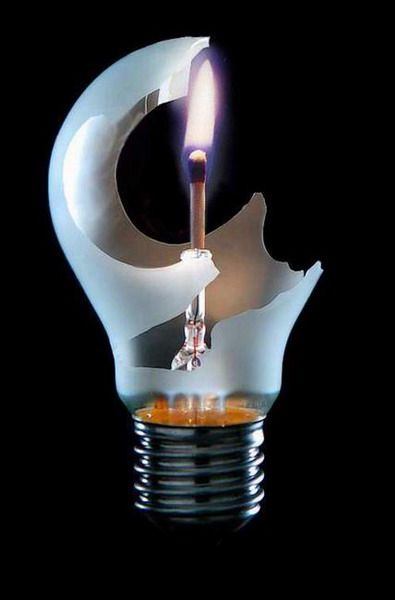
Scientists are becoming more interested in trying to pinpoint precisely what’s going on inside our brains while we’re engaged in creative thinking. Which brain chemicals play a role? Which areas of the brain are firing? Is the magic of creativity linked to one specific brain structure? The answers are not entirely clear. But thanks to brain scan technology, some interesting discoveries are emerging. ScriptPhD.com was founded and focused on the creative applications of science and technology in entertainment, media and advertising, fields traditionally defined by “right brain” propensity. It stands to reason, then, that we would be fascinated by the very technology and science that as attempting to deduce and quantify what, exactly, makes for creativity. To help us in this endeavor, we are pleased to welcome computer scientist and writer Ravi Singh’s guest post to ScriptPhD.com. For his complete article, please click “continue reading.”
Before you can measure something, you must be able to clearly define what it is. It’s not easy to find consensus among scientists on the definition of creativity. But then, it’s not easy to find consensus among artists, either, about what’s creative and what’s not. Psychologists have traditionally defined creativity as “the ability to combine novelty and usefulness in a particular social context.” But newer models argue that these type of definitions, which rely on extremely-subjective criteria like ‘novelty’ and ‘usefulness,’ are too vague. John Kounios, a psychologist at Drexel University who studies the neural basis of insight, defines creativity as “the ability to restructure one’s understanding of a situation in a non-obvious way.” His research shows that creativity is not a singular concept. Rather, it’s a collection of different processes that emerge from different areas of the brain.
In attempting to measure creativity, scientists have had a tendency to correlate creativity with intelligence—or at least link creativity to intelligence—probably because we believe that we have a handle on intelligence. We believe can measure it with some degree of accuracy and reliability. But not creativity. No consensus measure for creativity exists. Creativity is too complex to be measured through tidy, discrete questions. There is no standardized test. There is yet to be a meaningful “Creativity Quotient.” In fact, creativity defies standardization. In the creative realm, one could argue, there’s no place for “standards.” After all, doesn’t the very notion of standardization contradict what creativity is all about?
To test creativity, researchers have historically attempted to test divergent thinking, an assessment construct originally developed in the 1950s by psychologist J. P. Guilford, who believed that standardized IQ tests favored convergent thinkers (who stay focused on solving a core problem), rather than divergent thinkers (who go ‘off on tangents’). Guilford believed that scores on IQ tests should not be taken as a unidimensional measure of intelligence. He observed that creative people often score lower on standard IQ tests because their approach to solving the problems generates a larger number of possible solutions, some of which are thoroughly original. The test’s designers would have never thought of those possibilities. Testing divergent thinking, he believed, allowed for greater appreciation of the diversity of human thinking and abilities. A test of divergent thinking might ask the subject to come up with new and useful functions for a familiar object, such as a brick or a pencil. Or the subject might be asked to draw the taste of chocolate. You can see how it would be very difficult, if not impossible to standardize a “correct” answer.
Eastern traditions have their own ideas about creativity and where it comes from. In Japan, where students and factory workers are stereotyped as being too methodical, researchers are studying schoolchildren for a possible correlation between playfulness and creativity. Nath philosopher Mahendranath wrote that man’s “memory became buried under the artificial superstructure of civilization and its artificial concepts,” his way of saying that that too much convergent thinking can inhibit creativity. Sanskrit authors described the spontaneous and divergent mental experience of sahaja meditation, where new insights occur after allowing the mind to rest and return to the natural, unconditioned state. But while modern scientific research on meditation is good at measuring physiological and behavioral changes, the “creative” part is much more elusive.
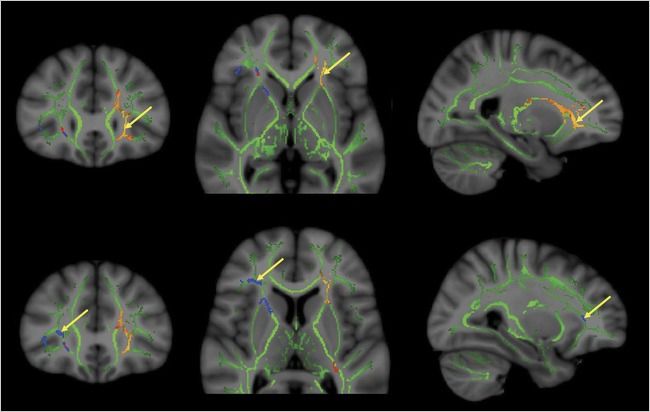
Some western scientists suggest that creativity is mostly ascribed to neurochemistry. High intelligence and skill proficiency have traditionally been associated with fast, efficient firing of neurons. But the research of Dr. Rex Jung, a research professor in the department of neurosurgery at the University of New Mexico, shows that this is not necessarily true. In researching the neurology of the creative process, Jung has found that subjects who tested high in “creativity” had thinner white matter and connecting axons in their brains, which has the effect of slowing nerve traffic. Jung believes that this slowdown in the left frontal cortex, a brain region where emotion and cognition are integrated, may allow us to be more creative, and to connect disparate ideas in novel ways. Jung has found that when it comes to intellectual pursuits, the brain is “an efficient superhighway” that gets you from Point A to Point B quickly. But creativity follows a slower, more meandering path that has lots of little detours, side roads and rabbit trails. Sometimes, it is along those rabbit trails that our most revolutionary ideas emerge. You just have to be willing to venture off the main highway.
We’ve all had aha! moments—those sudden bursts of insight that solve a vexing problem, solder an important connection, or reinterpret a situation. We know what it is, but often, we’d be hard-pressed to explain where it came from or how it originated. Dr. Kounios, along with Northwestern University psychologist Mark Beeman, has extensively studied the the “Aha! moment.” They presented study participants with simple word puzzles that could be solved either through a quick, methodical analysis or an instant creative insight. Participants are given three words then are asked to come up with one word that could be combined with each of these three to form a familiar term; for example: crab, pine and sauce. (Answer: “apple.”) Or eye, gown and basket. (Answer: ball)
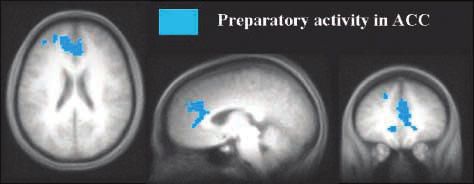
Regions of the brain lighting up in people who "thought about" the answers to a creativity puzzle.
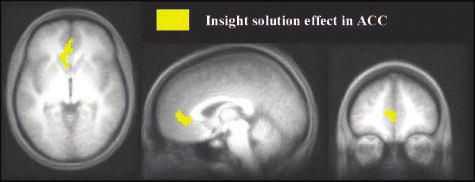
Regions of the brain lighting up for people who had "Aha!" moments to the creativity puzzle.
About half the participants arrived at solutions by methodically thinking through possibilities; for the other half, the answer popped into their minds suddenly. During the “Aha! moment,” neuroimaging showed a burst of high-frequency activity in the participants’ right temporal lobe, regardless of whether the answer popped into the subjects’ minds instantly or they solved the problem methodically. But there was a big difference in how each group mentally prepared for the test question. The methodical problem solvers prepared by paying close attention to the screen before the words appeared—their visual cortices were on high alert. By contrast, those who received a sudden Aha! flash of creative insight prepared by automatically shutting down activity in the visual cortex for an instant—the neurological equivalent of closing their eyes to block out distractions so that they could concentrate better. These creative thinkers, Kounios said, were “cutting out other sensory input and boosting the signal-to-noise ratio” to enable themselves retrieve the answer from the subconscious.
Creativity, in the end, is about letting the mind roam freely, giving it permission to ignore conventional solutions and explore uncharted waters. Accomplishing that requires an ability, and willingness, to inhibit habitual responses, take risks. Dr. Kenneth M. Heilman, a neurologist at the University of Florida believes that this capacity to let go may involve a dampening of norepinephrine, a neurotransmitter that triggers the fight-or-flight alarm. Since norepinephrine also plays a role in long-term memory retrieval, its reduction during creative thought may help the brain temporarily suppress what it already knows, which paves the way for new ideas and discovering novel connections. This neurochemical mechanism may explain why creative ideas and Aha! moments often occur when we are at our most peaceful, for example, relaxing or meditating.
The creative mind, by definition, is always open to new possibilities, and often fashions new ideas from seemingly irrelevant information. Psychologists at the University of Toronto and Harvard University believe they have discovered a biological basis for this behavior. They found that the brains of creative people may be more receptive to incoming stimuli from the environment that the brains of others would shut out through the the process of “latent inhibition,” our unconscious capacity to ignore stimuli that experience tells us are irrelevant to our needs. In other words, creative people are more likely to have low levels of latent inhibition. The average person becomes aware of such stimuli, classifies it and forgets about it. But the creative person maintains connections to that extra data that’s constantly streaming in from the environment and uses it.
Sometimes, just one tiny stand of information is all it takes to trigger a life-changing “Aha!” moment.
Ravi Singh is a California-based IT professional with a Masters in Computer Science (MCS) from the University of Illinois. He works on corporate information systems and is pursuing a career in writing.
*****************
ScriptPhD.com covers science and technology in entertainment, media and advertising. Hire our consulting company for creative content development.
Follow us on Twitter and our Facebook fan page. Subscribe to free email notifications of new posts on our home page.


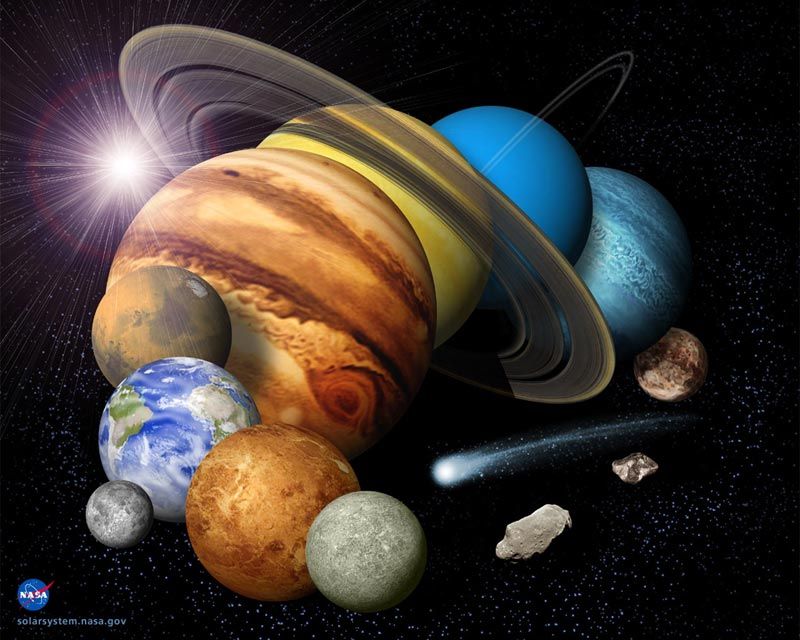
Our solar system, a true wonder to behold! Image © NASA, all rights reserved.
“I think we’re living through the greatest age of discovery our civilization has ever known,” declares British physics superstar Professor Brian Cox as a preamble for each episode of The Science Channel’s BBC import Wonders of the Solar System. Episode by episode, Dr. Cox deconstructs our wondrous Universe one focus at a time—the Sun, the Big Bang, life on other planets. But he does something even more important. He infuses his own obvious enthusiasm and passion for his field in each experiment and factoid. As a viewer, you can’t helped but be absorbed in the intergalactic vortex of knowledge. The timing of this mini-series and emergence of Cox’s exuberant personality could not be better. Funding for NASA missions has been cut dramatically, with an ongoing re-evaluation the role space exploration should play in the national budget and science ambition. American viewers should get used to Cox as a modern-day Carl Sagan, because his star is rising fast. ScriptPhD.com was extraordinarily fortunate to sit down with Dr. Cox in Los Angeles for a one-on-one podcast about the show, the current state of space exploration, and what is possible to achieve experimentally if we only try. My conversation with the inspirational, eloquent and brilliant Brian Cox, along with our review of Wonders of the Universe, under the “continue reading” cut.

An extreme ultra-violet image of the sun from SOHO (Solar & Heliospheric Observatory) - image courtesy ESA/NASA)
Astronomy was never my strongest suit academically. And while I’ve always had a respectful admiration for the solar system and interplanetary sciences, I was never the kind to stargaze or spend hours on the telescope on the off-chance of spotting Mars, Venus or the Saturn rings. It’s a testament, then, to the immensity, ambition and quality of The Science Channel’s latest mini-series project, Wonders of the Solar System for holding me positively captivated while screening the first two episodes. A concept as simple as a solar eclipse is the running theme for the entirety of the first episode, “Empire of the Sun.” By the time the eclipse is recorded, it is the climax to an astounding collection of facts about how rare, precious and ordered the Sun (and its position to the Earth really is). A perfect eclipse is only possible right here on planet Earth—400 times the planetary distance away from the Moon, with the Sun an exact 400 times the diameter of the Moon. No other moon in the vast expanse of the solar system has these properties. Pretty amazing stuff, right? The timing of Wonders of the Solar System could not come at a better time. With our economic and moral spirits at a nadir, it’s time to discuss the importance of space travel and exploration to our scientific, nationalistic and optimistic psyches. President Obama’s 2011 NASA budget, while providing an increase of $6 billion for technology innovation, scrapped manned space flights, including a manned mission to the Moon and any proposals of future Mars exploration. Neil Armstrong, the first man to walk on the Moon, strongly criticized the move as handicapping spaceflight and exploratory ambition. One of the things Wonders of the Universe reminds us, and that Dr. Cox reiterated in our podcast below, is that scientific discoveries come out of limitless ambition, and often from asking completely unrelated questions. Nothing is more ambitious for mankind than exploring the Universe that houses our miraculous existence. Future episodes will examine the Wonders of our atmosphere, the similarity between our planet and Mars, and most excitingly, examining the possibilities of alien life in the solar system.

Brian Cox prepares to take in a solar eclipse in India in the episode "Empire of the Sun." Photo ©2010 BBC/Science Channel.
Part of the appeal of Wonders is that unlike many educational platforms that talk at the viewer in order to inform, Wonders feels like an interactive, experimental experience. When Cox isn’t zipping from one far-fetched corner of the world to another (catching an aurora borealis in the Arctic Circle! a solar eclipse in India! Mars-watching in Tunisia!), he’s pointing out cool, and often eye-catching, experiments that show viewers the science and physics that makes our solar system so fantastically unique. Who would ever know that a tornado in the Midwest is actually a physics parallel to the formation of our very universe. The scientific principle at hand—conservation of angular momentum—stopped the solar system from collapsing under its own gravity during formation, allowing a stable, rotating disc of planets to form. We all know the sun is powerful, shining 1 kW of energy for meter squared of the Earth’s surface, equal to one million times the yearly power consumption of the United States in each second! But it’s a lot more fun to watch Cox show this measurement in Death Valley with a pail of water, a thermometer, and some physics. Likewise the Sun’s sunspots, a still not quite understood phenomenon that has been correlated to the Earth’s seasons and weather, which Cox illustrates with a digital camera. All of this extemporaneous experimentation is reminiscent of the best of Carl Sagan, just with a modern twist.
The Los Angeles Times, in their television review of Wonders called Brian Cox “the nerd that’s cooler than you.” Already a budding superstar in the world of particle physics (check out his TED talk on his work at CERN’s Hadron Supercollider), Cox is that perfect mix of half-scientist, half-TV star. Without him, Wonders would be a completely different endeavor. (Listen to our podcast below as an example of his charismatic eloquence.) To boot, BBC and The Science Channel spared no expenses when it came to production values. In our one on one meeting, Cox let us in on the secret that the whole of Wonders was filmed with an old-fashioned 1970s cinematic lens, lending a decidedly movie feel to the show, particularly the graphics and digital sequences. While some imagery is real, such as amazing Martian sunsets captured by the Mars rover, other digital effects (notably in the “Empire of the Sun” episode) are stunning enough to make you feel like your television is the portal window of a spacecraft in intergalactic orbit.
Wonders of the Solar System airs on The Science Channel on Thursdays at 9 PM ET.
While in Los Angeles last week to promote Wonders of the Solar System, Dr. Cox graciously sat down with ScriptPhD.com to discuss the show and his views on space exploration. Take a listen to our illuminating and very exclusive podcast below:
~*ScriptPhD*~
*****************
ScriptPhD.com covers science and technology in entertainment, media and advertising. Hire our consulting company for creative content development.
Follow us on Twitter and our Facebook fan page. Subscribe to free email notifications of new posts on our home page.
As Comic-Con winds down on the shortened Day 4, we conclude our coverage with two panels that exemplify what Comic-Con is all about. As promised, we dissect the “Comics Design” panel of the world’s top logo designers deconstructing their work, coupled with images of their work. We also bring you an interesting panel of ethnographers, consisting of undergraduate and graduate student, studying the culture and the varying forces that shape Comic-Con. Seriously, they’re studying nerds! Finally, we are delighted to shine our ScriptPhD.com spotlight on new sci-fi author Charles Yu, who presented his new novel at his first (of what we are sure are many) Comic-Con appearance. We sat down and chatted with Charles, and are pleased to publish the interview. And of course, our Day 4 Costume of the Day. Comic-Con 2010 (through the eyes of ScriptPhD.com) ends under the “continue reading” cut!
Comics Design
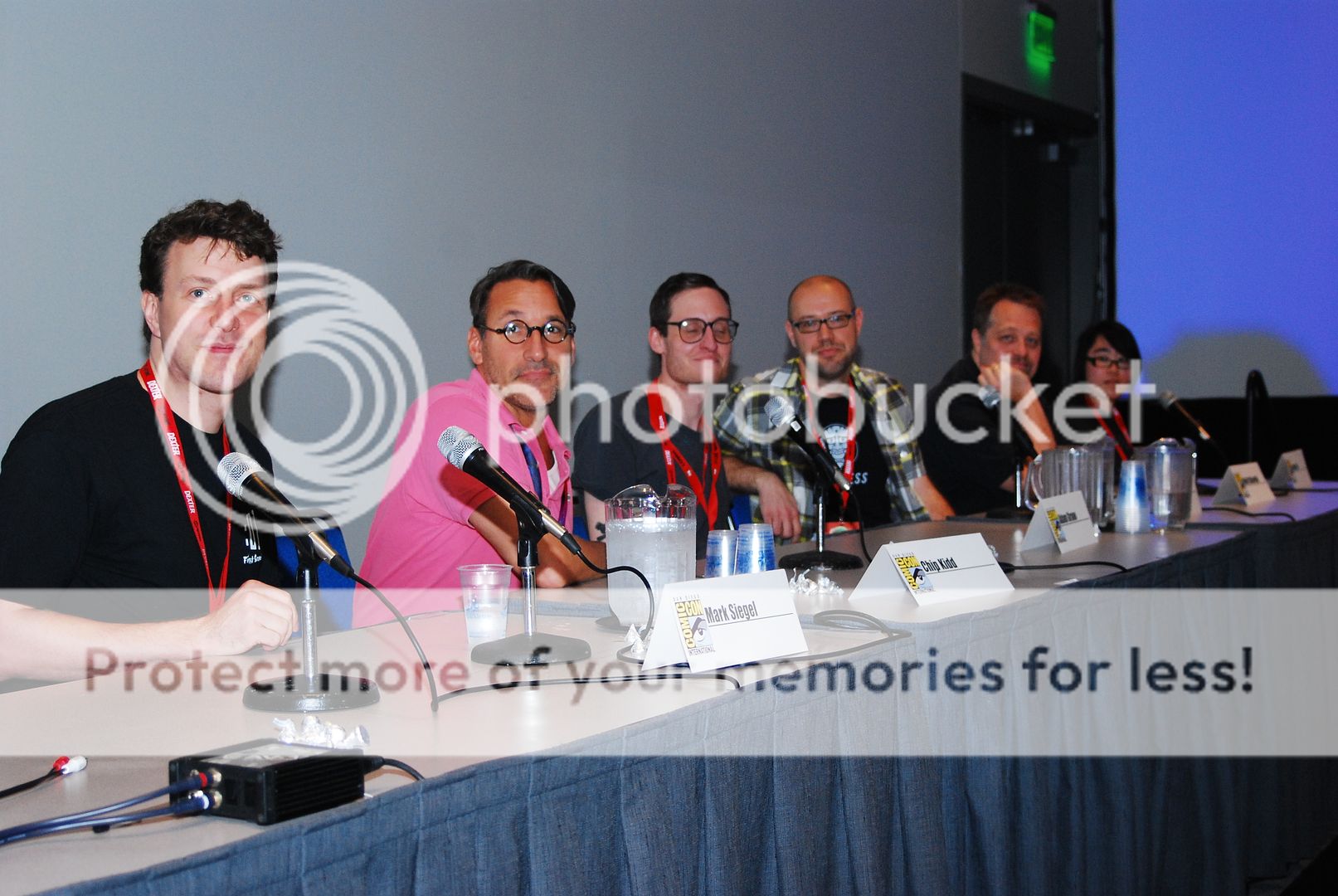
The visionaries of graphics design for comics (from left to right): Mark Siegel, Chip Kidd, Adam Grano, Mark Chiarello, Keith Wood, and Fawn Lau.
We are not ashamed to admit that here at ScriptPhD.com, we are secret design nerds. We love it, particularly since good design so often elevates the content of films, television, and books, but is a relatively mysterious process. One of THE most fascinating panels that we attended at Comic-Con 2010 was on the design secrets behind some of your favorite comics and book covers. A panel of the world’s leading designers revealed their methodologies (and sometimes failures) in the design process behind their hit pieces, lifting the shroud of secrecy that designers often envelop themselves in. An unparalleled purview into the mind of the designer, and the visual appeal that so often subliminally contributes to the success of a graphic novel, comic, or even regular book. We do, as it turns out, judge books by their covers.
As promised, we revisit this illuminating panel, and thank Christopher Butcher, co-founder of The Toronto Comic Arts Festival and co-owner of The Beguiling, Canada’s finest comics bookstore. Chris was kind enough to provide us with high-quality images of the Comics Design panel’s work, for which we at ScriptPhD.com are grateful. Chris had each of the graphic artists discuss their work with an example of design that worked, and design that didn’t (if available or so inclined). The artist was asked to deconstruct the logo or design and talk about the thought process behind it.
Mark Ciarello – (art + design director at DC Comics)
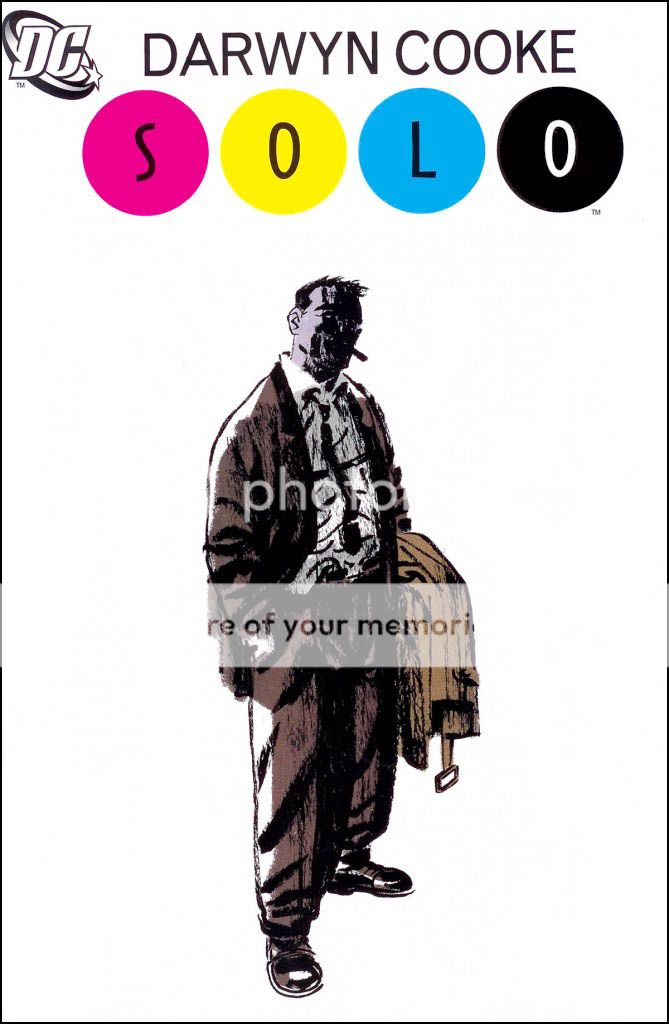
SOLO, a new release from DC Comics.
Mark chose to design the cover of this book with an overall emphasis on the individual artist. Hence the white space on the book, and a focus on the logo above the “solo” artist.
Adam Grano – (designer at Fantagraphics)

The book cover of A Drunken Dream by Moto Hagio
Adam took the title of this book quite literally, and let loose with his design to truly emphasize the title. He called it “method design.” He wanted the cover to look like a drunken dream.
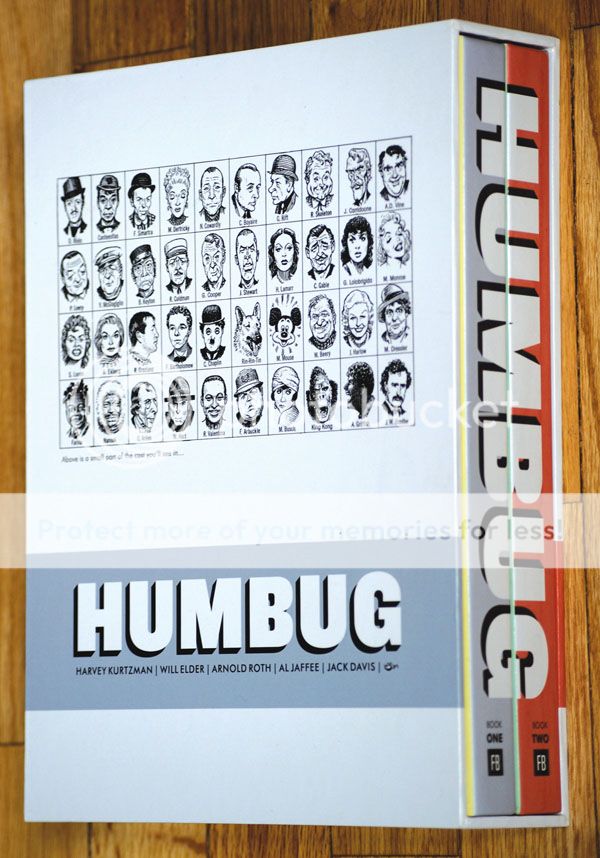
The Humbug collection.
For the Humbug collection, Grano tried hard not to impress too much of himself (and his tastes) in the design of the cover. He wanted to inject simplicity in a project that would stand the test of time, because it was a collector’s series.
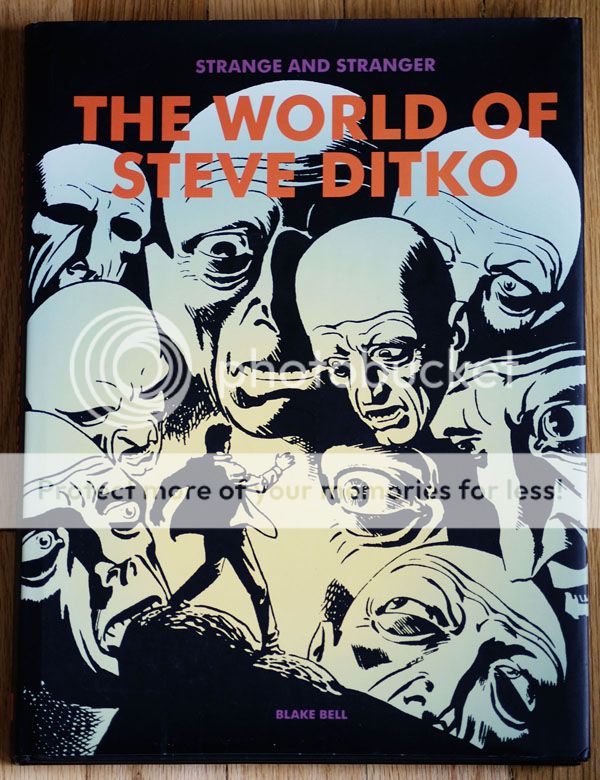
Book cover for The World of Steve Ditko by Blake Bell.
Grano considered this design project his “failure.” It contrasts greatly with the simplicity and elegance of Humbug. He mentioned that everyone on the page is scripted and gridded, something that designers try to avoid in comics.
Chip Kidd – (designer at Random House)
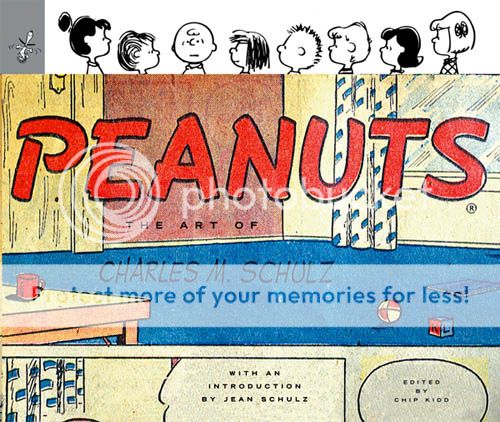
The first Peanuts collection release after Charles M. Schultz's death.
Chip Kidd had the honor of working on the first posthumous Peanuts release after Charles M. Schultz’s death, and took to the project quite seriously. In the cover, he wanted to deconstruct a Peanuts strip. All of the human element is taken out of the strip, with the characters on the cover up to their necks in suburban anxiety.
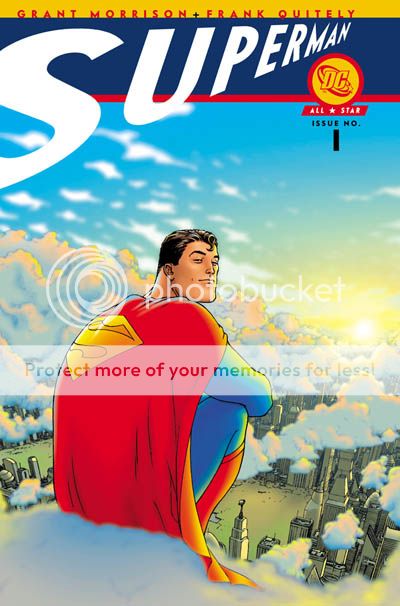
Grant Morrison's Superman.
Kidd likes this cover because he considers it an updated spin on Superman. It’s not a classic Superman panel, so he designed a logo that deviated from the classic “Superman” logo to match.
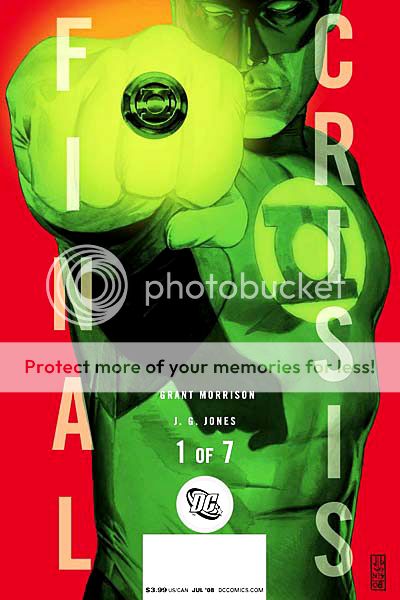
Final Crisis, volume 1, by Grant Morrison and J.G. Jones.
Kidd chose this as his design “failure”, but not the design itself. The cover represents one of seven volumes, in which the logo pictured disintegrates by the seventh issue, to match the crisis in the title. Kidd’s only regret here is that he was too subtle. He wishes he’d chosen to start the logo disintegration progression sooner, as there’s very little difference between the first few volumes.
Fawn Lau – (designer at VIZ)

GenKaku Picasso by Usamaru Furuya
Fawn was commissioned to redesign this book cover for an American audience. Keeping this in mind, and wanting the Japanese animation to be more legible for the American audience, she didn’t want too heavy-handed of a logo. In an utterly genius stroke of creativity, Lau went to an art store, bought $70 worth of art supplies, and played around with them until she constructed the “Picasso” logo. Clever, clever girl!
Mark Siegel – (First Second Books)
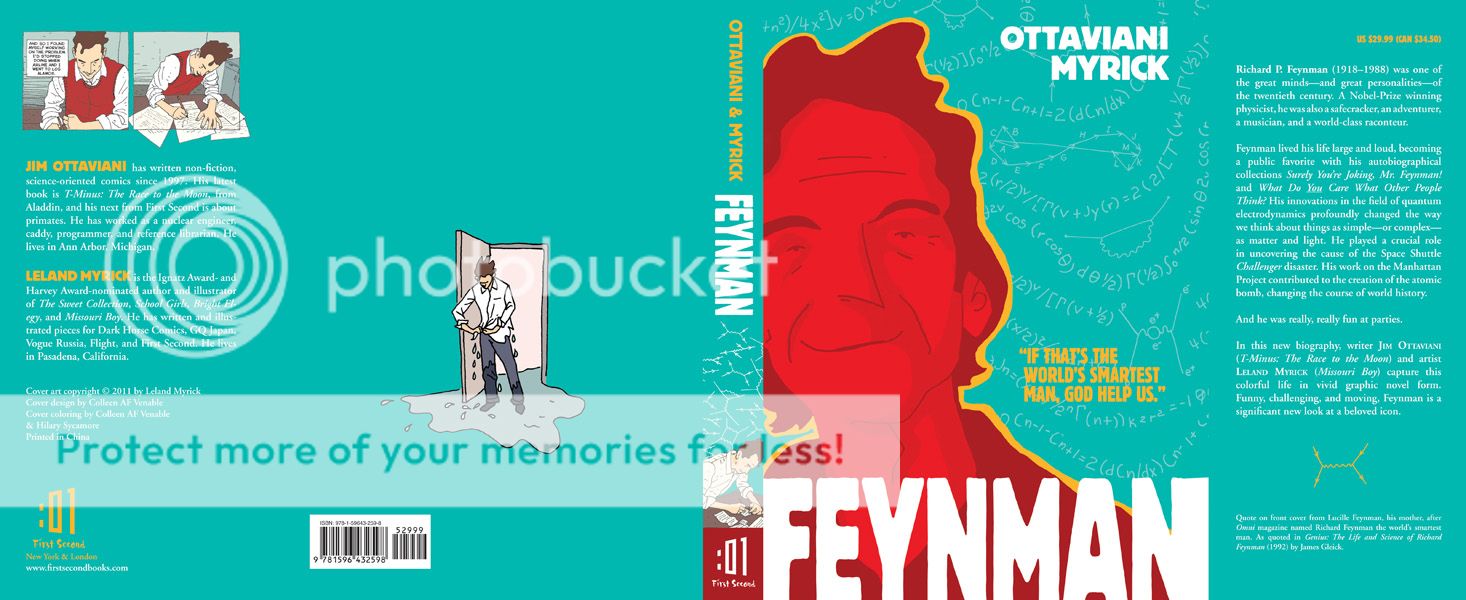
The new biography "Feynman" by Ottaviani Myrick.
Mark Siegel was hired to create the cover of the new biography Feynman, an eponymous title about one of the most famous physicists of all time. Feynman was an amazing man who lived an amazing life, including a Nobel Prize in physics in 1965. His biographer, Ottaviani Myrick, a nuclear physicist and speed skating champion, is an equally accomplished individual. The design of the cover was therefore chosen to reflect their dynamic personalities. The colors were chosen to represent the atomic bomb and Los Alamos, New Mexico, where Feynman assisted in the development of The Manhattan Project. Incidentally, the quote on the cover – “If that’s the world’s smartest man, God help us!” – is from Feynman’s own mother.
Keith Wood – (Oni Press)

The Queen and Country collection.
Wood remarked that this was the first time he was able to do design on a large scale, which really worked for this project. He chose a very basic color scheme, again to emphasize a collection standing the test of time, and designed all the covers simultaneously, including color schemes and graphics. He felt this gave the project a sense of connectedness.

Local by Bryan Wood and Ryan Kelly.
Wood chose a pantone silver as the base of this design with a stenciled typeface meant to look very modern. The back of the cover and the front of the cover were initially going to be reversed when the artists first brought him the renderings. However, Wood felt that since the book’s content is about the idea of a girl’s traveling across the United States, it would be more compelling and evocative to use feet/baggage as the front of the book. He was also the only graphic artist to show a progression of 10-12 renderings, playing with colors, panels and typeface, that led to the final design. He believes in a very traditional approach to design, which includes hand sketches and multiple renderings.
The Culture of Popular Things: Ethnographic Examinations of Comic-Con 2010
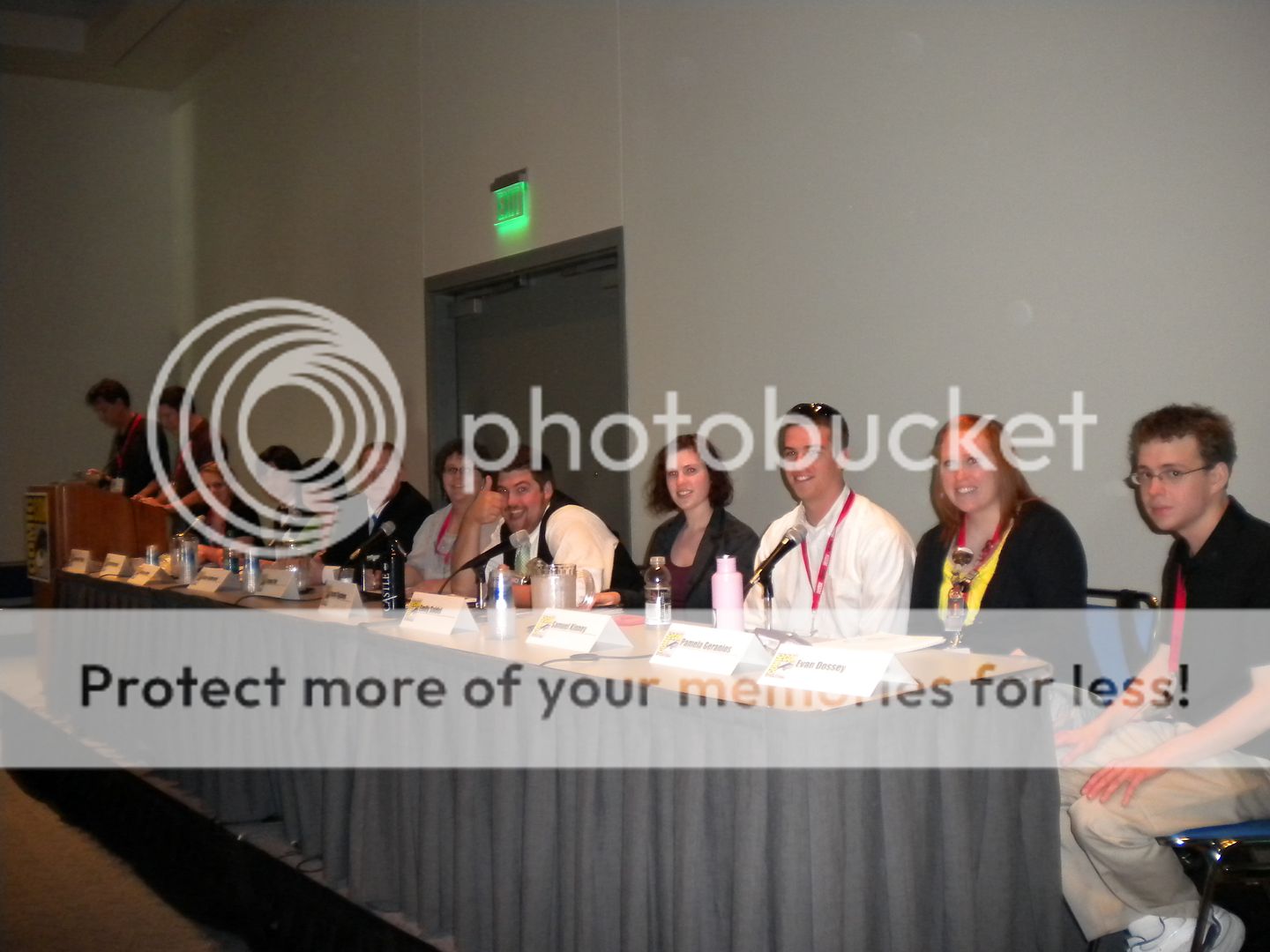
Undergraduate and graduate students present their sociology and economics analyses of Comic-Con 2010.
Each year, for the past four years, Comic-Con ends on an academic note. Matthew J. Smith, a professor at Wittenberg University in Ohio, takes along a cadre of students, graduate and undergraduate, to study Comic-Con; the nerds, the geeks, the entertainment component, the comics component, to ultimately understand the culture of what goes on in this fascinating microcosm of consumerism and fandom. By culture, the students embrace the accepted definition by famous anthropologist Raymond J. DeMallie: “what is understood by members of a group.” The students ultimately wanted to ask why people come to Comic-Con in general. They are united by the general forces of being fans; this is what is understood in their group. After milling around the various locales that constituted the Con, the students deduced that two ultimate forces were simultaneously at play. The fan culture drives and energizes the Con as a whole, while strong marketing forces were on display in the exhibit halls and panels.
Maxwell Wassmann, a political economy student at Wayne State University, pointed out that “secretly, what we’re talking about is the culture of buying things.” He compared Comic-Con as a giant shopping mall, a microcosm of our economic system in one place. “If you’ve spent at least 10 minutes at Comic-Con,” he pointed out, “you probably bought something or had something tried to be sold to you. Everything is about marketing.” As a whole, Comic-Con is subliminally designed to reinforce the idea that this piece of pop culture, which ultimately advertises an even greater subset of pop culture, is worth your money. Wassmann pointed out an advertising meme present throughout the weekend that we took notice of as well—garment-challenged ladies advertising the new Green Hornet movie. The movie itself is not terribly sexy, but by using garment-challenged ladies to espouse the very picture of the movie, when you leave Comic-Con and see a poster for Green Hornet, you will subconsciously link it to the sexy images you were exposed to in San Diego, greatly increasing your chances of wanting to see the film. By contrast, Wassmann also pointed out that there is a concomitant old-town economy happening; small comics. In the fringes of the exhibition center and the artists’ space, a totally different microcosm of consumerism and content exchange.
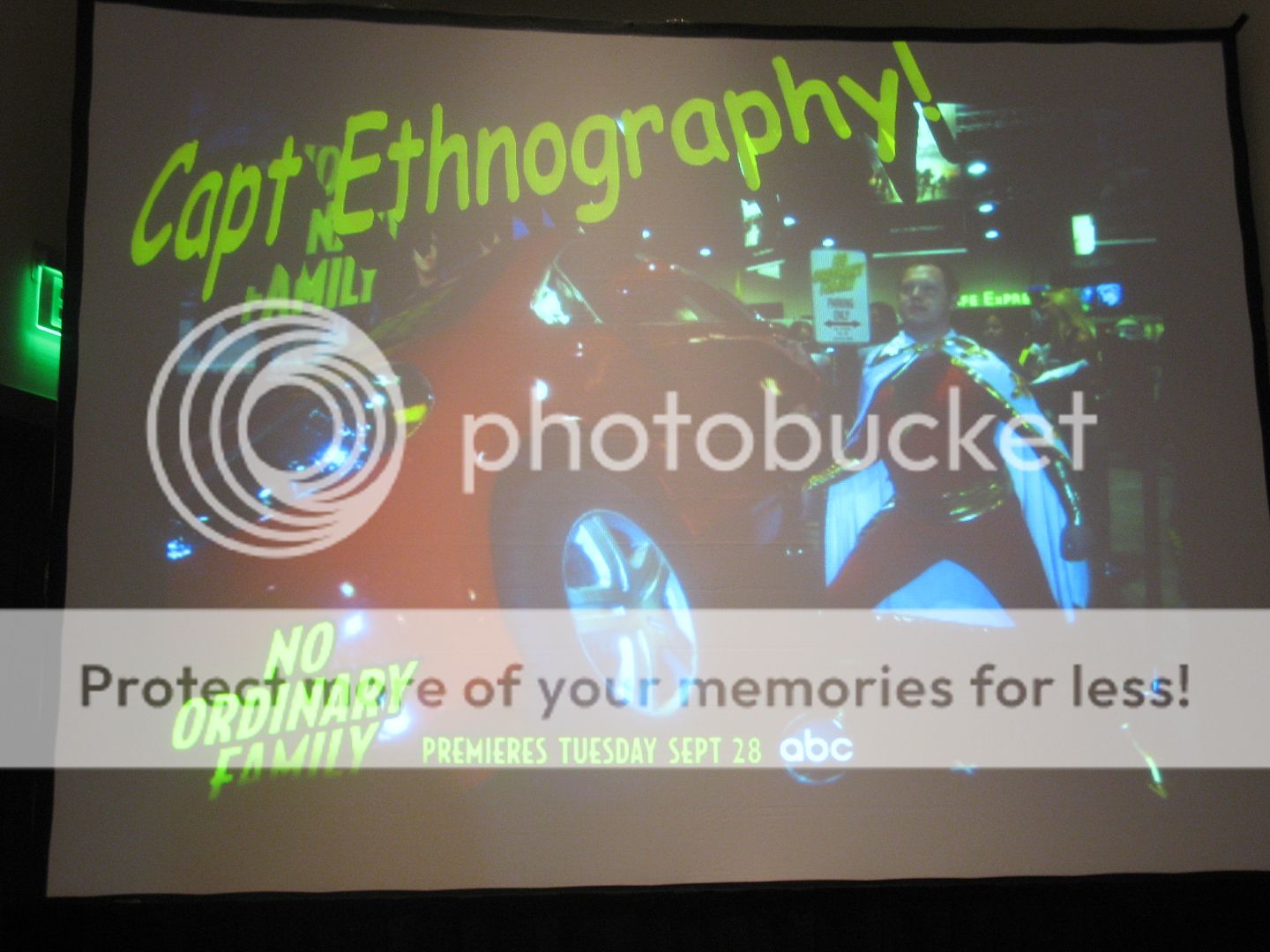
Kane Anderson dressed up in a costume as he immerses himself in the culture of comics fans in San Diego.
Kane Anderson, a PhD student at UC Santa Barbara getting his doctorate in “Superheroology” (seriously, why didn’t I think of that back in graduate school??), came to San Diego to observe how costumes relate to the superhero experience. To fully absorb himself in the experience, and to gain the trust of Con attendees that he’d be interviewing, Anderson came in full costume (see above picture). Overall, he deduced that the costume-goers, who we will openly admit to enjoying and photographing during our stay in San Diego, act as goodwill ambassadors for the characters and superheroes they represent. They also add to the fantasy and adventure of Comic-Con goers, creating the “experience.” The negative side to this is that it evokes a certain “looky-loo” effect, where people are actively seeking out, and singling out, costume-wearers, even though they only constitute 5% of all attendees.
Tanya Zuk, a media masters student from the University of Arizona, and Jacob Sigafoos, an undergraduate communications major at Wittenberg University, both took on the mighty Hollywood forces invading the Con, primarily the distribution of independent content, an enormous portion of the programming at Comic-Con (and a growing presence on the web). Zuk spoke about original video content, more distinctive of new media, is distributed primarily online. It allows for more exchange between creators and their audience than traditional content (such as film and cable television), and builds a community fanbase through organic interaction. Sigafoos expanded on this by talking about how to properly market such material to gain viral popularity—none at all! Lack of marketing, at least traditional forms, is the most successful way to promote a product. Producing a high-quality product, handing it off to friends, and promoting through social media is still the best way to grow a devoted following.
And speaking of Hollywood, their presence at Comic-Con is undeniable. Emily Saidel, a Master’s student at NYU, and Sam Kinney, a business/marketing student at Wittenberg University, both took on the behemoth forces of major studios hawking their products in what originally started out as a quite independent gathering. Saidel tackled Hollywood’s presence at Comic-Con, people’s acceptance/rejection thereof, and how comics are accepted by traditional academic disciplines as didactic tools in and of themselves. The common thread is a clash between the culture and the community. Being a member of a group is a relatively simple idea, but because Comic-Con is so large, it incorporates multiple communities, leading to tensions between those feeling on the outside (i.e. fringe comics or anime fans) versus those feeling on the inside (i.e. the more common mainstream fans). Comics fans would like to be part of that mainstream group and do show interest in those adaptations and changes (we’re all movie buffs, after all), noted Kinney, but feel that Comic-Con is bigger than what it should be.
But how much tension is there between the different subgroups and forces? The most salient example from last year’s Con was the invasion of the uber-mainstream Twilight fans, who not only created a ruckus on the streets of San Diego, but also usurped all the seats of the largest pavilion, Hall H, to wait for their panel, locking out other fans from seeing their panels. (No one was stabbed.) In reality, the supposed clash of cultures is blown out of proportion, with most fans not really feeling the tension. To boot, Seidel pointed out that tension isn’t necessarily a bad thing, either. She gave a metaphor of a rubber band, which only fulfills its purpose with tension. The different forces of Comic-Con work in different ways, if sometimes imperfectly. And that’s a good thing.
Incidentally, if you are reading this and interested in participating in the week-long program in San Diego next year, visit the official website of the Comic-Con field study for more information. Some of the benefits include: attending the Comic-Con programs of your choice, learning the tools of ethnographic investigation, and presenting the findings as part of a presentation to the Comics Arts Conference. Dr. Matthew Smith, who leads the field study every year, is not just a veteran attendee of Comic-Con, but also the author of The Power of Comics.
COMIC-CON SPOTLIGHT ON: Charles Yu, author of How To Live Safely in a Science Fictional Universe.
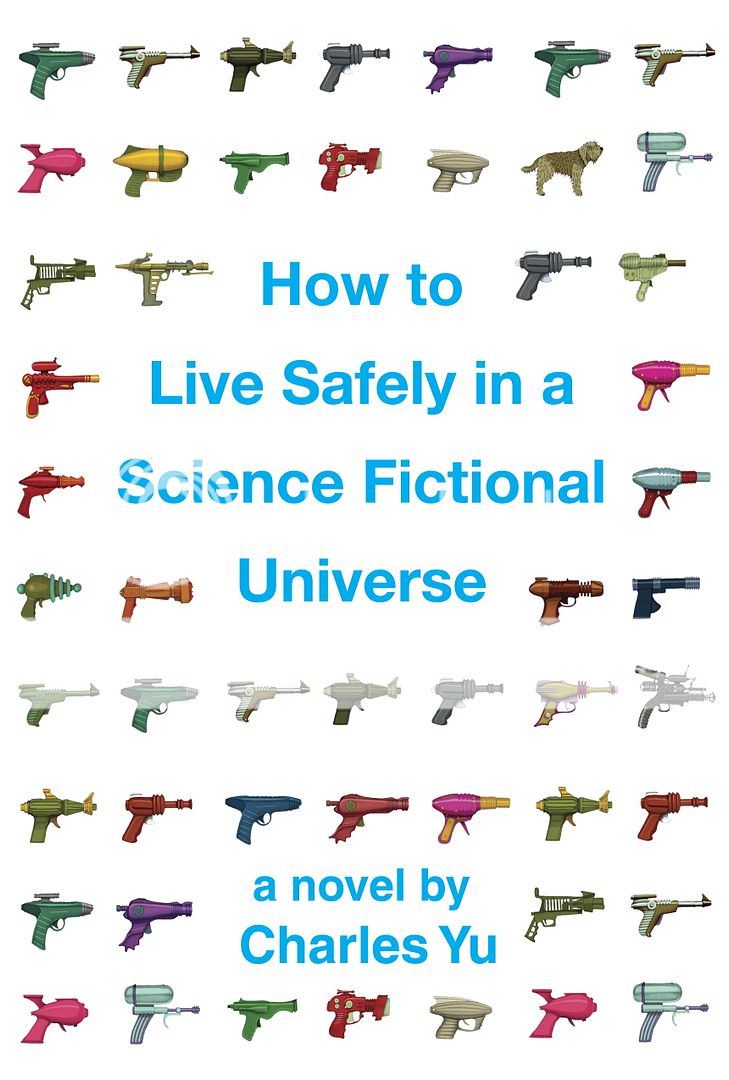
How To Live Safely in a Science Fictional Universe, out in release September 7, 2010.
Here at ScriptPhD.com, we love hobnobbing with the scientific and entertainment elite and talking to writers and filmmakers at the top of their craft as much as the next website. But what we love even more is seeking out new talent, the makers of the books, movies and ideas that you’ll be talking about tomorrow, and being proud to be the first to showcase their work. This year, in our preparation for Comic-Con 2010, we ran across such an individual in Charles Yu, whose first novel, How To Live Safely in a Science Fictional Universe premieres this fall, and who spoke about it at a panel over the weekend. We had an opportunity to have lunch with Charles in Los Angeles just prior Comic-Con, and spoke in-depth about his new book, along with the state of sci-fi in current literature. We’re pretty sure Charles Yu is a name science fiction fans are going to be hearing for some time to come. ScriptPhD.com is proud to shine our 2010 Comic-Con spotlight on Charles and his debut novel, which is available September 7, 2010.
How To Live Safely in a Science Fictional Universe is the story of a son searching for his father… through quantum-space time. The story takes place on Minor Universe 31, a vast story-space on the outskirts of fiction, where paradox fluctuates like the stock market, lonely sexbots beckon failed protagonists, and time travel is serious business. Every day, people get into time machines and try to do the one thing they should never do: try to change the past. That’s where the main character, Charles Yu, time travel technician, steps in. Accompanied by TAMMY (who we consider the new Hal), an operating system with low self-esteem, and a nonexistent but ontologically valid dog named Ed, Charles helps save people from themselves. When he’s not on the job, Charles visits his mother (stuck in a one-hour cycle, she makes dinner over and over and over) and searches for his father, who invented time travel and then vanished.
Questions for Charles Yu

Sci-fi author Charles Yu.
ScriptPhD.com: Charles, the story has tremendous traditional sci-fi roots. Can you discuss where the inspiration for this came from?
Charles Yu: Well the sci-fi angle definitely comes from being a kid in the 80s, when there were blockbuster sci-fi things all over the place. I’ve always loved [that time], as a casual fan, but also wanted to write it. I didn’t even start doing that until after I’d graduated from law school. I did write, growing up, but I never wrote fiction—I didn’t think I’d be any good at it! I wrote poetry in college, minored in it, actually. Fiction and poetry are both incredibly hard, and poetry takes more discipline, but at least when I failed in my early writing, it was a 100 words of failure, instead of 5,000 words of it.
SPhD: What were some of your biggest inspirations growing up (television or books) that contributed to your later work?
CY: Definitely The Foundation Trilogy. I remember reading that in the 8th grade, and I remember spending every waking moment reading, because it was the greatest thing I’d ever read. First of all, I was in the 8th grade, so I hadn’t read that many things, but the idea that Asimov created this entire self-contained universe, it was the first time that I’d been exposed to that idea. And then to have this psychohistory on top, it was kind of trippy. Psychohistory is the idea that social sciences can be just as rigorously captured with equations as any physical science. I think that series of books is the main thing that got me into sci-fi.
SPhD: Any regrets about having named the main character after yourself?
CY: Yes. For a very specific reason. People in my life are going to think it’s biographical, which it’s very much not. And it’s very natural for people to do that. And in my first book of short stories, none of the main characters was named after anyone, and still I had family members that asked if that was about our family, or people that gave me great feedback but then said, “How could you do that to your family?” And it was fiction! I don’t think the book could have gotten written had I not left that placeholder in, because the one thing that drove any sort of emotional connection for the story for me was the idea of having less things to worry about. The other thing is that because the main character is named after you, as you’re writing the book, it acts as a fuel or vector to help drive the emotional completion.
SPhD: In the world of your novel, people live in a lachrymose, technologically-driven society. Any commentary therein whatsoever on the technological numbing of our own current culture?
CY: Yes. But I didn’t mean it as a condemnation, in a sense. I wouldn’t make an overt statement about technology and society, but I am more interested in the way that technology can sometimes not connect people, but enable people’s tendency to isolate themselves. Certainly, technology has amazing connective possibilities, but that would have been a much different story, obviously. The emotional plot-level core of this book is a box. And that sort of drove everything from there. The technology is almost an emotional technology that [Charles, the main character] has invented with his dad. It’s a larger reflection of his inability to move past certain limitations that he’s put on himself.
SPhD: What drives Charles, the main character of this book?
CY: What’s really driving Charles emotionally is looking for his dad. But more than that, is trying to move through time, to navigate the past without getting stuck in it.
SPhD: Both of his companions are non-human. Any significance to that?
CY: It probably speaks more to my limitations as a writer [laughs]. That was all part of the lonely guy type that Charles is being portrayed as. If he had a human with him, he’d be a much different person.
SPhD: The book abounds in scientific jargon and technological terminology, which is par for the course in science fiction, but was still very ambitious. Do you have high expectations of the audience that will read this book?
CY: Yeah. I was just reading an interview where the writer essentially said “You can never go wrong by expecting too much [of your audience].” You can definitely go wrong the other way, because that would come off as terrible, or assuming that you know more. But actually, my concerns were more in the other direction, because I knew I was playing fast and loose with concepts that I know I don’t have a great grasp of. I’m writing from the level of amateur who likes reading science books, and studied science in college—an entertainment layreader. My worry was whether I was BSing too much [of the science]. There are parts where it’s clearly fictional science, but there are other parts that I cite things that are real, and is anyone who reads this who actually knows something about science going to say “What the heck is this guy saying?”
SPhD: How To Live… is written in a very atavistic, retro 80s style of science fiction, and really reminded me of the best of Isaac Asimov. How do you feel about the current state of sci-fi literature as relates to your book?
CY: Two really big keys for me, and things I was thinking about while writing [this book], were one, there is kind of a kitchiness to sci-fi, and I think that’s kind of intentional. It has a kind of do-it-yourself aesthetic to it. In my book, you basically have a guy in the garage with his dad, and yes the dad is an engineer, but it’s in a garage without great equipment, so it’s not going to look sleek, you can imagine what it’s going to look like—it’s going to look like something you’d build with things you have lying around in the garage. On the other hand, it is supposed to be this fully realized time machine, and you’re not supposed to be able to imagine it. Even now, when I’m in the library in the science-fiction section, I’ll often look for anthologies that are from the 80s, or the greatest time travel stories from the 20th Century that cover a much greater range of time than what’s being published now. It’s almost like the advancement of real-world technology is edging closer to what used to be the realm of science fiction. The way that I would think about that is that it’s not exploting what the real possibility of science fiction is, which is to explore a current world or any other completely strange world, but not a world totally envisionable ten years from now. You end up speculating on what’s possible or what’s easily extrapollatable from here; that’s not necessarily going to make for super emotional stories.
Charles Yu is a writer and attorney living in Los Angeles, CA.
Last, but certainly not least, is our final Costume of the Day. We chose this young ninja not only because of the coolness of his costume, but because of his quick wit. As we were taking the snapshot he said, “I’m smiling, you just can’t see it.” And a check mate to you, young sir.

Day 4 Costume of the Day.
Incidentally, you can find much more photographic coverage of Comic-Con on our Facebook fan page. Become a fan, because this week, we will be announcing Comic-Con swag giveaways that only Facebook fans are eligible for.
~*ScriptPhD*~
*****************
ScriptPhD.com covers science and technology in entertainment, media and advertising. Hire our consulting company for creative content development.
Follow us on Twitter and our Facebook fan page. Subscribe to free email notifications of new posts on our home page.
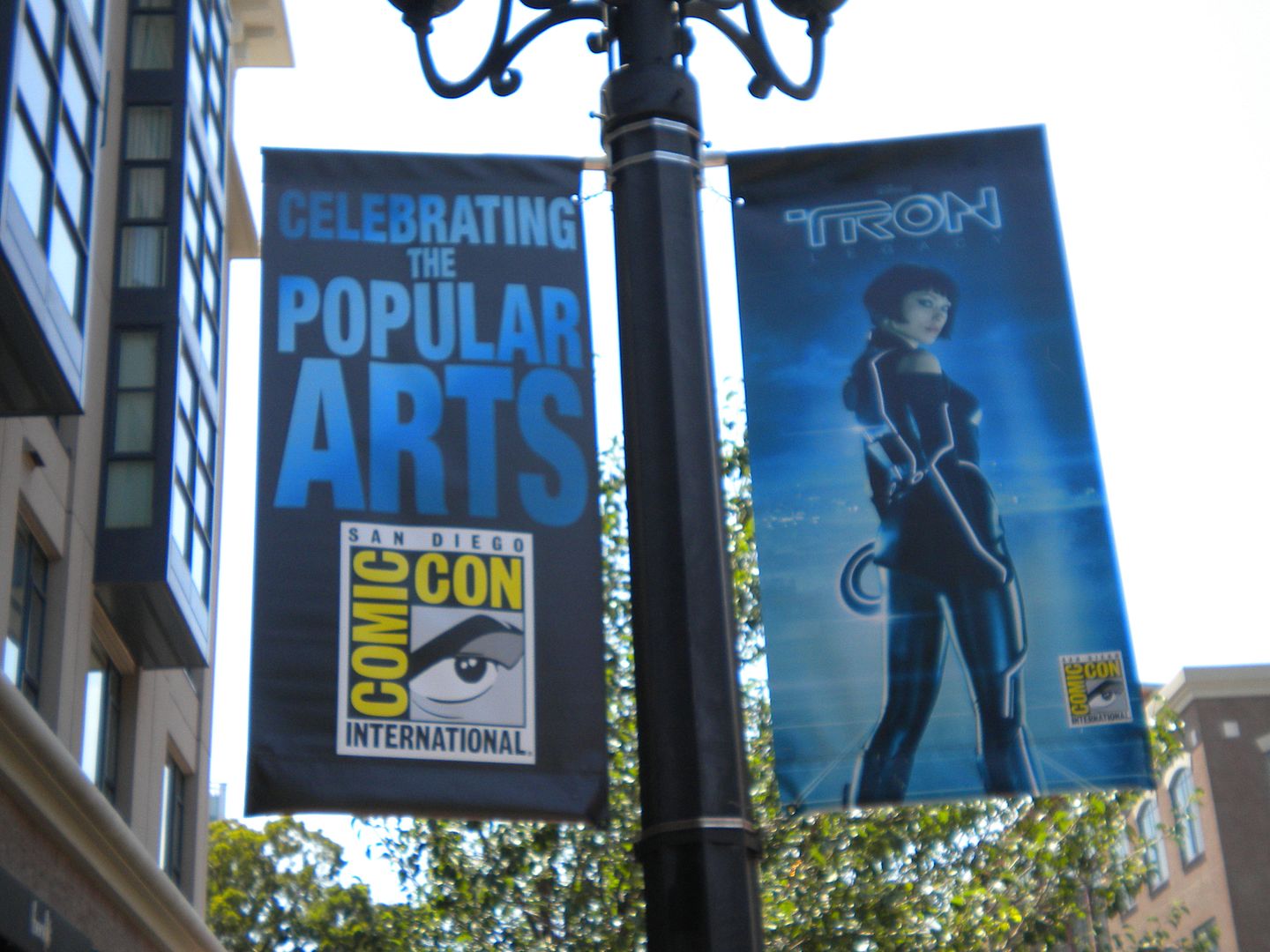
Street signs adorning the City of San Diego for Comic-Con 2010
Day 3 was Star Wars Day at San Diego Comic-Con International and we have something shocking to report, ladies and gentlemen. We did not see a single light saber, not one! Since we almost incurred an unfortunate eye injury last year due to an overenthusiastic Jedi, this was most welcome relief. For ScriptPhD.com, today was all about science and technology. In a day that could not have been more tailor-made for our website, we enjoyed panels with the eminent sci-fi television writers of today discussing writing for genre TV (a must-read for any aspiring TV writers out there!), a visit from the greatest science fiction writer in the history of science fiction, Ray Bradbury, a preview of next season’s sci-fi show The Event, and a panel on how exactly shows like CSI “tech” out with gadgets galore. Oh, yes, did we mention we got to hang out privately with the MythBusters?? With the help of our intrepid reporter Bryy Miller, we bring you the most complete Comic-Con coverage on the web. Plus, our Costume of the Day, after the “continue reading” cut!
The Write Stuff: Creating Genre Television
LOST. CSI. V. Battlestar Galactica. It seems that sci-fi, tech, and geek-chic television is everywhere. Not only is it a staple of prime time (across basic and extended cable), it’s an increasingly popular genre for which good writers are constantly in demand. Since we are SCRIPTPhD.com, an opportunity to listen in as a panel of some of today’s hottest genre television writers gave away secrets of their craft and advice for aspiring writers was irresistible.
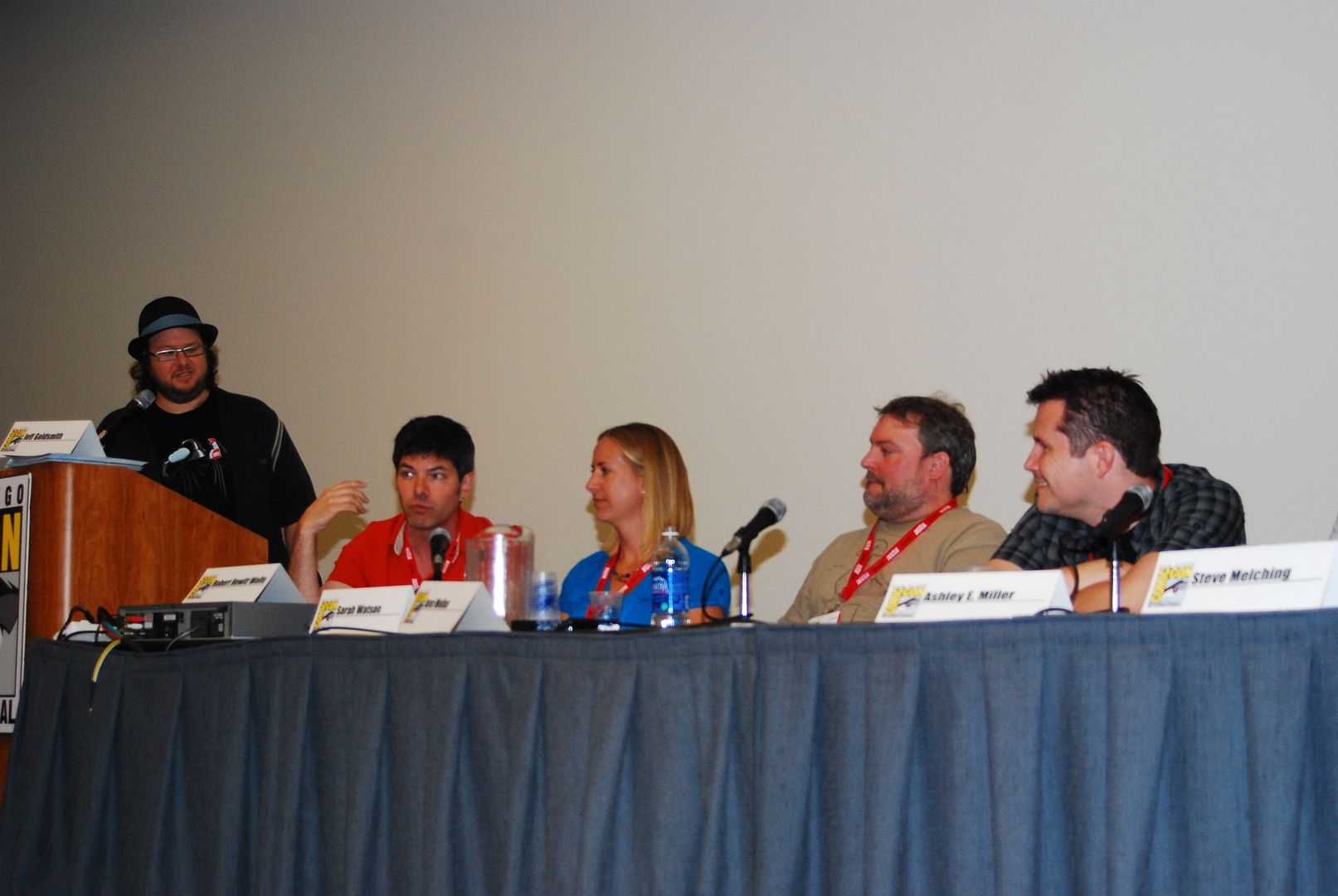
Writing for Genre TV panel Part 1 (from left to right): Moderator Jeff Goldsmith, Javier Grillo-Marxuach, Sarah Watson, Robert Hewitt Wolfe, Ashley E. Miller
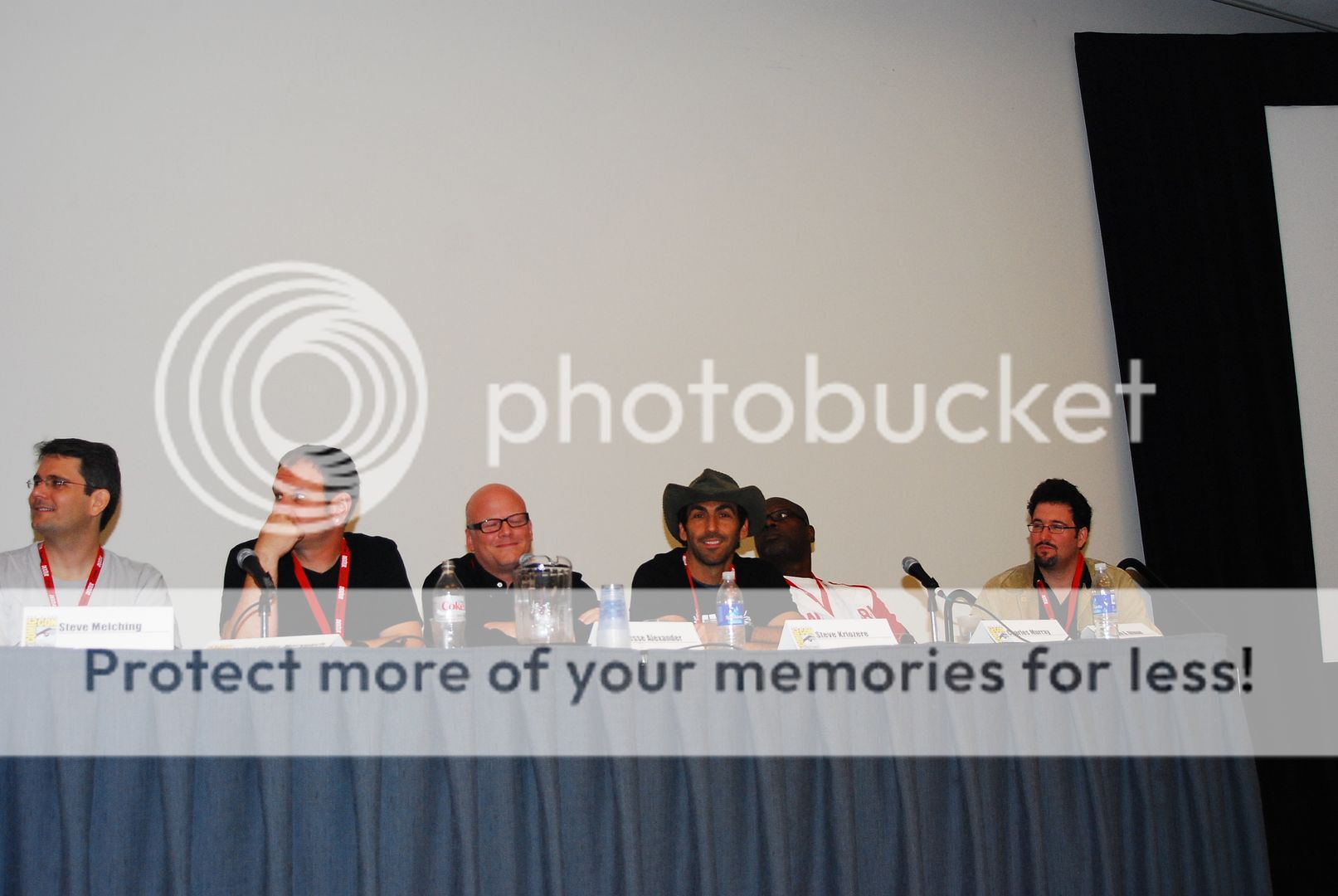
Writing for Genre TV Part 2 (from left to right): Steve Melching, Gabrielle Stanton, Jesse Alexander, Steve Kriozere, Charles Murray, and Mark Altman.
Since this panel consisted of so many writers, albeit a dream team thereof, there was only an allotted amount of time for three questions, each of which the panelists answered one by one down the line, and quite enthusiastically. The moderator, Jeff Goldsmith, who runs the industry rag Creative Screenwriting correctly pointed out that not only are they all working in TV, but if they weren’t on this panel, they’d be at Comic-Con anyway. He called them the “Algonquin geek table.” The first question was to ask each screenwriter what brilliant idea they had that would revolutionize a show they were working on at the time, but that couldn’t get past the network censors.
Mark Altman (Castle, Elvis Van Helsing) recalled creating a pilot called Elvis Van Helsing, but ABC went with The Middle Man instead. So he turned it into a graphic novel, and the rest was history. Charles Murray (V, Criminal Minds) actually recalled a terrific idea for an episode of Criminal Minds, where a serial killer would put a milk carton in someone’s fridge and the “Have You Seen This Person?” picture would be of the dead person. Clever, we thought! Steve Kriozere (NCIS, VIP) had the clever idea on VIP of casting Bruce Campbell to play Pamela Anderson’s uncle. The amazing and talented Jesse Alexander (Alias, LOST, Heroes) recalled a victory for geeks in the form of Heroes Season 1 in an episode entitled Days of Future Past where all the characters went into alternate future. He mentioned that it was so hard to approve and get on air, but the episode went on to win multiple awards. What didn’t make it? “Season 5.”
Steve Melching (Clone Wars, Transformers, The Batman) recalled writing for the animated series The Batman taking place in his first few years in Gotham City, and wanted (but failed) to approve a B story about a frat boy group dressing up in D-List costumes, committing fake crimes and then videotaping their subsequent ass kicking by Batman. We wonder why that didn’t get approved. Ashley E. Miller (Fringe, Terminator) wanted a Fringe follow up to the episode “Bishop Revival,” which had an immortal Nazi. He wanted a flashback episode to 1942, where we find out that Agent Phillip Broyles is 100 years old, and whacking Nazis. Jose Molina (Castle, Firefly) wanted a Firefly payoff episode with a 9-months-pregnant woman being evil, where the team kills her but they save the baby, and the episode would consist of three acts of “Three Men and a Baby.” Right. Sarah Watson (Middleman, Parenthood) recalled being hired to do a SyFy Channel movie of the week about an untapped volcano under Manhattan (seriously!), and she had grand plans for lava engulfing Statue of Liberty, taking over all of Manhattan island, but when the movie got produced the visual ended up being lava trickling out from under a garage. Robert Hewitt Wolfe (The Gates, Deep Space Nine) was writing for 4400 in its final season, and was obsessed with the idea of creating an aerosol promycin bomb over Seattle (hmmm, as a Seattleite, I booed this from the audience). The showrunners created a promycin bomb at the end. So the next time you think all TV writers are geniuses, just remember that for every great episode of your favorite show, there were many bad ideas tossed around in the writers’ room.
Next, Goldsmith asked the panel to recount (as diplomatically as possible) the stupidest network notes they’d ever encountered for a show script they worked on.
Mark Altman recalled working on a SyFy Channel movie where executives asked him to recap the whole plot at the beginning of the hour because of people tuning in from HBO. Charles Murray, while working on V, was told he couldn’t use the word lizard in an episode. How do you get past something like that, he was asked. “I left the show. That’s how you get past it.” Steve Kriozere revealed the #1 SyFy Channel rule of movies: don’t speak to the monster. Jesse Alexander, having worked on some of the greatest sci-fi hits ever, waxed more philosophical. Everyone has an opinion on these shows, but executives want the rules of the show’s world, they want everything spelled out clearly, a lot of exposition. They’re generally happier if the shows are procedurals, but sci-fi shows don’t have room for that—if all the secrets and exposition are revealed it drives people away from the content. Steve Melching pointed out that a lot of animated shows have hyper-sensors because they’re aimed at children. The dumbest note he ever received was that you can’t say “killer satellites.” Ashley E. Miller was reminded (we are shocked!) that you cannot have an 11 year old boy say douchenozzle on prime time TV. Jose Molina recalled an episode of Castle where a body is found in the teaser, the guys go through case, and find out that the victim was killed by a stiletto. Said the executives: “Does the killer have to kill with a shoe?” Sarah Watson revealed that the most annoying thing to writers on shows now is that they’re paid by sponsors, so writers have to put products into scenes strategically. Her worst example was an episode of a show with a surf competition…sponsored by Tampax. To make this work, they had to cover a poor actress’s entire surf bodysuit with Tampax logos. Robert Hewitt Wolfe was taken out to dinner by the main executives of a show he was working on and flat out asked to dumb down the series. Ahhh, the things you learn when the iron curtain goes down.
Finally, Goldsmith asked the panel to give advice to young TV writers (or aspiring writers) on how to best write for a budget, which is unfortunately what most young writers will face on television these days.
Without question, the panel answered unanimously that the secret in the writing is all. about. character. The best and cheapest special effects are two actors in a room with terrific conflict and terrific dialogue—that’s what’s compelling, that’s what’s intimate. Most physical action, they reminded us, is actually superfluous—only revert to it after all possible dialogue is tapped out. Ultimately, you must look at how what you cut (if you are forced to cut things) affects the character. If you put six people in a scene, make sure that all of them need to be in the scene, because it is extremely expensive to shoot. The writers lamented that networks sometimes have too much money, and a subsequent desire to compete with Transformers or Iron Man, which television can’t do. Writers must remember that character works for television, and you can have high-concept ideas for sci-fi. That’s why shows on cable, which are often budget-restricted, are so great. Sarah Watson reminded the audience that you can always make a show cheaper, and fantastic, with great writing and great dialogue. This is how Friday Night Lights, which shoots on a shoestring budget down in Texas, was able to survive for five seasons.
Mostly, in advice relevant to any writer reading this, they said not to repeat past mistakes.
The Event
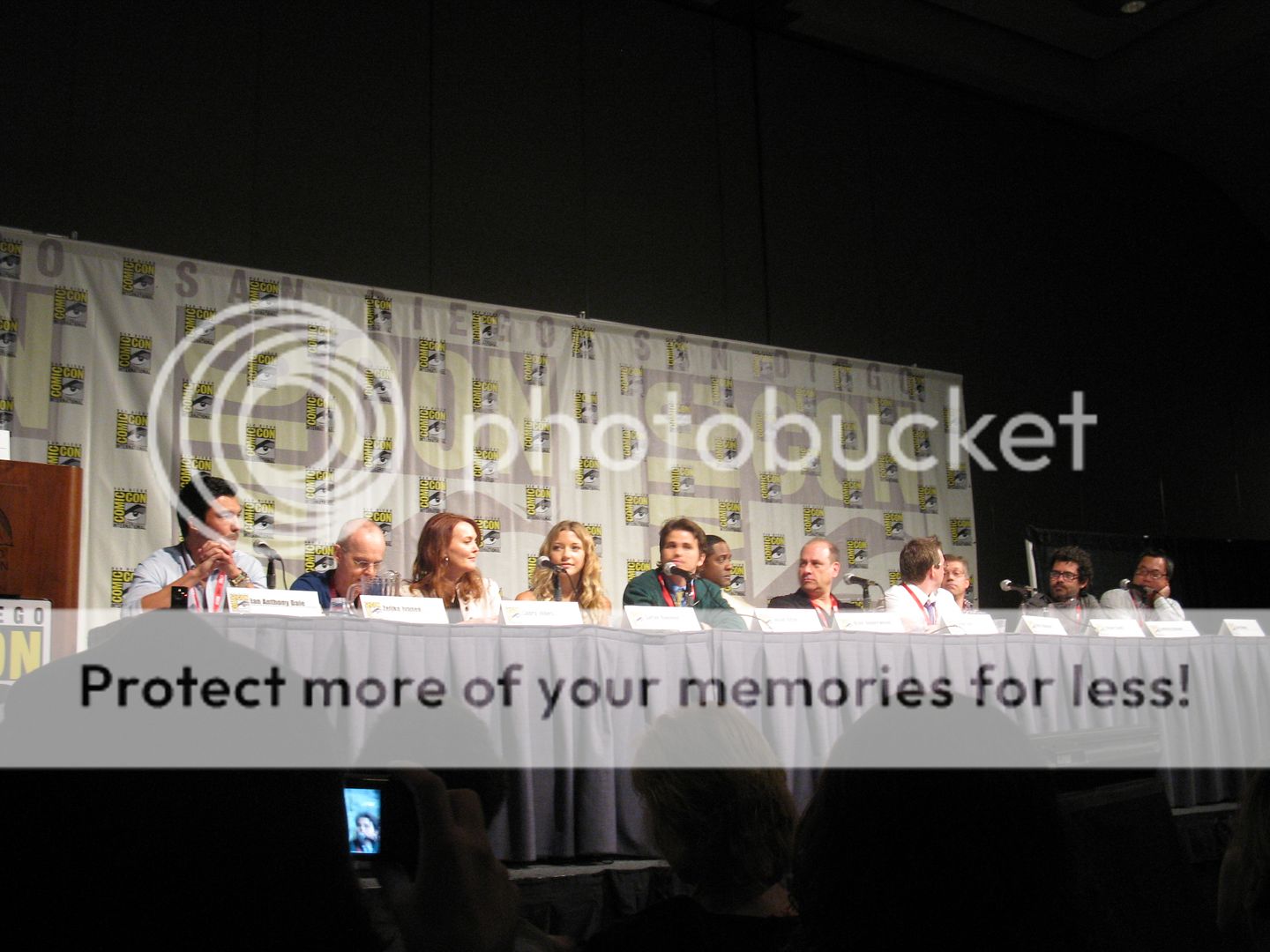
The Event panel (from left to right): Ian Anthony Dale, Zeljko Ivanek, Laura Innes, Sarah Roemer, Jason Ritter, Blair Underwood, and producers Evan Katz, Steve Stark, Jeffrey Reiner, Nick Wauters and Jim Wong.
This television show, premiering in the fall of 2010, might be the new LOST, or it might be the new FlashForward. I’m not sure yet. The Event, a show that is so steeped in mystery that even its title is nothing more than Something Happens, was a show—and will be a show—with as many problems as it has concepts. Fortunately, all of its flaws are structural.
The pilot is laid out as three separate stories (well, actually, four, but one is extremely short in comparison) over the course of three separate acts. We actually start the show in the middle of the story when our hero, Sean Walker (Jason Ritter), hijacks a plane in order to save it, and then flash back to eight days earlier, and then forward to seven days earlier, and then once more to the present. It gets even more confusing when President Eli Martinez (the incredibly suave Blair Underwood) gets his go at the story, and then his segment goes back an entire year. The other two stories comprise of the father of Sean’s girlfriend, whose house and family are assaulted by unknown forces, and Simon Lee (Ian Anthony Dale), the supposed second-in-command of a secret government base/prison that lies at the center of The Event. It’s a shame that Lee’s section is so short, as Dale is a fantastic actor even within the confines of such little material. But perhaps the best acting comes from ER/West Wing (and Northwestern University!) alumna, Laura Innes, who absolutely nails her cryptic sayings as Sofia, the leader of the base/prison/thing-to-be-revealed-later.
The show will need to cut out some of the flashes in order to survive past its initial thirteen episodes, but it is definitely a unique format that works for this type of story. The writing was high-quality and so was the dialogue; there were no qualms there. It also revealed quite a bit about the world that had been set up if you looked closely enough. Co-Producer Evan Katz made the promise that answers would actually come a lot faster than with other mystery longforms. This is welcome, especially since I am of the belief that mystery shows can maintain the mystery if they answer questions in the right or clever way. Sometimes, it is even essential to answer them if you want the show to progress to its next level of weirdness. Blair Underwood was then asked what it is like to be the first Cuban president, to which he replied that there would be no Salsa dancing.
Katz then ended the panel the only way it could have possibly ended:
“The Salsa is not The Event.”
Spotlight On: Ray Bradbury
He is brilliant. He is one of the foremost technology predictors since Leonardo DaVinci. He is irreverent, utterly aware of his importance, and quite simply, the greatest science fiction writer in the history of the genre. He none other than Ray Bradbury. Ray has been coming to Comic-Con since the very first year of its inception. A devoted comics and graphic novel buff, he loves interacting yearly with fans, and gracing them with his musings, knowledge and appreciation. We were honored and somewhat overwhelmed to be there in person for Ray’s 41st Comic-Con panel, on the heels of his 90th birthday. Because Bradbury’s words speak for themselves, we bring you the panel through his eyes.
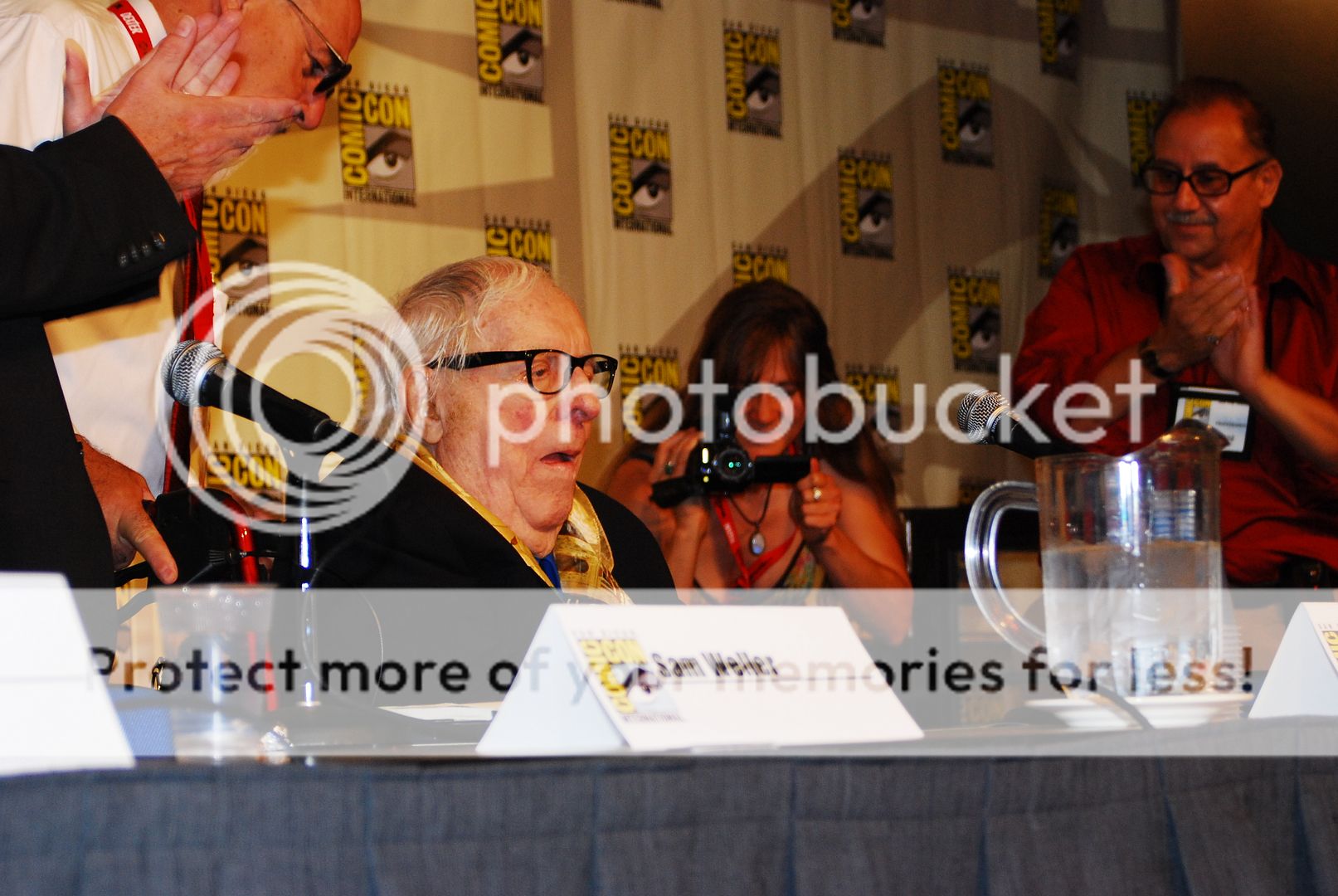
Ray Bradbury being wheeled in for his Comic-Con panel.
Bradbury, not shy about quips and bold statements, starts out his panel with a bang: “I want to make an announcement. Sam Weller and I are working on a new book together: Let’s Let The Cat out of the Bag.” In actuality, Weller and Bradbury released a brand new book of interviews (out June 29th) entitled Listen to the Echoes: The Ray Bradbury Interviews. Weller has spent over a decade with Bradbury, getting to know him, studying his works, and acted as his guide during the panel (Mr. Bradbury has become a bit hard of hearing). Bradbury is currently working on a new book of 20 short stories entitled “Juggernaut” to be published next Christmas.
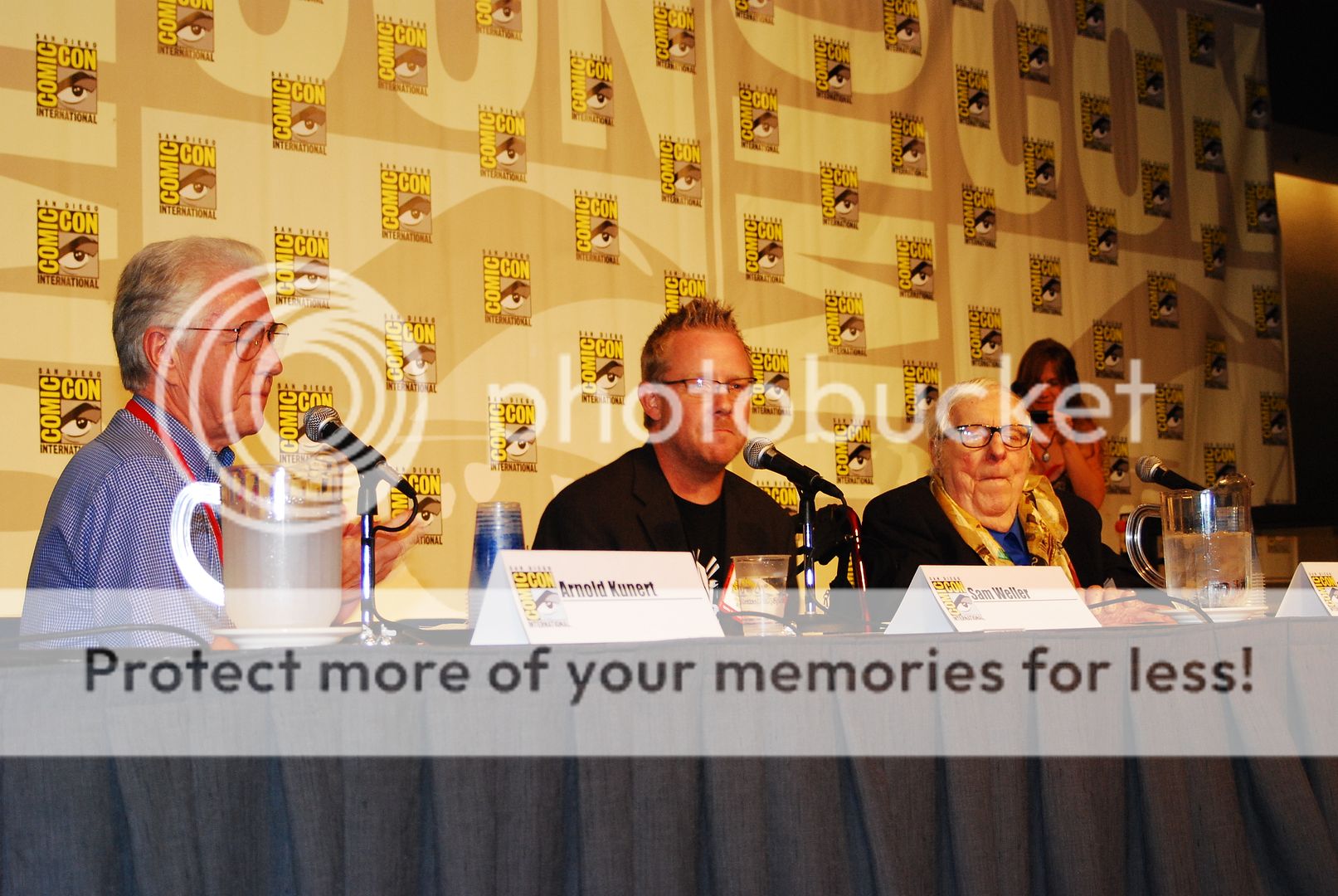
Sam Weller, middle, Ray Bradbury's biographer, led the panel and discussion at Comic-Con
On how it feels to be Ray Bradbury and if he ever marvels at himself, after a long, thoughtful pause, a hearty laugh and: “It feels mighty damn good.”
Fahrenheit 451 was among the most prescient sci-fi works of all time, predicting technology such as earbuds, flat screen televisions, school violence, and the rise of graphic novels. How did Bradbury predict all this stuff?
“The secret of life is being in love. By being in love, you predict yourself. Whatever you want is what you get. You don’t think about things; just do them. Don’t predict them—just make them.”
Of the technologies Bradbury predicted, he also warned about many, including rise of mass media. What tech would he like to see next?
Again, a thoughtful pause. “I’d like certain technologies to disappear. The internet is a great, big, stupid goddamn bore.” Keep in mind that when Bradbury was approached by an internet magnate to publish his works as e-books for the internet, he responded with: “Prick up your ears and go to hell!” The internet magnate? None other than the CEO of Yahoo.
Another strong, recurring theme of Bradbury’s panel was his love (adoration, really) of space exploration, most notably colonization of Mars and the Moon. Why? “Because we’re going to live forever. We should go back and build a base on the Moon, put a civilization on Mars. 500 years from now, we’ll go out into the Universe, and when we do that, we have a chance to live forever.”
Weller tried to get Bradbury to discuss the new book, once again evoking his crotchety sense of humour: “You can’t afford it. So get out of here and forget it.” In an extremely revealing, intimate moment, Weller pointed out that many Mars stories and works are inspired by and cut from Bradbury’s Martian Chronicles, none more similar than the Twilight Zone. Bradbury then revealed something that many of his fans probably don’t know. “Rod Sterling came to my house many years ago. He didn’t know anything about writing sci-fi. So I took him down to my basement and gave him copies of books written by Roald Dahl, John Collier, a number of other great sci-fi authors, and myself. Rod Sterling forgot that he read all these books, and when he wrote his programs, he copied some of his ideas from me, and we got into a big argument.” The two never reconciled.
As we’ve mentioned, Bradbury came to Comic-Con in its first year, where he said only 300 people came to first meeting, quite different from today, where 1,000 people were gathered in his room alone. Why does he come so often? “Because I’ve been collecting comic strips all my life. I have 30 years’ of Prince Valiant Sunday illustrations put away, all of Buck Rogers. My background in becoming a writer was falling in love with comic strips.” How did they influence his prose and narrative? “Comic strips are full of imagination and glorious adventures. My all-time favorite is Mutts. A year from now, there will be a graphic novel of “The Martian Chronicles” and “Something Wicked This Way Comes.”” Bradbury is, in fact, the world’s greatest (and possibly oldest) fanboy. He is famous for writing fan letters to writers and other figures that he admires. He sent books to John Huston, the famous screenwriter and filmmaker. He sent a hand-written letter to Edgar Rice Burroughs begging him to come to a meeting of Bradbury’s science fiction society club.
Another thing fans may not know is that Bradbury is considered the patron saint of the American library system. He has been very active in rescuing libraries that are under fire because of budgetary crises. He recounted the story of his love affair with the library. “When I left high school, I had no money to go to college. I decided to not worry about going to college. I thought: “I will educate myself.” So I walked down the street, I walked into a library for 3 days a week for 10 years. Most of you in the audience can’t afford to go to college. But if you want to educate yourself, you can afford to go to the library. When I was 28 years old, I graduated from the library.”
The concept of time travel is explored in the short story “A Sound of Thunder.” If Bradbury could time travel, he was asked to what moment it would be? “Every. Single. Moment. Every single moment of my life has been incredible. I’ve savored it. It’s beautiful, because I’ve remained a boy. The man you see here tonight is a 12 year old boy, and he’s having fun!” How does he stay connected to his inner child? “Don’t worry about the future, or the past, you just explode every day. If you’re dynamic, you don’t have to worry about what age you are.”
Indeed, childhood is a theme of many of his short stories. Why is this so important to Bradbury? “Because I grew up loving carnivals and circuses. That’s why I wrote those stories.”
When asked if he had any regrets in life, Bradbury evoked the biggest laugh of the day: “I regret that I didn’t have more time with Bo Derek.” What’s the Bo Derek story? She came up to him in Paris train station, and exclaimed “Mr. Bradbury, I love you!” To which he responded, “Who are you?” She replied, “My name is Bo Derek. Mr. Bradbury, will you travel on the train with me?” With a stoic face he recalled replying: “Yep, I will!” The rest was censored.
Other than Be Derek, what was his greatest love? Bradbury turned philosophical. “I am the world’s greatest lover. I love to write short stories. I write them. I love to write novels. I write them. I love to write poetry. I write it. I love to paint pictures. I paint them. I loved directing a film. So I directed it. Those are my greatest lovers. I have loved all these things I have told you about.”
What authors inspired Bradbury growing up? “Edgar Rice Burrows. And Edgar Allan Poe—scared the hell out of me.”
Another fact about Bradbury that many people may not know is his rather illuminating and successful career as a designer and architect. He was asked how he got involved with designing the San Diego city center Horton Plaza. ”I designed a lot of other places all over LA. 50 years ago, the people who were building the New World’s Fair asked me to redesign the United States Pavilion. I helped build Epcot down in Florida. Because of those works, the people of San Diego came and asked for input in building The Horton Plaza at the center of San Diego.”
Aldous Huxley famously said of Bradbury, “You know what you are sir? You are a poet.” When asked who the poets are that have influenced his writing, Bradbury immediately responded: “Shakespeare and Alexander Pope.”
What are the things that keep Bradbury motivated now? “I have more work to do.”
On how his writing has changed over time: “It’s gotten more brilliant.”
As such a fan of Mars, Bradbury was asked how he feels about the ongoing Martian probes, and the real science evidence they have brought back to Earth. “I’m glad we are doing that [research], but we should be doing more. We should be going there in person. Not with a lander, but with a real rocket ship and landing on Mars.” In a rather endearing moment, Weller revealed that Bradbury has never driven an automobile. But he was invited to the Jet Propulsion Laboratory in Pasadena, where scientists asked him if he’d like to drive the Mars Rover over Mars. So he hasn’t driven on the 405 freeway, but he has driven across Mars! The scientists even gave him a Martian drivers license.
Any futuristic technologies for cities that Bradbury would like to see? “Monorails all over LA and California. Get rid of the goddamn freeways!” As a Los Angeles resident, hear, hear, Mr. Bradbury!
What was the intended audience of Fahrenheit 451 and how does he feel about its rise to prominence as a true modern American classic? “I am not a science fiction writer. All my books are fantasy. But the one book that is pure science fiction is Fahrenheit 451. So I’m glad that I wrote it. I’m glad that you all feel that way about it too.”
Does Bradbury have a favorite work? “All of my books are my favorites. All of my books are my children. I love all my children.”
How does Bradbury feel about digital books? With a cranky grunt: “I’ve already told you that. I don’t like them. I think of iPads and Kindles as books with a computer screen. Real books smell, real books have memories.” We here at ScriptPhD.com would like to give that statement a heartfelt “AMEN!”
Finally, Bradbury, on turning 90 in a few weeks. How does it feel? “It’s been 90 goddamned incredible years!” To which the audience responded by singing him “Happy Birthday.” A surreal, incredible and special moment.
Teching Out on TV
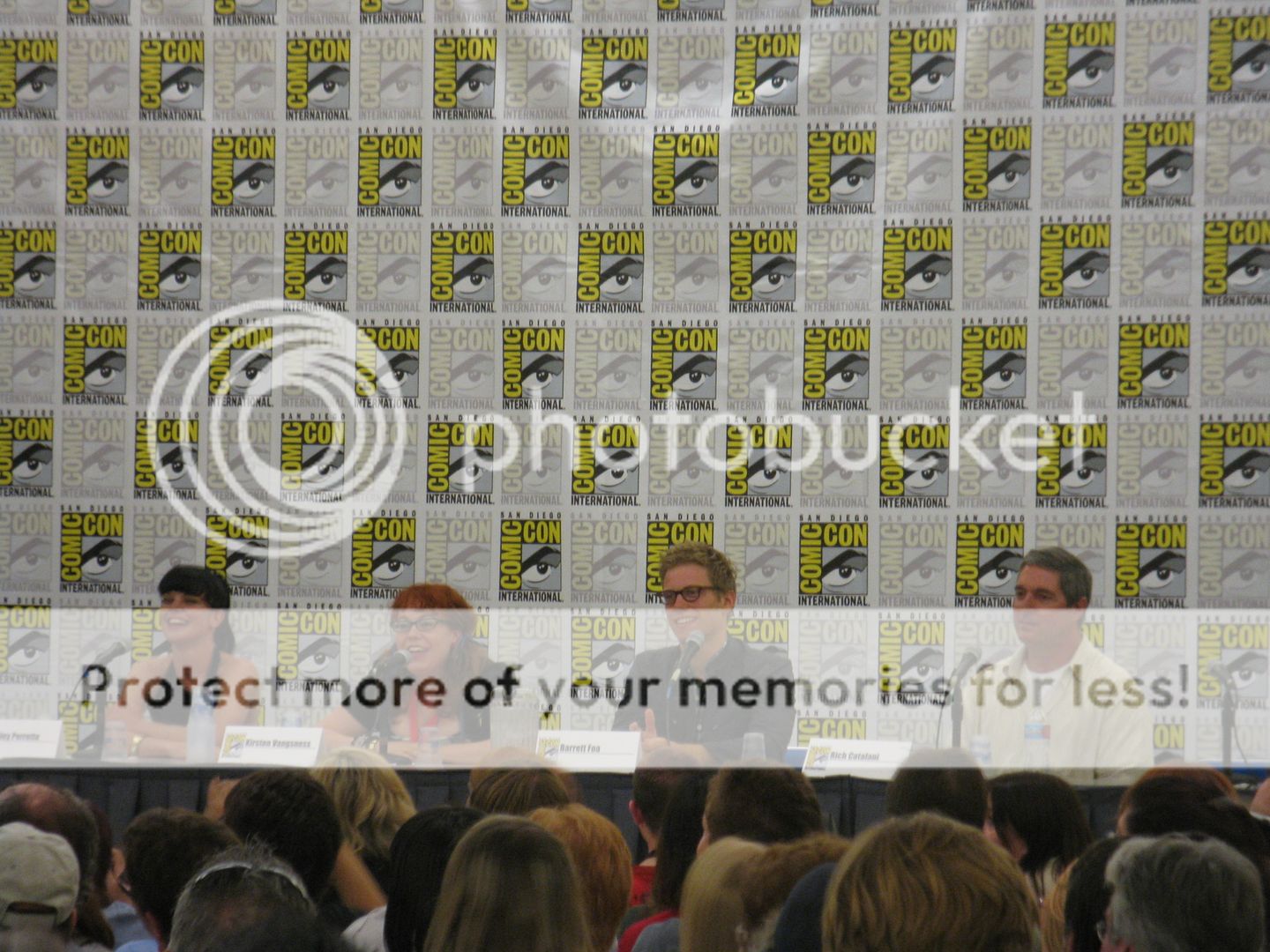
The Teching Out on TV panel (from left to right): Pauley Perrette, Kristen Vangsness, Barrett Foa, and Rich Catalani.
This panel started out with an inundating montage of clips from tech-chic procedurals CSI and NCIS that involved technology of all sorts. It was part awesome and part utterly corny, as words to the song that was spliced in occasionally would find themselves on to the screen. I was afraid that this foreshadowed the panel being just a huge PR stroke for both shows, but I was later proven wrong. Despite the moderator speaking in a loud, fast, incoherent style of mumbling, the rest of the speakers (Anthony Zuicker, creator of CSI; Pauley Perette, CSI; Barrett Foa, NCIS: Los Angeles; Kirsten Vangsness, Criminal Minds; and Rich Catalani, producer of CSI) were very articulate about all aspects of technology on their shows. They strove to make it less a panel about technology on CSI and NCIS and more about technology and how it relates to CSI and NCIS.
The presentation started out with questions about how everyone got involved in their work, and more specifically, how they got involved in technology, or if they even were. Perette studied forensics in college, talking about how, back in her early years, nobody knew a thing about it. She related a story that the first time that her computer was hacked into, she tried to tell the police, but ended up having to explain to them what an IP Address was. Then, after shows such as CSI and Law & Order made technology and forensics mainstream, everyone was a part of a club that they felt they cultivated. “We all became semi-experts,” she said. “It’s been an incredible decade of change. What we’re showing on our show is the grand upmovement”. Vangsness was a tad in the opposite direction: she took teaching jobs in order to support herself, and one of those jobs was teaching PowerPoint to third graders. She now has images of third graders hacking into government installations to post spam of kittens.
Foa stopped the discussion at one point to explain to the audience that his show, unlike the original CSI, does not stare at a green screen when looking at his computer tomfoolery. It is all real. Which complicated matters greatly when Perette’s character met Foa’s in a crossover between their two shows. She had to literally teach him on set how to react to a green screen as oppose to a real image. Foa also related how the super-tech that we often think of as fictional and made up is actually real. The CSI writers have access to China Lake, a military outpost where they test experimental technology. Scary, huh?
But sometimes technology cannot save you, and honest-to-God legwork must be put into use. For one CSI episode involving a stampede of ants, they actually had to hire an Ant Wrangler and clean up all the creepy crawlies using a vacuum. CGI was expected to just look too ridiculous. Then, in a devilish sort of irony, the projector broke, so the panel was cut short and went straight to questions. Perette was met with a young woman who was going to major in Cellular Biology in college because of Perette’s performance on CSI.
Thus, the cycle continues.
MythBusters: Panel + Press Room Coverage
How popular are Discovery Channel’s MythBusters? Very. Each year, the group of geeky demolition rock stars, who prove and disprove popular science myths through the scientific method, represent one of the fan favorite panels at Comic-Con. This year was no different. Press pass notwithstanding, we barely squeezed into a sardine-tight hall full of science fans awaiting their heroes’ arrival. Take a look at the picture below:

A packed-to-the-brim house of 2,000 people awaits the entrance of the MythBusters.
As if the presence of television’s most explosive group wasn’t enough, the audience was tantalized two-fold before the panel. First, a montage video introducing the Busters had us cracking up with its over-the-top… what else?… explosions!
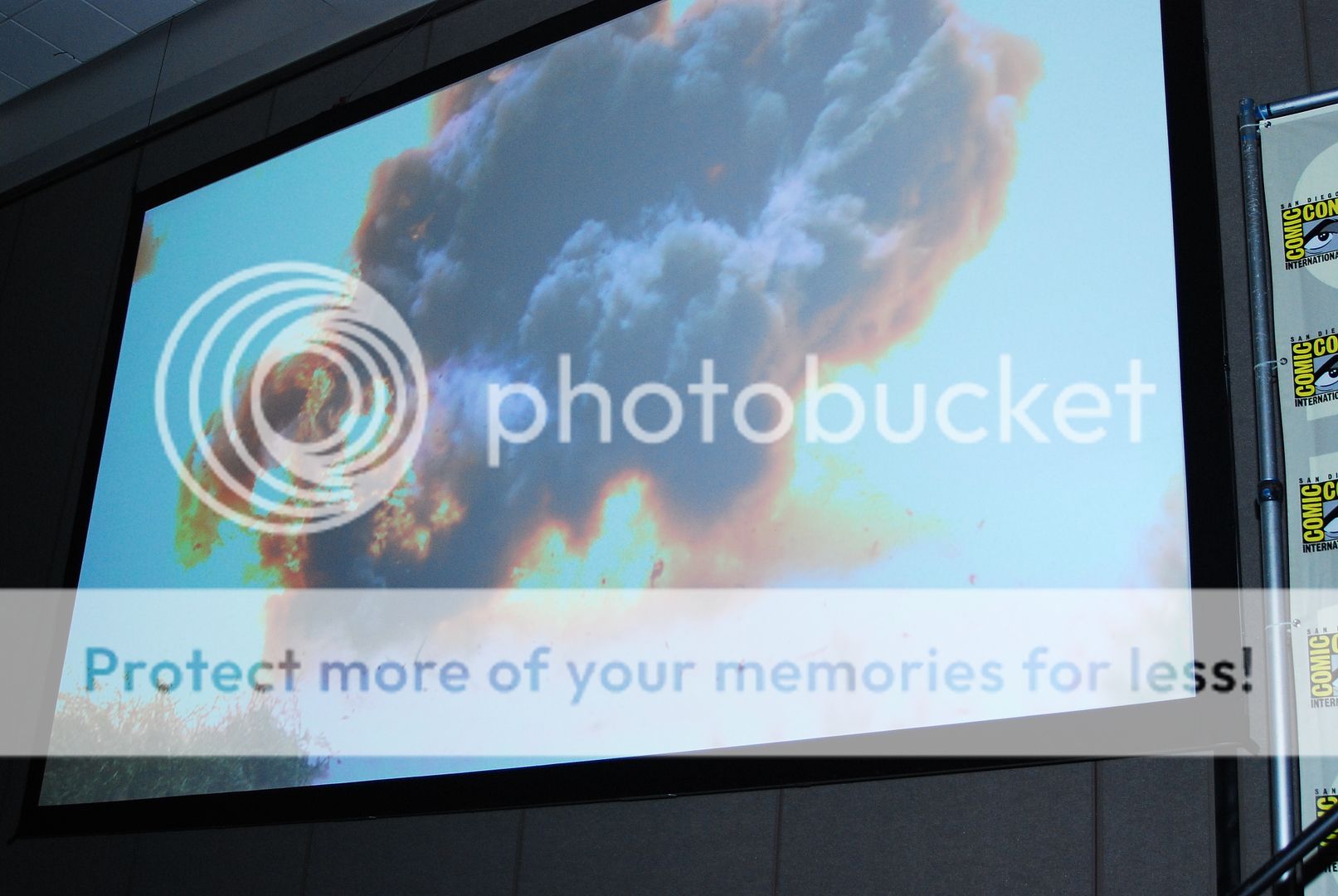
Their entrance was preceded by what else, but a montage of some of their greatest hits!
Then, a special guest, Geoff The Robot from The Late Show with Craig Ferguson, stepped out to proclaim his nerdy love of all things MythBusters.
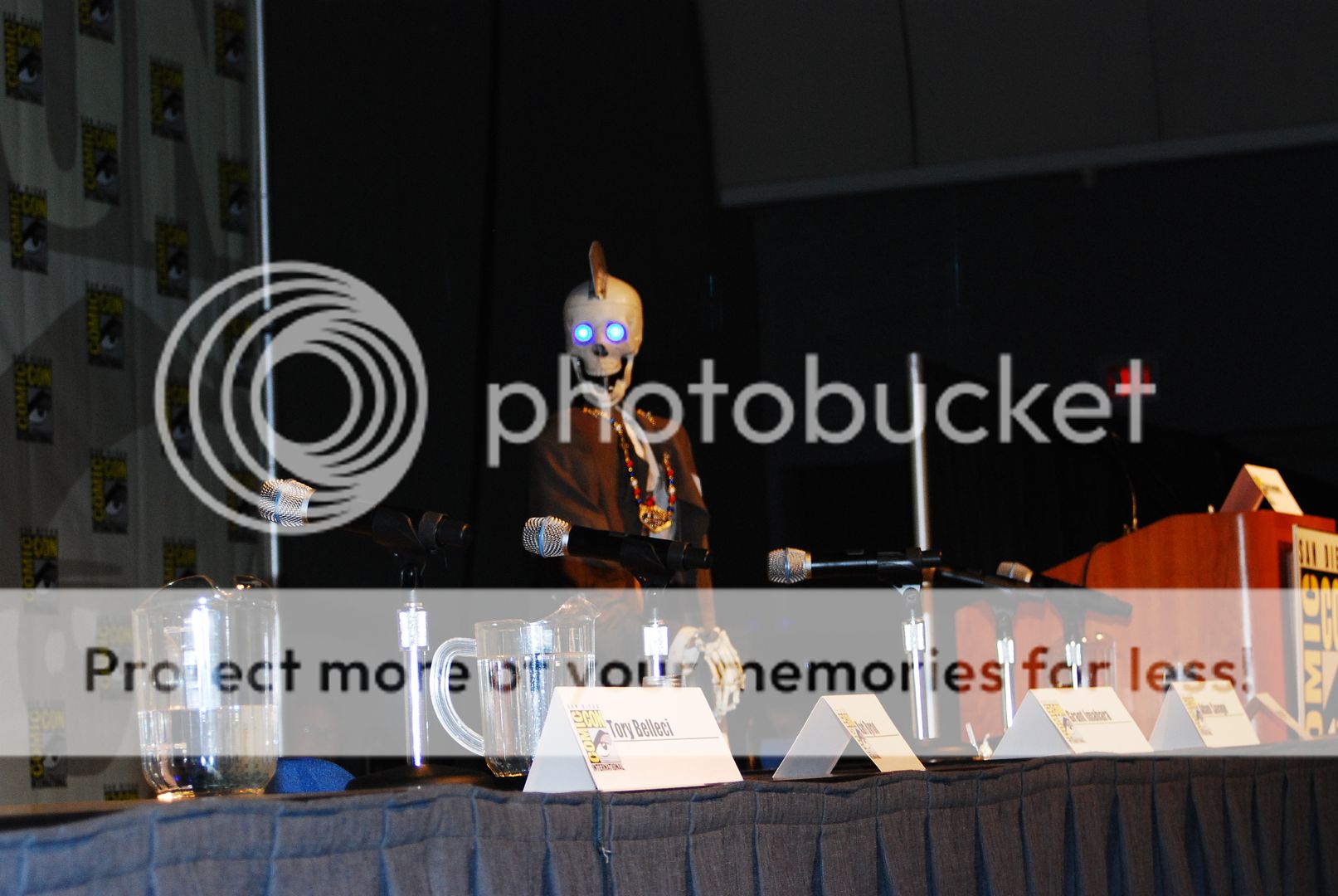
Geoff, the robot from the Late Show with Craig Ferguson.
Finally, to ear-deafening applause, Chris Hardwick of one of our favorite blogs The Nerdist (follow him on Twitter) introduced the MythBusters, who announced that they’ve signed up for 7 more years of glorious science. This is a very special Comic-Con for them. It’s the first time all five have come as a group, and it is gorgeous geek diva Kari Byron’s first Con.
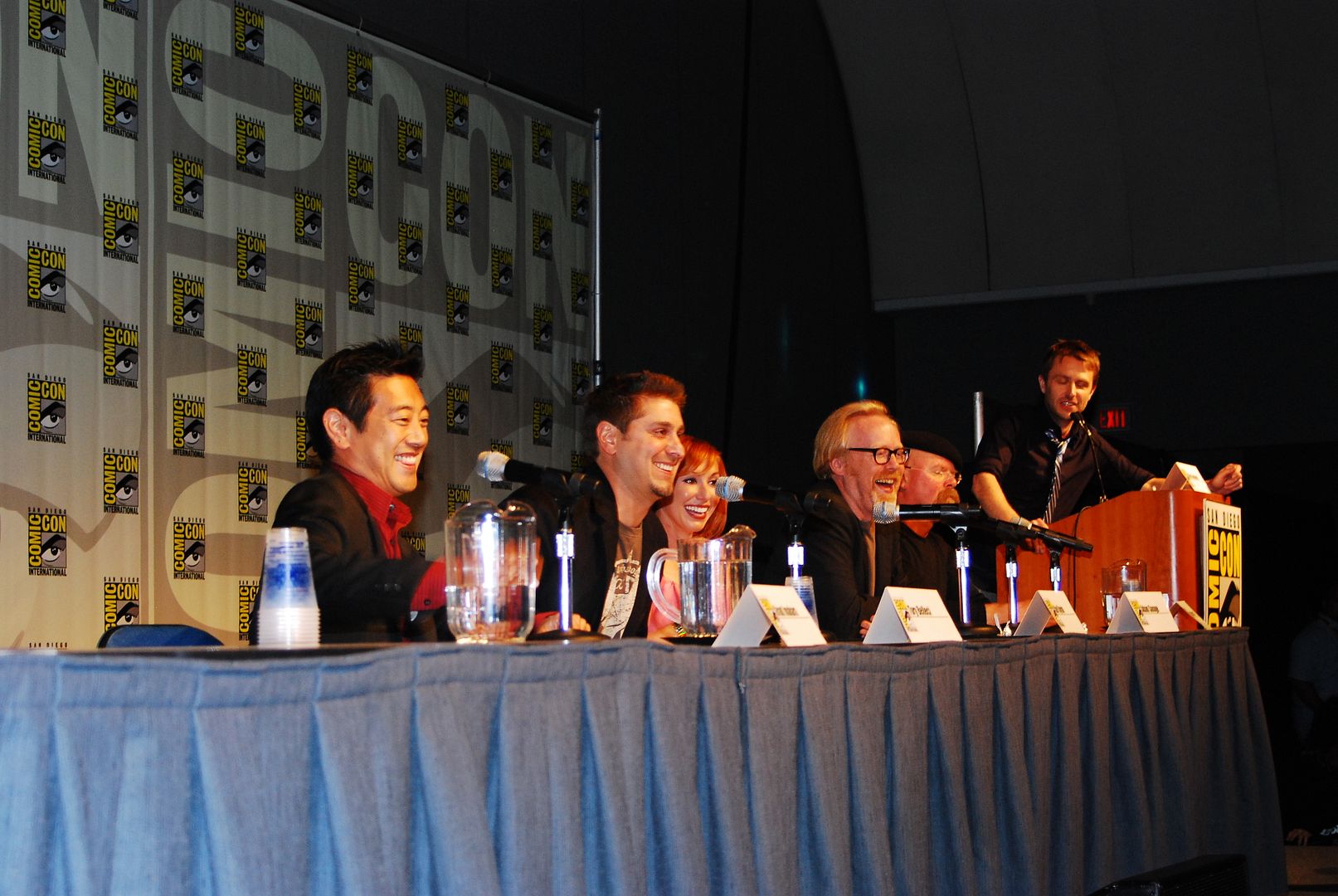
The MythBusters all together at Comic-Con--a first for them! From left to right: Grant Imahara, Tory Belleci, Kari Byron, Adam Savage, Jamie Hyneman, and host Chris Hardwick of The Nerdist.
The first thing the MythBusters wanted their fans to know is just how very real they are. Although they feel like royalty at the Con, when they go back home to San Francisco, MythBusters is far from glamorous. Inside their workshop, which is a workshop and not a studio, they are doing all of the stunts and building themselves. They get dirty, they get bruised, and they do all of the experimenting. Says Adam Savage: “If you see it, we built it.” Although Savage has started getting more involved behind-the-scenes, he explained that the team is so knowledgeable about how to build things, that it’s faster and more efficient for them to do the building than to leave it to someone else. Tory Bellici mused that it would be nice to have stunt doubles sometimes, to which Kari Byron quipped: “They’re not stunts when you fall off.” Did we mention that we love Kari? Jamie Hyneman, who initially signed up for MythBusters because of the allure of getting to try new things, is still having a hard time acknowledging being on TV. When asked what famous people he’d met because of MythBusters, he couldn’t recall one. “President Obama?” nudged Byron. “Oh. Yeah,” replied Hyneman hysterically. Not so for Grant Imahara, possibly the most famous robotics guy in the world. “Craig Ferguson called me the Keith Richards of robotics,” said Grant. “I’m not sure how to take that.”
The audience was treated to a highlight reel of the upcoming season, which promises to have the best, and most extreme, experiments yet. The team revealed some of the secrets. Adam Savage revealed that a scene of a Porsche flipping backwards violently was done to bust an old 1980s myth that classic sports cars are more aerodynamic going backwards than forwards. In an utterly bad-ass bit of reconstruction, the body of a Porsche chassis was cut off, flipped backwards on the car, then raced at 100 miles per hour. Any more questions, kids? A scene showing Kari puking violently (she joked that it was in her contract to have to throw up every year) was explained as an episode testing whether people really do get cold feet when they have to do something scary. For the team, scary meant picking, then eating, two of the most disgusting selections from a table of delicacies consisting of spiders, cockroaches, chicken feet and more. And where does the team get their constant supply of ideas? “Surfing the internet really works!” joked Grant Imahara.
As to whether the team is cognizant of how much they advance science and critical thinking, and actively try to build experiments around didactic aims, the answer is… NO! Jamie remarked that as a whole, the MythBusters are a remarkably curious group. They are curious about stuff, they try to figure it out, and do so in a methodical and logical way. But they never set out to do science. Which, honestly, in the opinion of this website, is why their science is so great.
At this point, the team shared fun and hilarious inside stories from their Comic-Con experience and tidbits from back home in San Francisco. Adam recalls being shocked at two geeks that came up to him at an autograph table with their baby, wearing a onesie that said “Proof that nerds have sex.” Despite his uncomfortable laughter, the duo then asked him to sign their baby! Another fan went up to Jamie and remarked: “I’ve been watching your shows since I was a little girl and now I’m a PhD!” We’re pretty sure Jamie was kidding, but Adam still poked fun back at him. “You’re old!”
Just in time for next week’s Discovery Channel Shark Week, Adam recalled a fan coming up to him a few months back with what the fan was convinced was a brilliant suggestion: “Dude, you know what you should totally do? You should totally prove that, like, punching sharks will make them go away! Seriously, dude, it would be awesome! You’d just punch them.” A brief pause from Adam. “8 months later, there we were, knee deep in sharks, punching them in the face…”
Kari revealed that she filmed the show up to her 10th month of pregnancy. She pointed out that it’s a myth that pregnancy only lasts 9 months. (BUSTED!) She was worried that her baby would never come out. Replied Grant: “With all those explosions and gunshots outside, I wouldn’t come out either!”
Finally, to a fan that asked whether the team is ever scared of an experiment as too dangerous, Jamie reminded him that danger is a relative term. Nothing the MythBusters do is any less dangerous than driving down a freeway at 70 miles an hour. The trick is to good engineering and survive by doing a good job.
The new season of MythBusters premieres in the fall. Find coverage of their Comic-Con panel and clips from the new season on the MythBusters website.
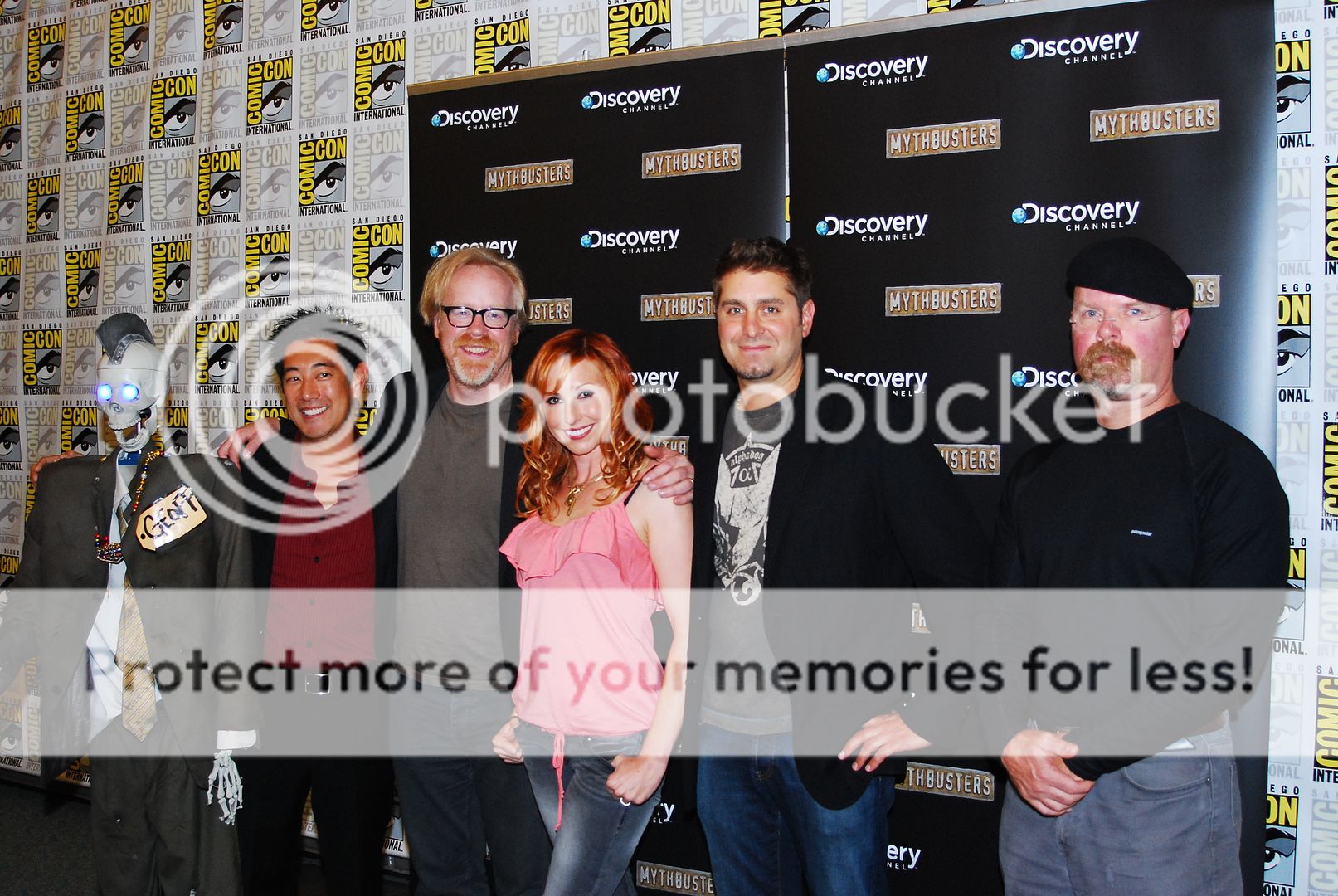
The MythBusters (and Geoff) chilling with us back in the press room after the panel. Aren't they all beyond adorable??
We got to spend even more time hanging out with the MythBusters (and Geoff) backstage in the press area to get even more scoop about the show. We all wondered about the research process that the team undergoes. First and foremost, Adam proclaimed that they “don’t ever get things tested because they’re too dangerous.” There’s nothing the team is afraid of, and no length of time is too long to wait for a payoff. The research can take anywhere from 2 weeks to 2 years. The team searched 19 months for a lead layer thin enough to do an experiment properly. By contrast, the poppy seed drug testing experiment took two hours. They ate poppy seed muffins at 9 AM, and tested positive for heroin at 11 AM (well into the next day).
When asked about their terrific rapport, the team reiterated that they very much enjoy each other’s company and socialize quite well. All of the process, from picking to carrying out experiments, is totally collaborative. Secondly, the team shares a bond because they know each other quite well. “It’s not like we’re a science show boy band,” joked Adam. Most of them have known each other and worked together well before MythBusters began. Unlike other shows, MythBusters goes on for most of the year (46-47 weeks) because the building portions of the segments are so time-consuming. The most important thing to Jamie is a strong sense of respect that trickles down all the way to the show’s loyal crew of 23 people.
For the future of the show, Jamie revealed an interest in looking at the dichotomy of destructive things that do good work as well, steam being high on his list. The team never gets inspiration from movie trailers or clips if there’s no story there and they’re not worthy of a myth.
Adam revealed the interesting fact that somebody actually bought the Corvette which had been fouled by a decomposing pig to prove that a decomposing body can destroy the inside of the car. Adam now associates the smell of cleaner with that episode, which makes him sick to this day. Was that the team’s least favorite experiment, wondered ScriptPhD.com? Grant picked the ear wax candle experiment, jokingly calling it the “seasickness experiment.” Tory picked the chili pepper cure experiment. (“Burns on the way in, burns on the way out!”), while Kari picked the water torture episode. The most destructive experiment to this day, much to the chagrin of OSHA and safety regulation organizations of San Francisco, was the Civil War rocket, tested with a wax core. The team thought they had a proper bunker in the shop, but unfortunately ended up setting fire to their ceiling!
On any potential Discovery Channel crossover shows, Adam revealed that he’d like to go out into the wild with Bear Grylls (and so would I!) while Kari revealed that she would not like to do a dirty job.
And for the highlight of my personal day…
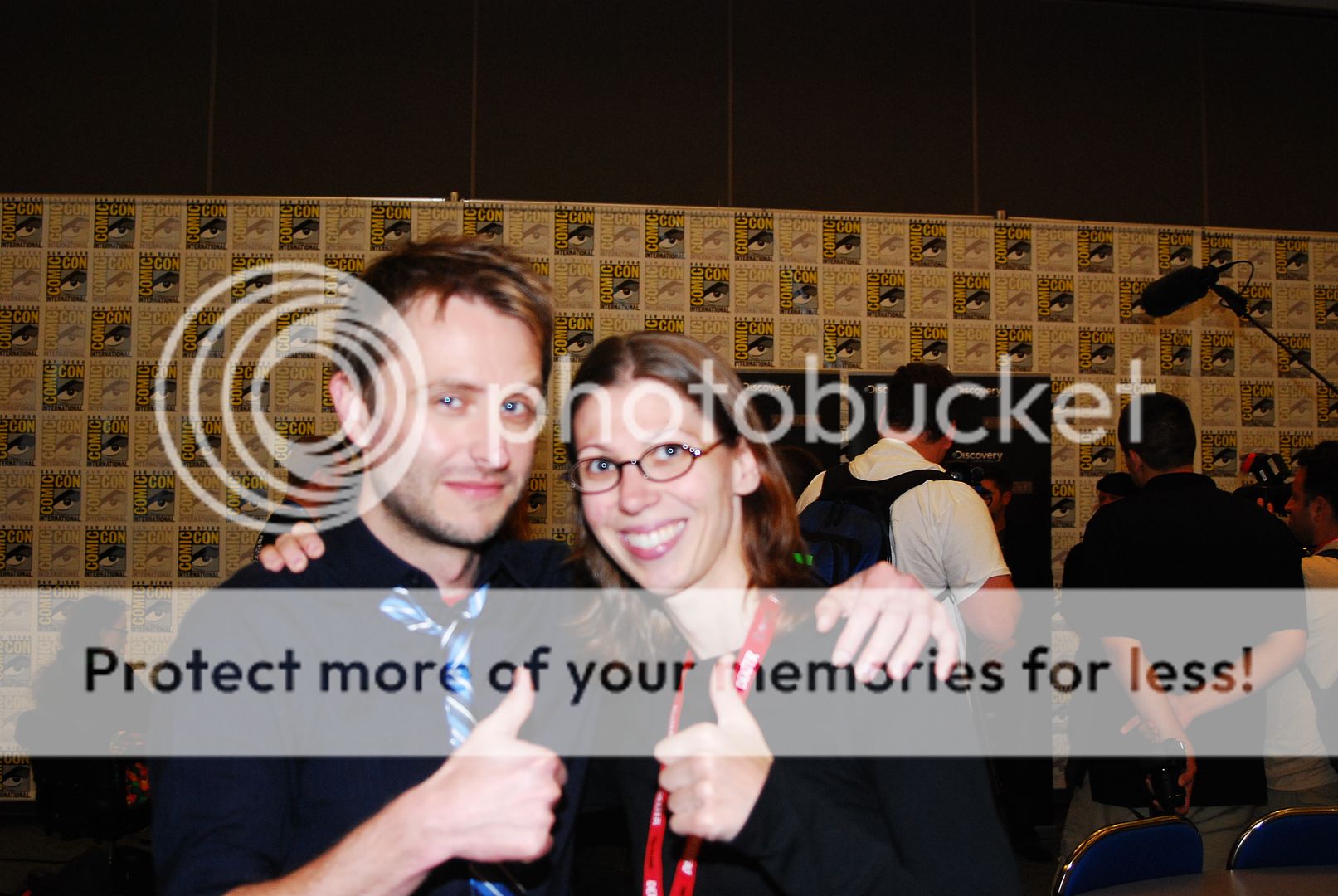
The Nerdist and The ScriptPhD giving a thumbs up to geekdom!
Last, but not least, is our official Day 3 Costume of the Day. We chose this warrior for a simple reason. He braved the chilly convention center without a shirt, yet with a completely covered head. Now if that isn’t upside-down thinking, we don’t know what is!

Our Day 3 Costume of the Day
Incidentally, you can find much more photographic coverage of Comic-Con on our Facebook fan page. Become a fan, because this week, we will be announcing Comic-Con swag giveaways that only Facebook fans are eligible for.
~*ScriptPhD*~
*****************
ScriptPhD.com covers science and technology in entertainment, media and advertising. Hire our consulting company for creative content development.
Follow us on Twitter and our Facebook fan page. Subscribe to free email notifications of new posts on our home page.
Day 2 of Comic-Con is over and now, the Convention is really underway! Today’s ScriptPhD.com coverage has a heavy focus on television, and sci-fi television to be specific. Really, is there any other kind? We spent time in the press room with the stars and producers of SyFy Channel hits Caprica and Stargate Universe, our favorite geeky physics show Big Bang Theory and the exciting (first-time ever!) Comic-Con Discovery Channel unveiling of their new scripted series Reign of the Dinosaurs. As always we try to pay hommage to the roots of Comic-Con with coverage of the design tricks behind comics and graphic novels. Additionally, we provide pictorial documentation of the costumes and happenings of the Con, and our Day 2 Costume of the Day. Complete coverage under the “continue reading” cut.
From the Press Room: Stargate Universe
We were delighted to start our day with the cast of one of our favorite sci-fi shows on the air, Stargate Universe, to get a little peek into the cast’s geeky sides and what they think of their characters and show.
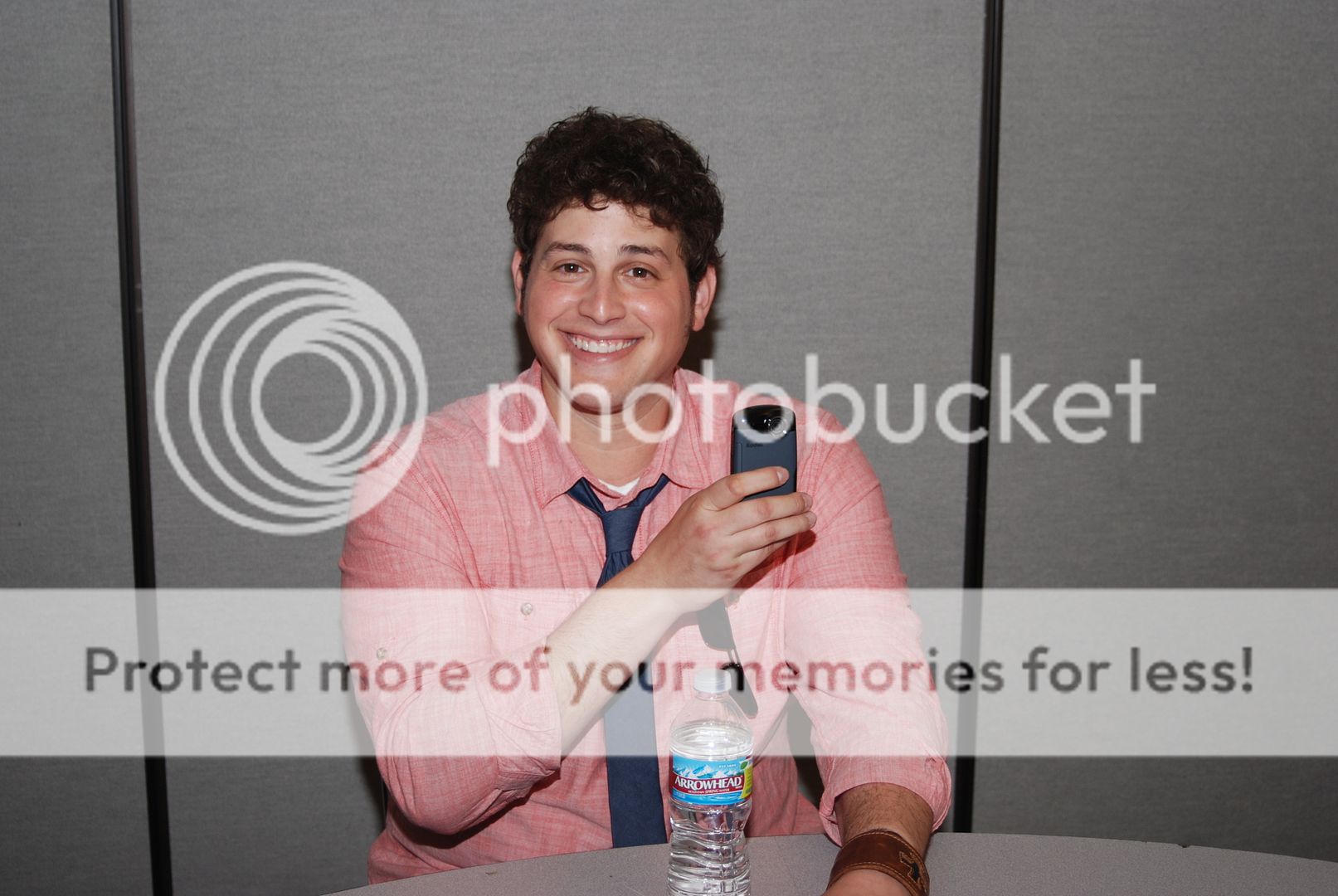
David Blue (Eli) of Stargate Universe being adorable.
For star David Blue, playing the ship’s resident math geek Eli Wallace, this year is a completely different experience. Last year, there was so much uncertainty about the show’s acceptance and success, while this year, the cast walks into Comic-Con confident of where they are headed. He spoke of liking the idea of Eli as a hero, the show’s surrogate for the audience. Though he admits to being a geek, he was very hesitant to play the role when he heard about it, because of his previous computer nerd role on Moonlight for fear of typecasting. But Eli is not a stereotypical nerd, and experiences a lot more emotional and character growth over the course of Season 2. “I am proud to be a geek/nerd,” Blue says. “Everything from computer programming to comic books to video games.”
We were so thrilled to hear that David was a certified Grade A USDA organic geek, that we got him to proclaim so on camera for you guys:

Ming-Na (Camile) of Stargate Universe was so fascinated with all of our recording devices, she taped US for CNN.com!
Ming-Na, whose character Camile Wray is far more controversial and decisive on the show, was asked right off the bat what she’d do differently in real life as opposed to her character. “Well, I wouldn’t be a lesbian,” the married actress quipped. Turning more serious, she said that she wouldn’t be as level-headed and calm as her character, who is often asked to make difficult, morally ambiguous decisions based on emotional issues. The fan’s response to Camile is largely a love-hate relationship. She’s gotten great response from the gay community, something that Na appreciates, but Camile’s escape from cliches or stereotypes is something that has resonated. The morally wrenching decisions are a staple of the show (and sci-fi television in general), and will only continue into Season 2. “You may not like her decisions,” says Na, “But I like her.”
From the Press Room: Caprica
Alessandra Torresani (the Cylon Zoey) of Caprica in the press room at Comic-Con.
One of the most pivotal roles in the history of sci-fi television (the first Cylon) went to a girl that didn’t even really know the significance of the part. “I didn’t know what Battlestar was before I got the role,” admits Torresani, who was not a real sci-fi geek growing up. “I actually turned it down because I didn’t want to do [Caprica]. I wanted to do [Gossip Girl-type fluff]. It’s exciting now to [realize how important the role is], but it wasn’t nerve-wracking at the beginning. When I read the pilot, she was a spoiled brat, and then she gets in a robot. We didn’t know that I was going to be a Cylon. We just thought they’d use my voice and the robot’s body.” Filming the scenes as the Cylon, Torresani revealed, involves acting next to a giant green 7′ tall stick that everyone communicates with as the Cylon. She finds that the hardest part for her as an actress are scenes as the Cylon where she can’t communicate vocally, such as being lit on fire and not being able to utter a single word. “It’s really challenging. That’s something I never thought I’d have to do.”
Battlestar Galactica and Caprica producer David Eick (and moi) in the press room at Comic-Con.
We started our time with executive producer David Eick with a humdinger—the question we know fans would want to ask. What has been the producers’ reaction to mixed reviews and fan division of the show, most notably from the Battlestar Galactica fanbase? “We knew to expect a much greater mix [of opinions] because we knew going in that we were not going to craft it or market it as a spin-off of Battlestar,” replied Eick. Rather than containing cheeky references to BSG or inside jokes only the audience knows, Caprica is very much its own beast. He hopes fervently that as the show finds itself and its own focus, that the audience, too, would find its own way in the show. He reminded us that the early days of Battlestar were equally contentious in terms of critical and fan opinions. “The very first Comic-Con we came to for Battlestar was like George W. Bush showing up at an ACLU rally.”
In many ways, he feels more challenged by Caprica, which lacks the ticking time-clock feel of BSG. It’s a more sophisticated style of storytelling, which is based in defining the characters and the world around then, Rome before the fall. The mythology of that world is deepened as the show progresses, and how it’s harnessed by Zoey to express herself. Eick spoke of how much more graceful and elegant Caprica is visually and content-wise, with Blade Runner being a huge influence on the producers and writers. By contrast, BSG had much more of a Black Hawk Down, action feel to it.
By the way, Ron and David have a longstanding tradition of taking a drink of tequila together before either a major show launch or major seminar/Convention. In fact, David brought the bottle and we all had a little fun. Kidding. But seriously, folks, next time you think the storylines on Caprica are getting a liiiiiiiittle wacky, just remember this picture:

TEQUILA! David Eick livens the Caprica press tables.
One of the happiest moments of my life, no joke. In the press room with sci-fi visionary, genius, and very gracious man, Battlestar Galactica/Caprica creator Ronald D. Moore.
Ronald D. Moore, who made a rare media appearance at Comic-Con this year, largely echoed Eick’s comments. Caprica, he maintained is a serial, and (purposefully) as different from Battlestar Galactica as possible. In an even rarer move, Moore openly self-criticized himself for some of the early hiccups of the show. He admitted that it was hard to follow, that the story was indeed confusing, but that the show gained confidence as it went on. He predicted as strong of a build-up for Caprica as the eventual success of Battlestar Galactica. Another fun tidbit that Moore revealed was that the group marriage concept was tossed around for Battlestar Galactica, but just never found the story or the characters to make it happen.
We asked Ron about his thoughts on the current state of sci-fi and what he enjoys. “I’m probably not up to speed on a lot of other science fiction,” Moore said. “I almost avoid it now because I spend so much of my time in a science fiction world that I tend not to go there. It becomes almost like more work to watch other science fiction shows. In my brain, I’m inevitably thinking ‘How does that compare to us? And that’s their structure. How many characters do they have? I wonder what their CGI budget was.’ I haven’t watched a lot of other science fiction television for that reason.” Nevertheless, he maintains that it’s a thriving genre that will always be with us, despite the rise and fall of popularity. The one holy grail Moore hopes for is a broadcast network (read mainstream) sci-fi hit. He isn’t sure what the reason is that this popularity has remained so elusive, LOST notwithstanding. “Maybe it’s just us,” he mused. “Maybe it’s just us [the collective sci-fi geekdom], and there’s not this gigantic mass market for it in television in the way that there is a gigantic mass market for movies. Maybe that will never happen.”
We here at ScriptPhD.com hope otherwise.
From the Press Room: Big Bang Theory
If Ronald D. Moore is concerned about the viability of a basic network science fiction hit, at least he can take solace in Big Bang Theory, arguably the smartest, most successful, streamlined show about science and scientists in the history of television. We had such a fun time hanging out with the actors last year, that this year, with access to the full production team, we decided to get as much scoop from the show as possible.
Big Bang Theory producers Lee Aaronson and Steve Molaro
Big Bang Theory creators Bill Prady and Cuck Lorre
One thing fans would be surprised to learn, and the first question we asked right off the bat, is just how geeky the team behind Big Bang Theory is. Producer/writer Lee Aaronson, a self-certified comics and graphic novel geek, used to own his own comic book store. This is where a lot of the inspiration for Sheldon (and the rest of the team’s) love of geek culture comes from. They also have a close relationship to UCLA physics professor and the show’s science advisor David Salzberg. Often, they will write a line like “Hey guys, I was just working on [insert science here]” and let him fill in the blanks. We were wondering about that, too!
Geeky enough? Not even close. Showrunner and co-creator Bill Prady is a former computer programmer. He’s far more excited about Apple founder Steve Wozniak guest starring on the show than any fame or fortune that has incurred because of it. He and co-creator Chuck Lorre maintained that the geek culture was their most important singular focus in writing the show. As one might glean from walking the halls of Comic-Con, they maintained that all geeks/nerds/scientists are not the same. There is a lot of heterogeneity amongst them, and differing, personal passions—be they Star Trek or the mathematical concepts behind string theory. And where do they get all their geeky throwaway lines? “Oh, those are all available on the internet!” And THAT is why we love Big Bang Theory.

A little something for the Penny/Sheldon fans. Johnny Galecki and Kaley Cuoco in the press room at Comic-Con.
Jim Parsons (and Simon Helberg looking on) of The Big Bang Theory in the press room at Comic-Con.
The actors themselves get right in the thick of the fun. Kaley Cuoco, playing perhaps the non-geekiest of the bunch in Penny, has nevertheless embraced geekdom. Her latest love? Her iPad! She and Johnny Galecki would both like to see a romance blossom between Penny and Sheldon (“Peldon,” joked Cuoco), but acknowledge that the road from platonic friendship to romantic involvement is filled with bumps and individual growth. Jim Parsons, who I shamelessly adore, started his time with us by telling me to shove it. He was, of course, talking about my tape recorder, but when I joked that I couldn’t believe Sheldon told me to shove it, his reply was: “And he’d tell you to shove it again and again!” Before telling Simon Helberg to bite him. Nice to know he stays in character so well!
We couldn’t leave a Big Bang Theory press room without getting our favorite superior elitist nerd to do something only for ScriptPhD.com fans. So here you have it, kids. From Jim Parsons, to you… a personal “Bazinga!”
Comics Design
The visionaries of grapics design for comics (from left to right): Mark Siegel, Chip Kidd, Adam Grano, Mark Chiarello, Keith Wood, and Fawn Lau.
One of THE most fascinating panels that we attended at Comic-Con so far was on the design secrets behind some of your favorite comics and book covers. A panel of some of the world’s leading designers revealed their methodologies (and sometimes failures) in the design process behind their hit pieces. An unparalleled purview into the mind of the designer, and the visual appeal that so often subliminally contributes to the success of a graphic novel, comic, or even regular book. We do, as it turns out, judge books by their covers.
We will be revealing each designer’s comments on their thought and art process, but are waiting for images from the panel to be emailed to us. So consider this a placeholder until we can finish this writeup and include it in Saturday or Sunday’s coverage. Stay tuned . . .
Graphic Novels: The Personal Touch
(From our correspondent Bryy Miller)
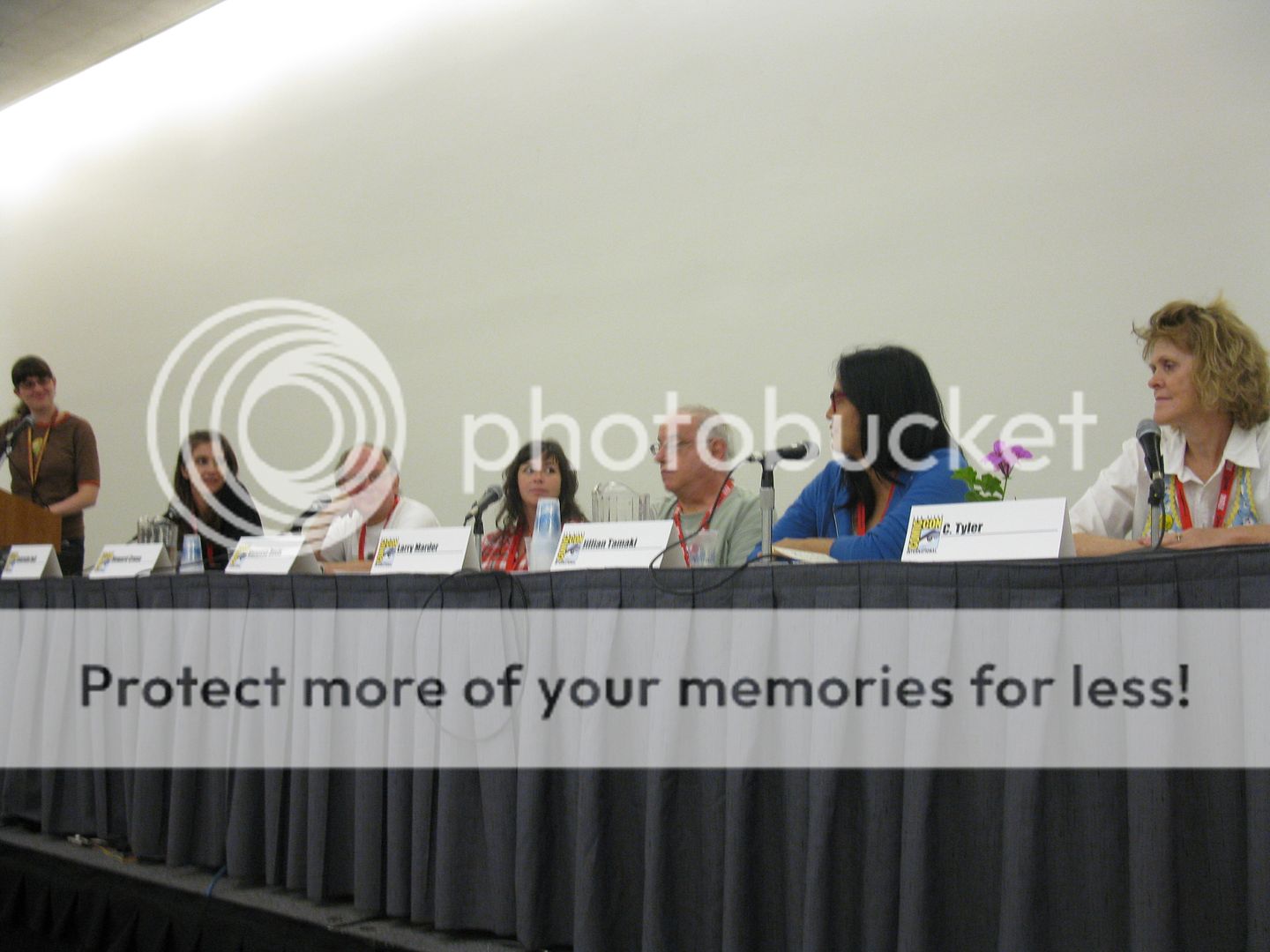
Graphic Novels: Personal Touch panel (from left to right): Shaenon Garity, Gabrielle Bell, Howard Cruse, Vanessa Davis, Larry Marder, Jillian Tamaki and C. Tyler.
Some panels have mysterious names, some not so much. This one belongs in the latter category. There was no hidden meaning behind the phrase “personal touch.” This was all about the writers (Gabrielle Bell of Cecil & Jordan in New York, Howard Cruse of Stuck Rubber Baby, Vanessa Davis of Make Me A Woman, Larry Marder of Beanworld, Jilliam Tamaki of Skim, C. Tyler of You’ll Never Know, and moderator Shaenon Garrity of Skin Horse). More importantly and interestingly, it was about who they were. Some didn’t know who they were, others did, but they all knew one thing: that something inside of them needed to write.
Tamaki started off the discussion by stating perhaps the simplest answer of why she writes what she does, “I think that’s the only kind of book I wanna make.” Davis continued by adding that “anytime… it’s going to have a personal touch. Comics can soak up the people’s idiosyncrasies and sensibilities.” Marder, perhaps the odd man in the group, stated that even though his autobiography is a FANTASY, it still is an autobiography in the sense that it tells stories about his own feelings. Before anyone else could chime in, C. Tyler (arguably the oldest member of the panel) shot to life with an amazing amount of energy and playfulness. “I’ve taken autobiographies for granted.” she started “I know we’re at Comic-Con, but I hate superhero comics. When I read the first autobiographical comic, I was floored… it was disturbing and in a comic.” She went on to describe how she is fascinated with the idea of putting yourself out there, grabbing pieces of scraps from the table and showing us as if they were her life story – or even her creative process – in visual form. She would get extremely animated, and it really helped to humanize the element of the mysterious writer’s block and constant internal struggle to find how to portray your story. She ended her opening remarks with this, “the personal touch for me is I do it all by hand.”
Bell was the most reluctant to speak, but also, besides Tyler, the most visual. Not in the sense that she was very gesticulative or alive, but that she obviously was thinking very hard but having trouble in how to phrase her thoughts. “I try to cut my personal touch out,” she started, displaying the classic writer’s twitch of not looking directly at her audience “[I try to] make it universal. Professional.”
This instigated a very visceral response from Tyler, who on the spot tried to get into an earnest conversation with her fellow comic artist about what it means to be professional. Sadly, it didn’t last that long as Bell migrated back into thought. Cruse then brought up the point that, if your content is good, then mistakes in your craft are easily overlooked by a reader. The discussion (because calling it a panel at the end would just feel weird) had reached its time limit. Cruse gave some parting advice to young writers, “It will literally paralyze you to think of how many people have an idea similar to yours.” Marder stated that you have to fail in public. Garrity reminded everyone to heed that advice, as “Carol, Larry, and Howard have been in the comics since the seventies.”
Tyler let out a self-taunting gag.
Reign of the Dinosaurs
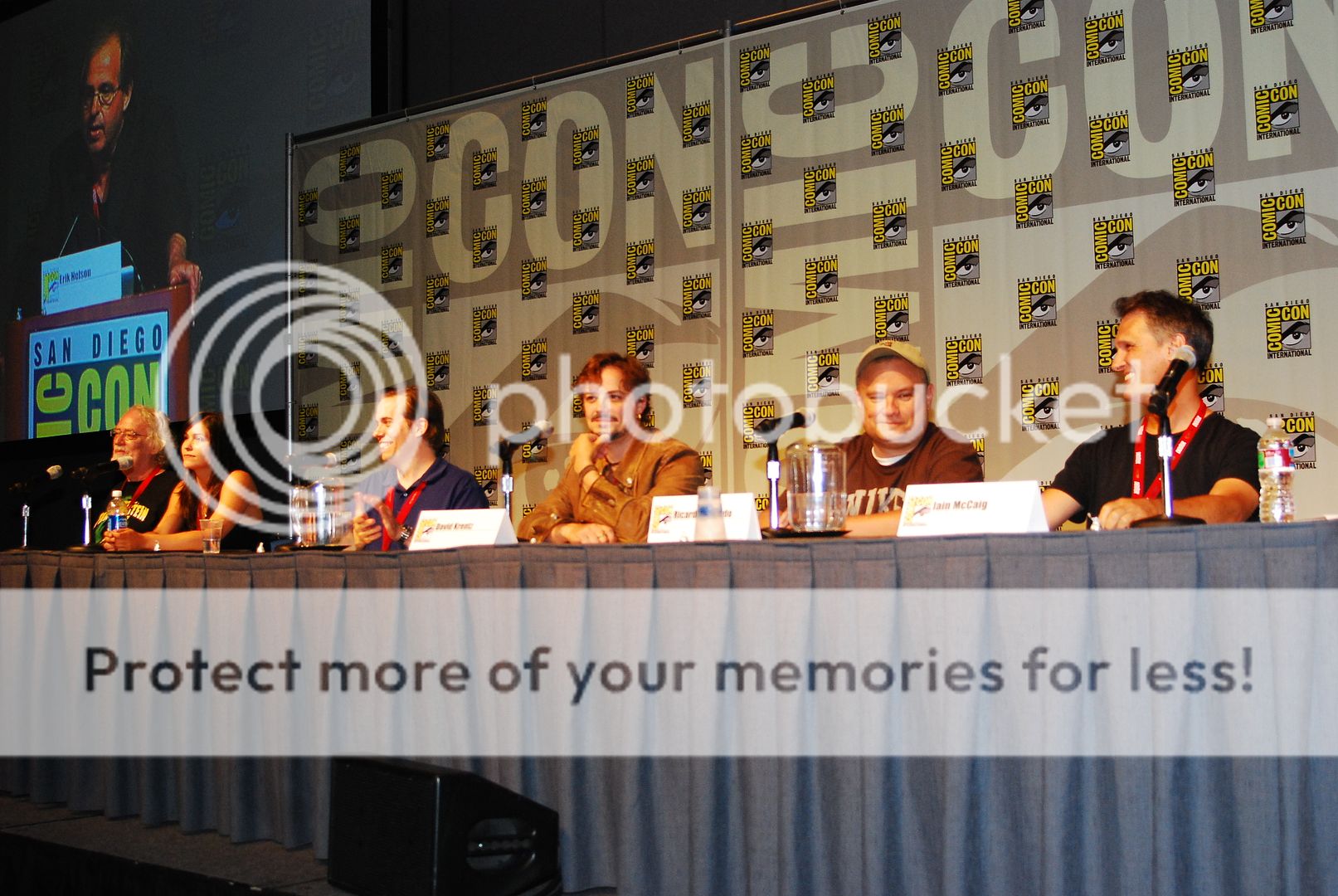
The Reign of the Dinosaurs creative team (from left to right): Pete Von Sholly, Mishi McCaig,Tom DeRosier, David Krentz, Ricardo Delgado and Iain McCaig. (Executive producer Erik Nelson speaks on the jumbotron.)
In November of 2008, the hoi polloi at Discovery Channel approached producer Erik Nelson (Grizzly Man) with a simple request: “the ultimate kick-ass dinosaur show.” They poured enormous resources, creative and fiduciary, to create a television series that will truly break ground, both for Discovery Channel and its own medium. Scripted, yet unnarrated, scientifically stunning, yet bereft of the omniscient “talking head” paleontologist, Reign of the Dinosaurs is the ultimate exercise in “show don’t tell.” Premiering in the Spring of 2011, Reign will consist of 36 self-contained episodes erected from the art up. The stories will be chronological, detailing the rise, reign, and ultimate extinction (with a twist!) of the dinosaur species. But unlike the plethora of educational shows that cover the same topic, these will be rooted in storytelling, in treating the dinosaurs not as dinosaurs, but characters with whom we share an emotional connection. Trust me, having seen the first few world-premiere clips, you will care for these creatures, and the show will both exhilarate you and break your heart.
The true key to the success of Reign of the Dinosaurs was a dedication to amassing cream of the crop talent, formerly of Disney and Pixar, which allowed them to channel superlative animation and design talents towards an ambitious format. Along with Nelson, the team (and Comic-Con panel) consisted of renowned artists Ricardo Delgado (Dark Horse’s Age of Reptiles), Tom DeRosier (Lilo and Stitch, Mulan), self-proclaimed dinosaur nerd David Krentz (Disney’s Dinosaur, John Carter of Mars), Iain McCaig (Star Wars 1, 2, and 3), Mishi McCaig (Iron Man), Pete Von Sholly (The Mask, Darkman). Along with showing the audience their two (so-far) completed “cold open” teasers that will open episodes of the show, several of the animators simulated storyboard pitches (see picture below), just like the ones they would exchange in a writers’ room for several forthcoming episodes.
A sample of storyboard animatics previewing storylines from the future series "Reign of the Dinosaurs."
Several things impressed me upon the early viewing of Reign of the Dinosaurs, aside from the stunning art direction and well thought-out design. First of all, this show is really cheeky and funny. When the writers say that they’ll give the creatures personalities, they mean it, and it’s all done through expository action rather than showy narration. An early cold open has a dinosaur, trying to soothe her babies to sleep in the wee hours of the dawn, annoyed at the incessant chirping of a smaller dinosaur deep in the forest. Finally, she marches over and does what a dinosaur would do: bites the head off of her more annoying, diminutive co-habiting pest. Literally. Secondly, the stories pack an emotional wallop. A cinema-quality sequence shown at the end, taking place post-impact of the asteroid that ultimately killed off the dinosaurs, has the post-apocalyptic feel of Cormack McCarthy’s The Road (which the illustrator said influenced him) and visual appeal of Blade Runner. The ending, a hopeful coda on the extinction of the dinosaurs as an evolutionary stepping stone for our modern birds, had me sobbing. And then giving the panel a standing ovation.
Spring of 2011 is far away in television terms, but close enough for me to say this. Be excited, folks. Be very, very excited.
From the Press Room: Reign of the Dinosaurs
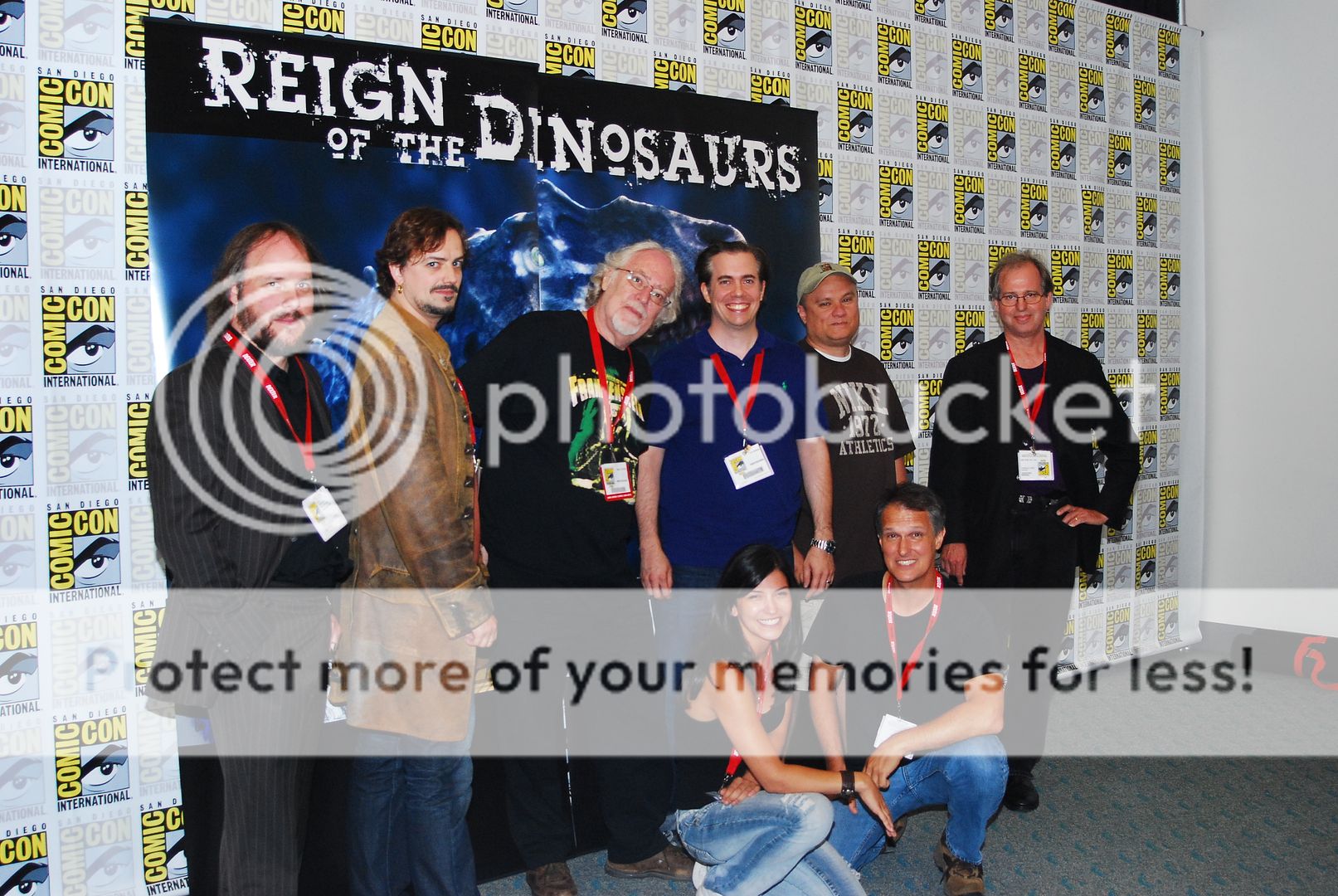
The creative team behind "Reign of the Dinosaurs" poses for ScriptPhD.com during their press room after their Comic-Con panel.
Not only did we get treated to a front-row preview of Reign of the Dinosaurs, ScriptPhD.com was extraordinarily fortunate to join the Discovery creative team for an intimate roundtable discussion panel after their panel. We were able to get enormous insight into the team’s collaborative process, storytelling aims, and dedication to balancing scientific accuracy with emotional connection, all while reinventing an entire medium. Ambitious? Just slightly.
One of the first things that impressed me upon talking to the Reign of the Dinosaurs team after their panel was their sheer dedication to, almost obsession with, “getting the science right.” Mishi McCaig and Iain McCaig spoke at length about the team’s dedication to nearing the line between science and entertainment. Hugely important to the project was the involvement of renowned University of Maryland paleontologist Thomas Holz, Jr., who cross-checks and gets pitched all the storyboard ideas. The behavior depicted in the show is speculative, but based on facts. This includes the animal’s muscle movements, how they would hunt prey, how they would interact—all aided by the paleontology knowledge of illustrator Dave Krentz. Ultimately, the team wants interest in the show to launch a more widespread educational initiative, which will include a Discovery multi-media website, and other supplementary materials to the show itself. Even when stories delve into the outrageous or fun, they’re rooted in research. A clip depicting high dinosaurs hallucinating was rooted in the marula tree, whose hallucinogenic fruit animals will eat and get high off of.
Producer Erik Nelson and illustrators Tom DeRosier and Ricardo Delgado spoke at length about the collaborative process of making the show, which they described like a TV writing room, only with animators. “Everyone’s sensibilities came together in a ‘hive mind’,” said Nelson. This visionary approach was important to the team, which is essentially trying to reinvent a TV genre. The last non-narrated, no-dialogue animated show was Walt Disney’s “Silly Symphonies” back in 1938. Needless to say, we’ve come a long way since then. The team was amazed at how constructing the dinosaurs’ stories moved them, comparing their effort to “March of the Penguins,” another simple vehicle showcasing animals that was rooted in an emotional audience response. This empathy for the dinosaurs peaks with the show’s conclusion, in which the dinosaurs die out (spoiler alert!), but which is still painted in an upbeat, survivalist way, as most geologists and paleontologists agree that modern birds are the direct evolutionary ancestors of dinosaurs.
“We’re not trying to hook you as a dinosaur person,” concluded Delgado. “We’re trying to hook you as a human being.”
Two last fun tidbits from today. Last year, on Day 3 of Comic-Con, we got geeky in the press room with our friend Barry of The Ugly Couch Show. When we saw each other again this year, we thought we’d start an annual tradition. So here it is, ladies and gentlemen. Two very tired, cranky, overworked press corps members getting silly in the press room:
With our good friend Barry of The Ugly Couch Show. Next year, we might take our act on the road!
And last, but definitely not least, is a very worthy Day 2 Costume of the Day. These ladies hit it out of the park. Bonus points if you can tell us which comics they’re representing:

ScriptPhD.com Day 2 Comic-Con costume(s) of the day.
Come back tomorrow for more geeky sci-fi fun! And don’t forget to become a fan of our Facebook fan page for extra Comic-Con photos and a chance to win amazing surprise swag when we get back from San Diego.
~*ScriptPhD*~
*****************
ScriptPhD.com covers science and technology in entertainment, media and advertising. Hire our consulting company for creative content development.
Follow us on Twitter and our Facebook fan page. Subscribe to free email notifications of new posts on our home page.
Greetings from sunny San Diego, everyone! ScriptPhD.com is in the absolute epicenter of sci-fi, comics and the illustrative arts: Comic-Con 2010. Armed with a press pass, our wonderful correspondent Brian Stempien of Lefty Films, and an industrial-sized vat of Purell, we are proud to bring you four-day coverage that spans the nexus of sci-fi, graphic arts, design, technology, film, television, and of course, the forum that started it all, comics. Day 1 coverage includes an array of panels covering the origins that drive an artist’s imagination, the future of cultural arts in a digital age, the future of space exploration with Iron Man’s Stark Industries as a model, good sci-fi, bad sci-fi, sci-fi that will change your life, and a conversation with two leading visionaries of the sci-fi genre, J.J. Abrams and Joss Whedon. ScriptPhD.com also got to chat with the stars and producers of our favorite forensics show, Dexter. Plus, we have a little secret teaser interview with a certain MythBusters star that we’ve been teasing for a good while now! As we always do at Comic-Con, we pick our Costume of the Day as part of our compete Day 1 coverage, under the “continue reading” cut.
The Spark of Imagination
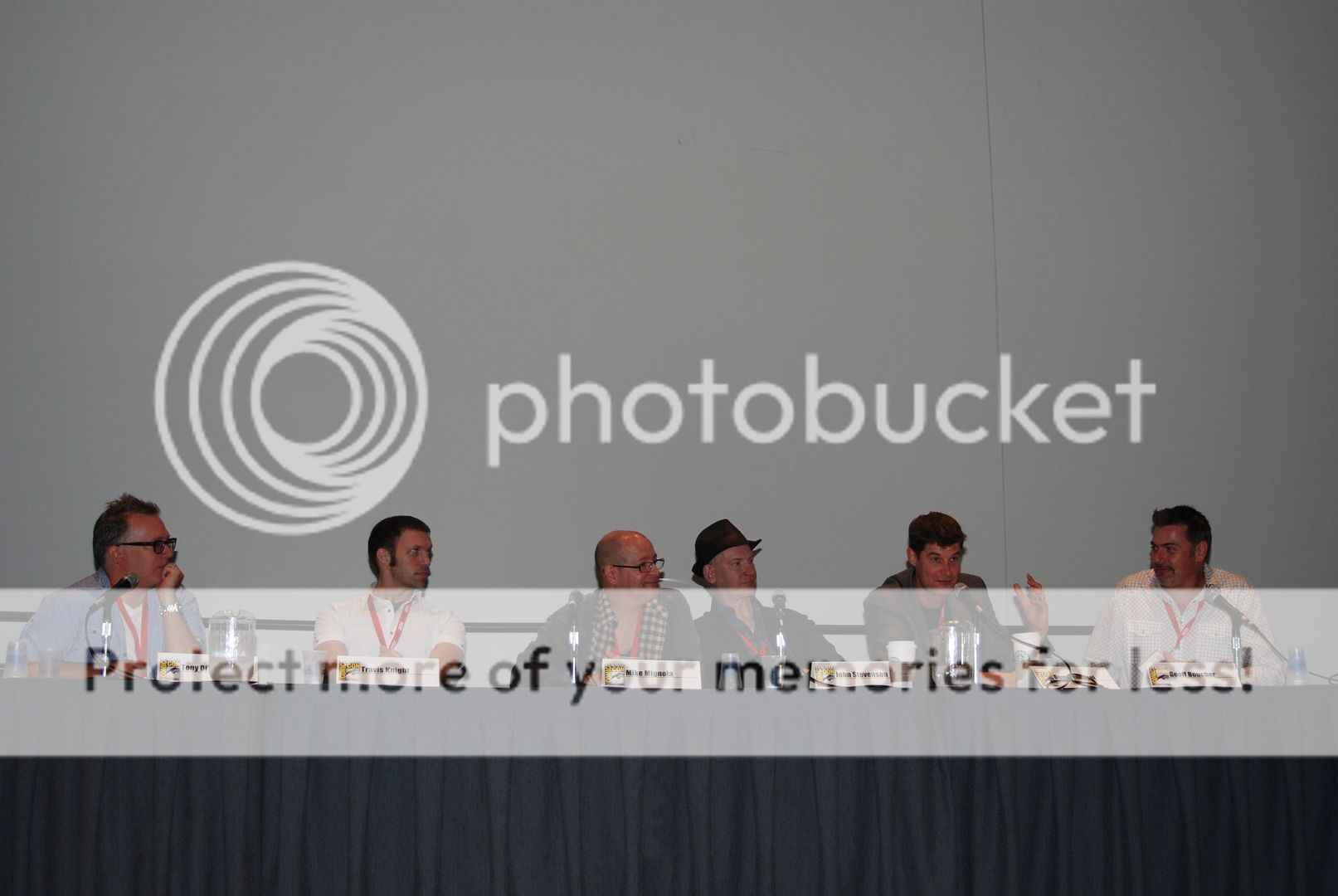
The Spark of Imagination panel: (from left to right) Tony DiTerlizzi, Travis Knight, Mike Mignola, John Stevenson, Doug TenNapel, and moderator Geoff Boucher
What better way to begin a four-day celebration of visual imagination than a panel of distinguished artists and designers discussing the “spark” that originates imagination, how to harness concepts and ideas, and how they feel imagination informs the creative process. The panel consisted of Tony DiTerlizzi (illustrator of The Spiderwick Chronicles), Travis Knight (lead animator of Disney’s Coraline), Hellboy creator/writer Mike Mignola, Kung Fu Panda director John Stevenson, Doug TenNapel (illustrator/writer of Earthworm Jim), and moderator Geoff Boucher of the LA Times blog The Hero Complex.
Let’s be honest, creative types are weird, weird people, me being one of them. Unequivocal unanimity was reached that this very oddness, which might alienate a person from the mainstay of society, was the very fuel that drove creativity and imagination. Tony DiTerlizzi recalled being a daydreaming doodler from elementary school onward, never listening to anything his teachers or figures of authority said to him, almost inhabiting his own world. (Sound familiar, creative readers?) Travis Knight concurred, adding that spontaneity, a side benefit of idiosyncrasy, is absolutely essential to the core of imagination. Artists never really grow up; they start out as hermits hiding in basements, grow into high school kids that get shoved into lockers, and end up playing with dolls as adults. But in a way, he added, it’s wonderful and liberating to live on the fringes of society, to see things in a way that adults have forgotten how to. Hellboy creator Mike Mignola expressed amazement and awe at people wiling to be brave enough to create things for the sake of creation, even if it will never see the light of day. “Let’s face it,” Knight sighed. “There’s something wrong with us.”
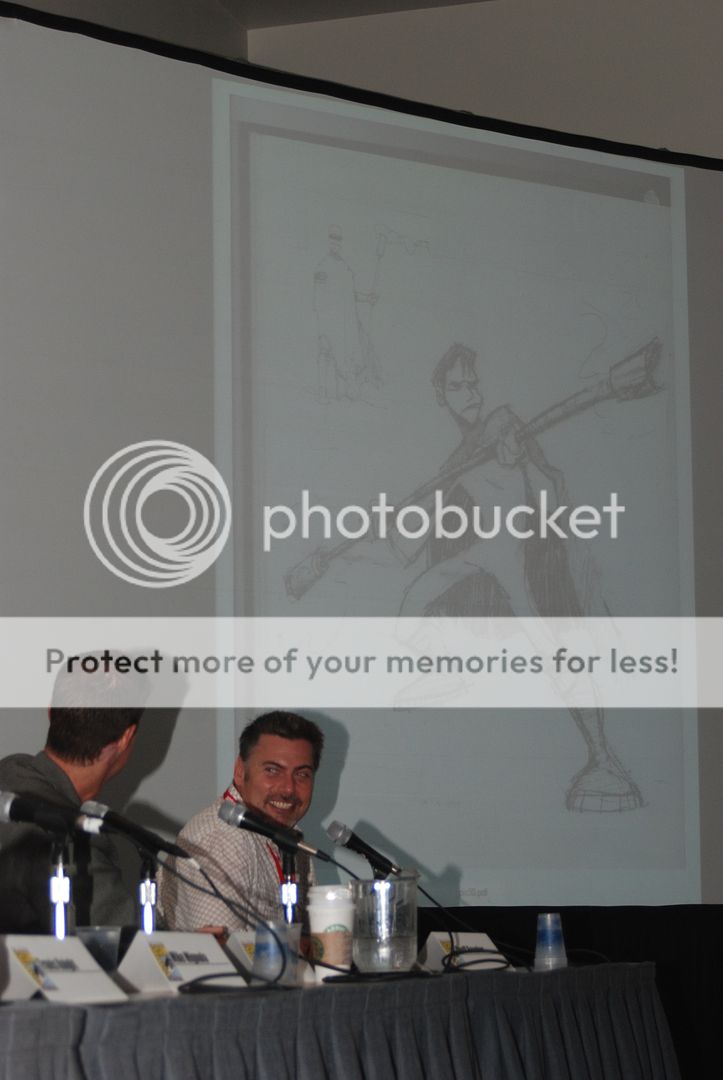
Doug TenNapel shows Geoff Boucher prototypes for illustrations.
Recognizing and managing productive imagination when it happens were also a popular consensus among the group. It’s really easy to come up with stuff, maintains Doug TenNapel; it’s not really a special gift or ability and we all have it to some degree. The hard part is the execution in all forms of art. There are millions of ideas that will cross through our minds that will never see the light of day not because they’re not good, but because they aren’t viable. To develop those skills of managing and presenting ideas and putting them to use so one can make a living off of them, an artist has to become an “imagination editor” that parses out the ones that matter. Thank goodness Mignola refined that skill, or Hellboy never would have seen the light of day. He’d been drawing for years at conventions and other comics gatherings, usually on-demand for fans. After endless renditions of popular figures such as Batman, the fans wanted something more original, and Mignola sketched an early, rough inception of what would become Hellboy. Later, when asked to contribute a monster to a convention comic book, he recycled the character, drawing “Hellboy” on his belt to fill a blank spot on the page. Only later, when Mignola wanted to do his own comics, would the stories and three-dimensional world grow around that original central character.
DiTerlizzi also utilizes a character as a focal point for his stories. In order to care about a world, he reminded the audience, you must first care about the character that will inhabit it. How to come up with these characters and worlds? Research, imagination, and life experience! In researching a new character for Coraline, a model, Travis Knight watched YouTube videos of runway models. His biggest regret as he walked the halls of Comic-Con was seeing so many sequels, rehashes and remakes of 1980s TV shows and recycled concepts, and such a paucity of new thinking and bold ideas. This, Knight maintained, is the driving force for the future group of designers and illustrators.
Ultimately, making movies, TV shows, and even designing is inherently a collaborative process, one that the artist must accept if they want to derive the pinnacle of their imagination. John Stevenson ended the panel by emphasizing the three key concepts of successfully harnessing imagination: collaboration and sharing (all too lacking in the modern, fearful world of design and illustration), inspiring the people you’re working with as a leader, and thanking people and showing appreciation for those that have contributed to the betterment of a project.
Be inspired. Create. Let your imaginations soar!
Iron Man and Rocket Men: Is Stark Industries an Appropriate Model for Private-Industry Space Exploration?

The Iron Man versus Rocket Man panel (from left to right): moderator Jeff Berkwits, Mark Street, John Hunter, Chris Radcliff, Dave Rankin and Molly McCormick.
Iron Man was easily one of our favorite sci-fi movies from the past couple of years… and really, what was not to love? Geeky gadgets, innovative applications, and a true purview into the scientific discovery process (more on this later). More than a few mainstream publications have noted the strong ties the movie has to innovation (a couple of good ones can be found here and here). But a bigger tie-in can be argued between Tony Stark himself and the government contractors that constitute the vast majority of the space infrastructure, most notably NASA. So when we saw a Comic-Con panel devoted to exploring this very topic, we jumped at the chance to catch some of the action. Leading New Space entrepreneurs Mark Street (XCOR Aerospace) and John Hunter (Quicklaunch) joined Chris Radcliff (SD Space) and Dave Rankin (The Mars Society—San Diego chapter), with moderator Jeff Berkwits (former Amazing Stories editor) gathered to discuss what is right and wrong with NASA, and how the presence of small businesses can only help quicken the ‘space race.’
First and foremost, let’s define New Space. When we talk about Stark Industries, for example, we are talking about the most extreme example of the tech-based industry, representing the Lockheed Martins and Boeings (and to some degree NASAs) of the world—funded by the government, developing missiles, rockets, and even top-secret projects. New Space, and the small, innovative companies that are leading the forefront of its revolution, represent realistic opportunities for outer space exploration. They are Tony Stark working in his basement, on the cheap, on experiments that no one is seemingly interested in. In this case, it’s the idea of making space exploration available to ordinary people, not just military or astronauts.
The first half of the seminar consisted of a very heated argument about why more companies have not been able to take the lead in space exploration and where, exactly, NASA has stagnated so much. Mark Street pointed out the dichotomy between the entrenched business models of industry versus small companies, some of whom are already launching innovative space solutions and making a profit off of them. The established market, on the other hand, has a steady source of defined income, and no real incentive to decrease costs associated with space travel, which will take lots of investment and trial and error. Boeing isn’t building the next rocket, per se, but they are building airplanes thanks to already established rules and comfort zones. Smaller companies are ultimately able to address these problems thanks to risk-taking, failure, learning lessons, and innovating. John Hunter likened NASA to a modern March of Dimes, a philanthropic organization that was relevant back in the 60s, when it helped cure polio, but has since usurped 90% of donations for cost overhead and only 10% for actual causes that it supports. NASA’s budget of $18 billion consists of 70% “legacy” projects and 30% new innovation. What they need, he claimed, is new thinking, new risk taking. During the space war with Russia, “some of the dumbest guys I knew were looking for jobs at NASA,” Hunter maintains. “Because they knew they could study vortexes coming off of golf balls for the next twenty years.” Ouch.
To Dave Rankin, this was somewhat unfair. He invoked the sign at the X-Prize launch of Spaceship 1: “Spaceship 1: 1, NASA: 0”. To be sure, the X-Prize accomplishment was a worthy one, but NASA has been launching human beings to space stations for years, and they are still the only ones with a proven track record in the United States. Part of the problem is that because NASA is subject to political whim, it has no clear-cut focus with its identity (does it launch rockets, do basic research, innovate new technology, etc?). That lack of risk-taking at NASA is where you wind up with stagnation; it’s so big, with so many stake holders, that the sheer size lends itself to bureaucracy. The panel also brought up NASA’s two shining stars: the Jet Propulsion Laboratory in Pasadena, CA, and the Hubble Space Telescope. While JPL provides some of the world’s best robotics, such as the Mars Rover, the photography coming from outer space is simply amazing. “You can’t put a dollar value on some of what NASA does. It’s who we are as human beings, but you can’t make a profit off of it. As humans, we have to keep looking into what are the places of the universe and how did we come to be here,” said Chris Radcliffe. Quipped Rankin: “Let it not be said that government does not fund the arts.”
Take a look at a video of the first commercial launch into space:
Is Tony Stark a model for our current space industry?
The inspiration for New Space exploration—for sticking Tony Stark into a basement—is that we need some more inspiration from space exploration than we are getting from traditional launches, and that will involve sending more people into space. Chris Radcliffe gave an example of a young engineer working at Hewlett-Packard in its early days who had the brilliant idea that computers could be more than technical devices; they could be personalized, streamlined, and made accessible to everyone. Hewlett-Packard didn’t agree, so he formed his own company and made that computer. The man? Steve Wozniak. The company? Apple. The computer? The Apple I. Like many of the companies comprising the New Space revolution, the design process in Iron Man is from top down, but the fun part is in the testing—you never quite get the process right the first time around.
Overall, the panel was very optimistic about the future of space travel and exploration, but emphasized the importance of spin-offs and small companies as a means to accomplish that. The biggest hurdles they will face is lowering prices of going to space, and overcoming the bad publicity of any first deaths that may come from the danger factor. Foreign competitors will have an even bigger role in driving our exploration. China will keep us on our toes, as they are very good at taking an idea, copying it and productionizing it. What will be the role of these companies in space exploration? Chris Radcliffe is pretty sure that space tourism will succeed, but that it will only comprise about 5% of the market. But it will be enough to drive producing vehicles and rockets and spacesuits and supplemental research off of things that will make money. The NASA CRuSR project, for example, takes existing suborbital platforms and doing science (in this case access to space for a reasonable cost) that they otherwise could not do on their own.
One of the more lighthearted moments, amidst a lot of PhD degree flaunting both from the panel and several people who asked questions, was a gentleman who prefaced his question by saying “I work in a coffee shop.” The reply from the panel: “You’re my hero!” While he respected space exploration as an ideal, he wondered whether the enormous cost of availing space to the average man might be better spent on pragmatic problems that can be solved right here and right now. Unanimously, the panel agreed that expanding human presence in space can only improve standards of living for everyone. If we wait until all our earthly problems are solved, they maintained, we’ll never do anything else.
Dave Rankin gave perhaps the best reason why New Space could be the future of exploration. “Space exploration is a forum for humanity: when we find a new space, we try to fill it.” We think Tony Stark would agree.
State of the Geek Report
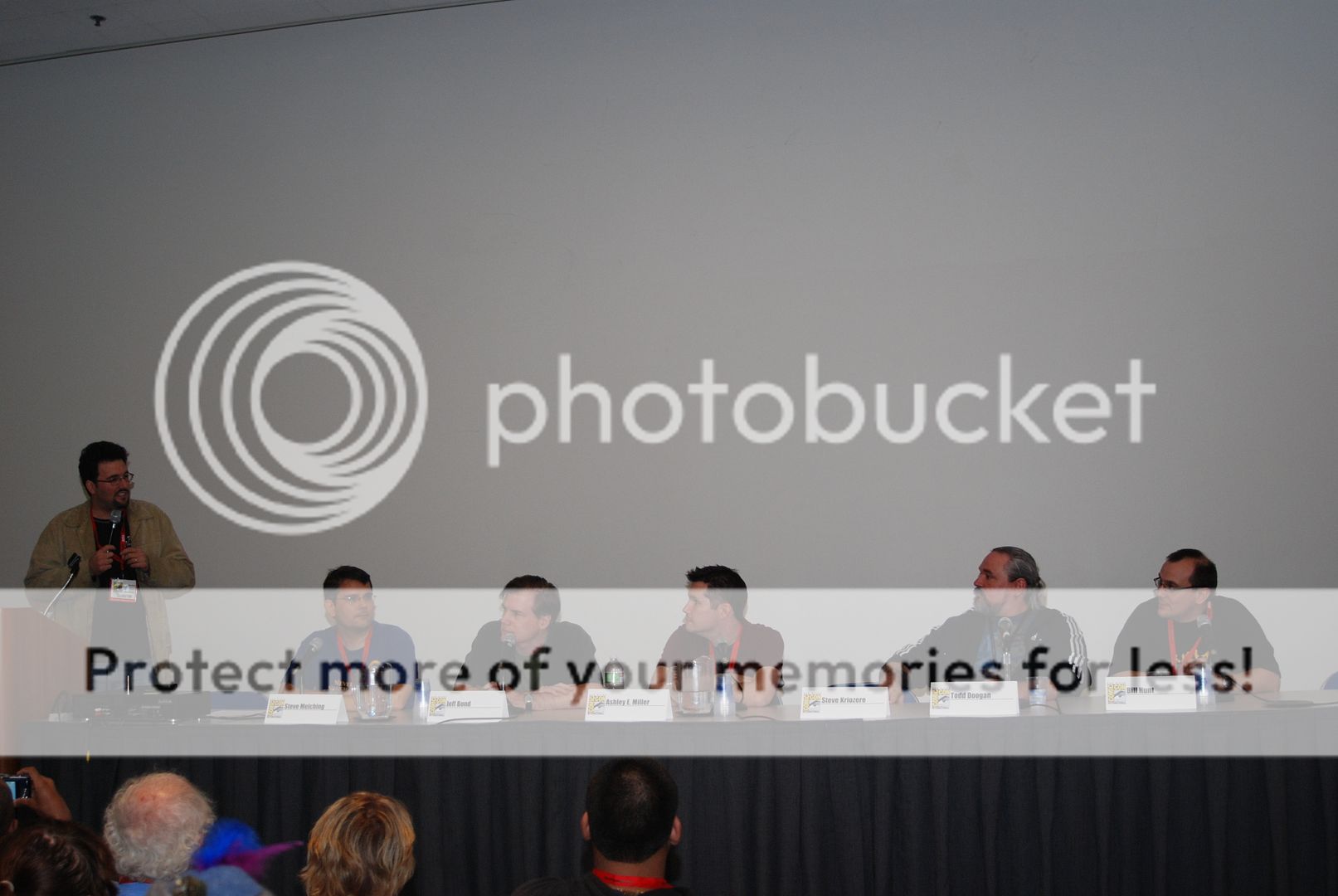
State of the Geek panel (from left to right): Moderator Jeff Bond, Steve Melching, Ashley E. Miller, Steve Kriozere, and Bill Hung and Todd Doogan.
From the more substantial programming of earlier in the day, we decided to devote the rest of Day 1 of Comic-Con to exploring our inner geek, with two panels looking at the best (and worst) of sci-fi in current entertainment. We started off with the “State of the Geek Report” panel, an exploration of the state of science fiction, fantasy, and horror in television and film today, and what the success of Avatar means for the future of movies. Steve Melching (The Clone Wars), Ashley E. Miller (Thor, X-Men: First Class), Steve Kriozere (Elvis Van Helsing), and Bill Hung and Todd Doogan of Digital Bits joined Geek Monthly editor and moderator Jeff Bond in discussing all things geeky in modern sci-fi.
Overall, the panel agreed that 2010 (largely carrying over from 2009) was one of the strongest years on record for sci-fi content. In some ways, we are at a peak of great sci-fi presence in pop culture and visual mediums, echoing 1982, considered by some to be the greatest year for sci-fi movies ever (Android, Blade Runner, ET, Forbidden World, The Wrath of Khan, Tron, etc). However, Bill Hunt maintained that Hollywood continues to try too hard to make every sci-fi film an “event,” and is getting excited for releases, but for all the wrong reasons. Not every film can be a blockbuster. In the past year, of the sci-fi films that got high marks from Jeff Bond, many were produced on extremely low budgets, including Moon, District 9, and the indie sci-fi film Yesterday Was a Lie. He also gave high marks to Star Trek and Avatar, which is where the panel took a big of a detour.
While Bond felt that the traditional, universal storytelling and high craft of Avatar made it a great success, Ashley Miller felt otherwise. Every dollar spent on the film was for aesthetics, and indeed, frame by frame, it is a beautiful film, including changing our expectations of what a 3D film should look like. However, as a complete work of art, it was shockingly lacking. To that, the panel brought up the point that what Cameron did with Avatar was harness 3D technology effectively, but the idea that every film now needs to be in 3D is ridiculous. Of recent releases, the brilliant Inception manages to be a challenging, engaging movie without the use of 3D technology.
Visionaries such as Christopher Nolan and James Cameron are given a lot of autonomy in their filmmaking—they are auteurists whose vision leads to the ultimate conclusion. Does sci-fi filmmaking lack for more Nolans and Camerons of the world? Autonomy, the panel decided, is earned. And not every director walking around is a Chris Nolan or James Cameron. Cameron made the original Terminator, which many feel is one of the greatest sci-fi movies of all time, on a shoestring budget. And Nolan used every penny of Inception’s mega-budget wisely. District 9 (which ScriptPhD.com loved) was shot in South Africa, with a native cast, on a very small budget. Moon, which we also liked, did all their special effects on model scale, with digital enhancements.
Ultimately, sci-fi is hurting most from studios turning everything into a “brand”: they are minimizing risk with constant remakes, but will ultimately have to swallow their tails and go towards original content at the risk of running out of material to remake. Sci-fi on television, which does not wallow in such an ignominious fate, is suffering from an embarrassment of riches. Highlights included Caprica, which invented an original, immersive futuristic world, and Stargate, which indulges in the essence of science fiction; to get the scope of wonder about other planets and life forms in the universe. (We will be joining cast and crew from both of these shows on Day 2 of Comic-Con!)
Abusing the Sci of Sci-Fi
The Abusing the Sci of Sci-Fi panel (from left to right): Moderator Phil Plait, Jaime Paglia, Kevin Grazier, Zack Stentz, and Sean Carroll.
From a discussion of the best of sci-fi, we went to what always ends up being one of our favorite Comic-Con panels, Discovery Magazine and Science and Entertainment Exchange’s “Science of Science Fiction.” Hosted by the hilarious, delightful and brilliant physicist Phil Plait (of the Bad Astronomoy blog), the panel was an equal mix of writers and scientists: Eureka creator/head writer Jaime Paglia, Battlestar Galactica and Eureka science advisor/physicist Kevin Grazier, Fringe writer Zack Stentz, and physicist/author Sean M. Carroll.
In perhaps one of the smartest ways we’ve seen yet at Comic-Con, the panel collectively provided examples of “good” and “bad” science on television and in film through clips. We’ll provide you with some of the highlights. Plait started the procession by admitting that he himself became interested in astronomy by watching Star Trek and Space:1999, and maintains that there is a lot of inspiring science in television and film, despite the bad. That said, his “worst” clip was from Armageddon, a scene Plait maintains is possibly the worst science film clip ever—Bruce Willis is supposedly on an asteroid and yet it’s raining! “Jerry Bruckheimer, you’re not in the audience are you?” He asked. “Armageddon. Worrrrrrrrrrst movie ever made!”
Paglia, bravely, picked scenes from Eureka as both his “good” and “bad” clips. The bad was a terrible attempt at an episode where nanoids have started to replicate biological organisms, while the good was an episode where Eureka made its own version of the Hadron supercollider. Quipped Stentz: “I have lived in Eureka in Northern California. Let me telll you…not filled with geniuses!”
Phil Plait REALLY dislikes the science in Armageddon.
Grazier, agreeing with Plait that Armageddon is the worst science film ever made, maintains that it has lessons of both good and bad science. In a scene showing the hypothetical impact of the impending asteroid (complete with overdramatic voiceover: “It has happened before, it will happen again!”), the shock wave of the impact is shown traveling around the Earth, which would not happen, while secondary impacts, which would happen, are omitted. The film was overly dramatic where it didn’t need to be, and yet missed out on an opportunity to show really scary science that was accurate. “It’s the only film that ever lost me in the first 30 seconds,” said Grazier. That said, the scenes showing post-asteroid tsunamis and other ramifications are so perfect, they could be a computer simulation for an asteroid impact on Earth.
Stentz, in a bit of writer’s defense, pointed out a bad scene from Fringe where the science was purposely abused in the service of an otherwise good episode. He wanted to illustrate that sometimes, you have to break the rules in order to tell the story you want to tell. Here, the writers wrote a story line where Walter’s hippocampus was “stolen” to remove his memory. To retrieve it, the team suggests implanting the memories (via the brain pieces) in the brain of someone who could interpret them. “I’m not a neurologist, but I know enough about memory to know that it doesn’t work that way. We knew that when we wrote it. We wanted the drama of a theft from someone’s brain, and how do you use them. That’s why you heard the line, ‘In theory, you shouldn’t be able to do that.’”
Carroll, ever the ambitious physicist, provided a theory, as opposed to just clips, against the philosophical backdrop of issues raised by the demands of narrative versus scientific accuracy. Take a look at the following Big Bang Theory clip of Sheldon explaining Superman and gravity:
This is the right way to think about science versus storytelling. A lot of writers are afraid of scientists because, frankly, we’re ANNOYING. We act as copy editors: “You can’t do this. You can’t do that.” But scientists are also good at telling you the consequences of existing laws, even if it ruins the romance of Superman. Science can make a story better by following this formula for conflict. On the opposite side of the spectrum, you have the mysterious “Red Matter” from this past year’s Star Trek remake. No one knew what the stuff was, how it worked, just that it was a ball, it was bad, and you had to use a hypodermic needle to handle it. It’s far more interesting if you know the rules, can explain the science, and integrate that smartly into the storyline.
A lot of times, people think science fiction means anything can happen at any time, and that’s actually science magic. The rules don’t have to be scientific rules, but good drama comes out of limitations (scientific or otherwise), characters not being able to do something and coming up with another solution for it. As a working writer in TV/film, you want people wanting clarity on one side, but on the other had, you don’t want people to feel stupid and you can’t bore them. You can introduce science and technology in a way that heightens the excitement rather than taking them back to science class. ER used a writing trick to make this happen: one line of exposition, another line of exposition (medical jargon), then an emotional line telling you what happens. Ellen Page of the recent move Inception served this purpose as the audience member—what questions would they ask of the characters in the movie. To this degree, Carroll awarded Iron Man the award for best “science” movie of recent times, not for any specific science content, but because building the suit shows the true scientific method, and that’s how it’s really done in the lab!
Our intrepid correspondent Bryy Miller also went to two very exciting panels that covered a bit more mainstream pop culture. Here is what he had to report:
Tripwire Magazine
The Tripwire Magazine panel (from left to right): Joel Meadows, Andy Grossberg, Jeff Carlisle, and Rich Johnston
I had a theater class in high school, and we used to say that it was the most “un-schooly” class ever. It existed within the confines of the high school, but did not feel as constricting or regulated. Sitting in with the guys from Tripwire Magazine, a joint UK-American geek culture print, evoked the same feeling. It understood that the Con existed, but the speakers (Editor-in-Chief Joel Meadows, U.S. Editor Andy Grossberg, and Staff Writer Jeff Carlisle, and guest speaker Rich Johnston [editor of Bleeding Cool News]) were so aloof and full of intelligent confidence that everything seemed to fade away. They made the audience feel like they were a part of Tripwire – Joel even mocked the obscurity of their little magazine being at Comic-Con by proclaiming “welcome to the Tron panel, everyone!”
Their little magazine, starting as nothing more than fan scribblings in 1992, slowly gained notoriety over the years until they halted for a bit in 2003 due to their current publisher financially screwing them over. They got back on the horse in 2007, and since then, have gone on to catch things in geek culture such as the coveted first set visit for the superhero film, Kick-Ass. This proved to come back to teach them a further lesson in industry magazine politics, as the article was released a full year before it was assumed that it would. Tripwire covers everything in geek culture except music and gaming, and now they have set their eyes on new media such as webcomics and webserials.
“Anyone can get in, but how do you get people’s attention?” Grossberg mused, before giving Felicia Day’s The Guild as an example. A highly successful webseries about gaming, The Guild has a frothing following that has attained such levels due to catering to an audience that already surfs the web daily, and that would most likely consist of gamers. But Grossberg has another theory, and it is much more pernicious in nature as well as much harder to digest. “You know what they expect [newspaper] editors to do?” Grossberg asks Meadows, talking about the changing roles of businessmen in the digital age. The Editor-in-Chief simply replies: “Everything”. Turning to us, Andy Grossgberg comes to the summary of the thought that he started with The Guild, and that is that old media is dying because nobody has an attention span. He then goes on to lay out all of the various people involved in the making of a print comic versus the one or ones involved in making a webcomic. Carlisle then speaks up with his input on if you want to make money as a comic creator in the age of new media, “do a webcomic … everything will be the same thing [as far as everything being digital].”
This all went over fairly well until they asked to see a show of hands concerning who knew what they were talking about. Apparently, I was the only hand that shot up. It seems that the digital divide is still there, which scared me, considering we just spent an hour talking about how fast the winds of change are blowing. The panel ended with a heated discussion over which comic adaptation is the most “meta” because after all, this is Comic-Con.
EW Visionaries: J.J. Abrams and Joss Whedon
EW Magazine's Jeff "Doc" Jensen chats with J.J. Abrams (left) and Joss Whedon (right).
Both J.J. Abrams (Alias, co-creator of Lost, What About Brian?, Cloverfield) and Joss Whedon (Buffy the Vampire Slayer, Firefly) are rock stars in the world of television genre writing. So it would go without saying that their combined might upon one singular panel would cause another big bang, or the birth of a unicorn, or at least get a boatload of fans churned up to Twilight-levels of excitement. That was the feeling in the enormous venue Hall H: that the world would halt for a brief hour while these two decided how to continue shaping it. Well, unfortunately, no unicorns were birthed. Fortunately, it was still a good time. Instead of the melding of ideas and thoughts, it was more of a dinner between two famous film people that enjoyed answering questions specifically asked of or about them. They would occasionally reference that the other dinner guest was eating at the sane table, but other than that, it could have been a Joss Whedon panel followed by a J.J. Abrams panel.
The moderator opened it up with a hum-dinger, asking Whedon if he was indeed officially announcing that he would be directing Marvel’s superhero team flick, The Avengers. At first, Whedon said that there was no official word yet, but then he followed that by saying the official word. This, needless to say, got a gigantic response from the unfathomably-huge, wide, and deep crowd. Abrams had nothing new, but gave a movie story none-the-less: when he was a small child, one of the crew members from The Exorcist mailed him an actual tongue from the movie. It was in no way related to what Whedon had just announced, nor was it a movie announcement, but it somehow felt like it was contributing to the larger narration of the panel. Abrams was then asked about his infamous draft of Superman Returns, in which Krypton does not explode and Lex Luthor is an alien. “It was not well received” Abrams sheepishly said, referencing the fan-storm that had swept the internet mere hours after it was put online. Abrams followed that up with talking about how he managed to team up with Steven Spielberg for Super 8, his mysterious monster move that, even though a teaser has been released, is not yet filming. “I was told that Steven Spielberg made movies when he was my age,” Abrams began “so they asked me and my friend to clean up some of his old movies…. They have in-house studios for that sort of thing, and they paid us $300, and I knew why they did not do that”. He added that the film would not be in 3D.
Whedon stated that he was fine with 3D, as long as it was done well. He was also fine with 3D as long as it was not in his upcoming horror movie, Cabin in the Woods – which it is. “I love it, it puts you in the space… [but] the movie has to work in 2D” he said. Abrams revealed that he was still on the fence regarding the issue, “everything gets dim… it seems less.”
Before a rather banal question and answer session filled with every Whedon and Abrams fanboy imaginable, Whedon took the time to talk about Dr. Horrible 2, the much talked about sequel to Dr. Horrible’s Sing Along Blog. When discussing the project, which would continue the story set forth in his webseries created during the Writer’s Strike (and has since become the second Whedon-written musical to become a staple of Comic-Con). “I missed my window,” Whedon said, on the topic of digital media “I was waiting for people to show up to the party.”
Even though the Q&A session was quite lame, and I do not like Abrams, something spectacular happened at the very end of the panel. A young lady asked if criticism is ever okay for writers, since her brother recently asked for some and then shut himself off from her when he received it. This clearly made Abrams livid, as he asked for the man’s phone number. His intentions were clear. That’s when I finally found something I liked about Abrams. I connected with him as a writer and as a human being. In the big picture, that’s what these panels are for. Not to showcase new projects or to grandstand, but to connect.
From the Press Room: DEXTER
ScriptPhD.com was extremely fortunate to join producers and stars of SHOWTIME hit Dexter on their way to their Comic-Con panel. Here’s some dirt that we picked up! (We promise to catch up with Michael C. Hall, who was literally rushed out before our very eyes, back in Los Angeles in a separate post devoted entirely to Dexter.)
Dexter star James Remar and producer Many Coto dish about Season 5.
The production staff at Dexter is getting a shake-up. This year, they’ve added several new producers, including Tony Goldwin (pictured), who visited Comic-Con along with the old guard to give us some insight into things we can expect from the show this season. Part of the strategy of the “new energy” is a shake-up of the show itself. The producers wanted to avoid the “one season, one adversary” formula and recalibrate the show’s content while delivering the same pleasing product to the audience. So expect a lot of differences this year with what Dexter deals with and whom he battles with (if at all).
Unlike a lot of other shows adopting the popular meme of “skipping time” for resolution, Dexter will pick up right where we left off to get all the blowback over Rita’s death. And what a lot of blowback there is! The newest change, producers tell us, is that Dexter is feeling a new emotion for the first time… guilt. It’s something he’s never felt before and quite new for him. Much of this is because he was so hopeful as the season ended that things might actually be heading towards a positive change, that he might get rid of the dark passenger, he was looking forward to a honeymoon with Rita, only to come home and find her dead and his son in a pool of blood. Dealing with that will be very difficult for him, but the producers couldn’t tease us with more. On top of all of this, people are starting to figure his tendencies out, which adds yet another layer of complexity.
ScriptPhD.com asked about the forensics of the show and how they’re keeping it fresh. Said Producer Sara Colleton: “Well, we have an expert who works with us, and they’re the tech person. You just keep up to date with what is used by police. What we don’t do is CSI-style, flashy, make-believe forensics. I don’t know how to go in your nose and down your throat and find a bullet and say “Here it is!” We really try to play by the rules in terms of how long a DNA test takes, what the limitations of top forensics are. We want those things to be real, because the conceit of the show is so unreal, that we want everything else to feel real.”
Dexter star Jennifer Carpenter dishes about Season 5.
Jennifer Carpenter (Deb Morgan) was very excited about Season 5′s changes, though she admitted that for the first time, she really didn’t know what was going to happen. In the beginning of the season, Deb hopes that she and Dexter have a certain kinship, because they’ve both experienced loss, but that isn’t quite what happens. She correctly noted something I’ve noticed a lot about Deb, which is that she does a lot of talking at Dexter, and not with Dexter, which leads to his typical one-word answers. Jennifer noted that a lot of times, women in particular are guilty of “filling in the blanks” with the stories we want to hear (guilty as charged!), which affects Deb’s relationship with Dexter. She felt a little pressure of Comic-Con, with such a concentration of die-hard fans that you have to please, but pointed out that this is also the great thing about Dexter; they hate you one week and love you the next. Jennifer also hinted at growing suspicion on Deb’s part about Dexter, who experiences his grief a lot differently than her, but that the sister part of her refuses to piece it together. We asked Jennifer about the growing stripping away of Deb’s vulnerability, and how much more of that we’ll see in the upcoming season, and frankly, what she thought of it as character growth. Here’s what she had to say:
“I have to say that last year, Keith Carradine (Lundy), his line “You’re confused, and now you’re not. We’ll figure it out together.” was the first time on the show that I’ve heard someone say (to Deb) I’m going to help you. And then immediately he’s dead. That one line helped me play [the character] for seven episodes. I think about it now and I could cry my eyes out. This year, I feel like it’s about standing up straight, choosing your words, how you enter a room, she’s not editing herself, but she’s calculating. She’s working like a cop. And a little less of a potty mouth.” But not too much, she promised us!
Finally, we are thrilled to publish an interview that we have teased you about long enough. As we await the yearly MythBusters panel, always a hit here in San Diego, we had the opportunity to get some pre-Comic-Con scoop from one of our favorite MythBusters about her new hosting adventure on the Science Channel. Check it out:
Interview with MythBusters’s Kari Byron
ScriptPhD.com: Head Rush will primarily be aimed at kid-enthusiastic presentations of science. How did your interest in hosting and putting this show come together?
Kari Byron: This has been a passion project that Debbie Myers [general manager of The Science Channel], The Science Channel and I have been talking about for a while. There is a disconnect at about the age of 12 where girls stop being interested in science. And we just wanted to figure out a way to get them, and obviously all kids around that age, interested in science in a way that they could be passionate about it as well. We figured if we could create a show that was cool, not talking down to them, we could keep that interest alive.
SPhD: You have a very non-traditional science background as a sculptor and painter. How important is it to you to convey that a layperson can have a healthy curiosity and passion about science?
KB: Well I obviously came to science a little later in life, and I think that’s why I have the same excitement that you’d have when you were a kid for it. I think having no science background makes it more accessible in the way that you don’t have to be a scientist to enjoy the science.
SPhD: This programs is affiliated with President Obama’s STEM initiative. You and I chatted a bit about girl power at the Discovery Channel 25th Anniversary party. What kind of responses do you get from girls that are fans of your work on MythBusters?
KB: It’s really cool! I talk to a lot of moms and teachers as well, and I get excited [that they use], I hate to use the word role model because I feel like I don’t deserve it, but it’s nice that they have a really positive response. They like seeing someone that’s more like them.
SPhD: What small sneak peek can you give us to tease fans during Comic-Con to get them super excited about watching the show?
KB: I’m actually so interested in the material that we’re doing, that I’m just amazed at the stories. We do a bunch of experiments that give a hands-on approach to science. [Head Rush] is so different from MythBusters that I can’t even compare it. We will be using clips from all the Discovery brand shows, and a lot of MythBusters, of course, but the Head Rush segment of it is its own beast. I don’t know who or what I can reveal!
There you have it folks! Kari is so excited about her new show, she is hard pressed to reveal any secrets to spoil it. We thank her and Discovery Channel for granting ScriptPhD.com a sneak preview. Head Rush will air on The Science Channel beginning August 23, Monday-Friday 4-5 ET/PT, and Saturdays, 7-9 AM ET/PT.
Comic-Con 2010 Costume of the Day: ….and the unanimous winner is…. Calendar Man! We gave points for creativity.

Calendar Man from the front.....

....and from the back!
For a complete album of pictures from Comic-Con (and many of the costumes that didn’t quite make the running for Costume of the Day, take a look at our our Facebook fan page (and become a fan!).
~*ScriptPhD*~
*****************
ScriptPhD.com covers science and technology in entertainment, media and advertising. Hire our consulting company for creative content development.
Follow us on Twitter and our Facebook fan page. Subscribe to free email notifications of new posts on our home page.
Inception poster ©2010 Warner Brothers, all rights reserved.
“What is the most contagious parasite?” asks Leonardo DiCaprio’s character Mr. Cobb in the early moments of Inception. “An idea.” From the tiniest seed, it spreads like a virus, he explains. This is what makes it vulnerable to manipulation and theft. In many ways, the same could be said for Inception itself. Bending time, delving layers of dreams within dreams, shifting between reality and fantasy, the movie is instantly contagious. By the final shocking scene, when four concomitant worlds finally weave together in a breathlessly taut salvo, one is left downright feverish. It also happens to be one of the smartest, best-written, enigmatic additions to the typically content-light action genre. ScriptPhD.com’s full review of Christopher Nolan’s chef d’œvre under the “continue reading” cut.
REVIEW: Inception
ScriptPhD.com Grade: A
Leonardo DiCaprio and Joseph Gordon-Levitt protecting themselves from subconscious intruders in one of the dream layers (the hotel) of Inception.
If Inception aims to be a mind-perplexing, labyrinthine race through the recesses of the dream-wake state, it boldly states so in its opening minutes. DiCaprio’s Cobb is deeply ensconced in a mission. Whatever shady company employs him has made information in Japanese business man Saito’s (Ken Watanabe) safe his ultimate mission. From trains, to Asian apartments, to Saito’s office, we criss-cross with Cobb and his team of co-dreamers (engineers) as they hone in on the target. A mysterious brunette (Marion Cotillard) named Mol stops Cobb in his tracks. She is his deceased wife, who shows up in the next dream layer to betray him on the cusp of completing the job. The plot is foiled, but not enough to leave Saito unimpressed with Cobb’s talents. Seito commissions him for one last ambitious project, to invade the dreams of magnate heir Robert Fisher and convince him to dissolve the company. Rather than extracting an idea, Cobb will practice ‘inception,’ his most difficult task to date. Both men have important incentives. Seito’s corporation will lose a major competitor in the energy sector. And Cobb will receive immunity to return home to his children, where he has been a wanted fugitive for the murder of his wife.
The idea of dream manipulation is, of course, neither new nor scientifically far-fetched. It is no big secret that the film is based on Christopher Nolan’s own experiences with lucid dreaming, a dream in which the sleeper is aware that he/she is dreaming. Lucid dreaming expert Robert Waggoner, recently interviewed about the lucid dreaming telepathy that Inception is based on, insists that it is a very real phenomenon. Waggoner recounts the experiments of three physicians conducting research in a sleep lab in Brooklyn and “found considerable evidence of this inexplicable, yet fascinating, phenomenon.” Furthermore, the idea of planting seeds through dreaming—known as dream incubation—has a couple of successful studies attached to it. The only difference is that dream incubation involves planting an idea in order for a specific dream to happen, whereas in Inception, the dream agents invade dreams. Nevertheless, while scientists can now easily image the sleeping brain through fMRI technology, including mind-reading software that could record dreams, technology to the degree found in the film is, while not a theoretical impossibility, still a longshot. Thankfully.
But back to fantasy. Cobb will use multiple layers of infiltration, dreams within dreams, each of which expands time to a greater degree, to implant his idea during the course of a ten-hour flight from Sydney. He anchors his team around a brilliant architect (Ellen Page), who will design the world of the dreams, borrowed from his psychologist father-in-law (Michael Cain). A chemist provides a secret formula for strategically sedating all the lucid dreamers. The rest of the team (including a scene-stealing Tom Hardy) acts as… security, of sorts. Once the plane lands, Cobb is a free man. The plan is simple. Until it gets complicated. The presence of opposing security forces in Fisher’s subconscious indicate that he’s already been trained against mind manipulation. They immediately endanger the entire team and force improvisation through the rest of the operation. The knockout kink in the armor is the tragic secret driving the film’s shocking conclusion. It is both how Cobb knows that the idea of inception works, and the last stand that he must fight—within layers of dream, no less!—to save his team and go home. The last one hour of the movie, the payoff for the complex setup, is so poignantly beautiful and sequentially well thought-out, that we will not even speak of it lest we ruin a single detail for our readers.

Gorgeous design and art direction is found throughout "Inception," such as this imagined 3D version of Paris.
While Inception is sure to have its detractors—too complicated! too esoteric! too many layers—the simple fact is that in this masterpiece, Christopher Nolan has bestowed moviegoers with one of the most complete cinematic pieces of recent memory. His script is tight, layered, cathartic and cheeky at just the right tense moments, and evinces a similar sympathetic frustration from the audience as his other mind-bending memory chess game, Memento. To say nothing of the pitch-perfect action sequences, Nolan’s directorial and camera choices (ideal for viewing in the IMAX experience) make the twisty, jumbled, misshapen dream layers jump off the screen and invite you into them. And finally, credit must be given to Inception‘s strongest silent character: the brilliant design and art direction. Perpetual staircases. Entire blocks of Paris folded onto one another like sheets. Dream layers that jump from Southeast Asia to New York to the ice tundras of the Arctic’s moutaintops. Imagined universes full of skyscrapers, bridges, and Pritzker-worthy architecture. If the trick to a successful inception is to create a world realistic enough to fool the dreamer into acquiescing their subconscious thoughts, with his technicolor palette and rich imagination, Nolan simultaneously pulls the rest of us in, as well.
Sweet dreams, everyone.
Inception goes into wide release at theaters nationwide Friday, July 16th, 2010.
Official Inception trailer:
~*ScriptPhD*~
*****************
ScriptPhD.com covers science and technology in entertainment, media and advertising. Hire our consulting company for creative content development.
Follow us on Twitter and our Facebook fan page. Subscribe to free email notifications of new posts on our home page.

Wind turbines collecting energy that will eventually be converted into electricity and other fuel sources. This technology is widely discussed in the new Discovery Channel special "Powering The Future." Image courtesy of Discovery Channel.
Nothing has done more to reinvigorate discussions about energy and fuel dependence than the tragic oil spill currently afflicting the Gulf Coast [excellent resource for trajectory, timeline and news sources]. Though scientists and oil manufacturers continue to debate the validity of the “Peak Oil” theory, a very uncomfortable reality looms that oil production may not be able to keep up with thirsty demand. With an ever-increasing global population, a constant proliferation of technology choices and lifestyle improvements, and a rising middle class in third world countries, the factors contributing to fuel consumption may be the precipice of an eventual geopolitical crisis. In an effort to showcase their dedication to addressing the most salient energy and environmental questions affecting our generation, the Discovery Channel, backed by founder John Hendricks, is launching a revolutionary four-part documentary called Powering The Future. In it, they address a range of economics, national security, social and scientific questions related to energy and fuel all through the single focal point of searching for a modern, clean, limitless supply of energy. Our coverage of Powering the Future includes a review of the first installment and an exclusive podcast interview with the show’s host, lead scientist for the Nature Conservancy, Dr. M. Sanjayan. For full content, please click “continue reading.”

Dr. M. Sanjayan, host of Powering The Future, and lead scientist at The Nature Conservancy.
“We are the energy generation, but we as Americans do not fundamentally understand what energy is, where it comes from, how we use it, and how much we need,” remarks Dr. M. Sanjayan, host of the new Discovery Channel four-part documentary Powering The Future. Indeed, any honest retrospective of the modern energy crisis first requires a primer reviewing how our dependence on major fuel sources (coal, oil, and natural gas) came about and the unique challenges that breaking it poses. I consider myself a fairly well-informed individual, particularly on scientific matters, but in watching the first installment, The Energy Revolution, even I was amazed at the sheer interconnectedness of major electrical grids, and how much links us globally in energy delivery vessels. A German electrical engineer in the documentary compares running a major grid to being an air traffic controller.
Much of the current hope for alternative energy sources rests in grandiose ‘silver bullet’ solutions. Scientists at the National Ignition Facility are using the world’s biggest and highest powered lasers as a power source for smashing together the hydrogen atoms in a droplet of water, resulting in nuclear fusion. This mimics the way that the sun makes energy, and, if successful, would harness a limitless supply of power. Nuclear fusion research has been ongoing since the 1940s, but has never been applied successfully on a large enough scale like the undergoing experiments at the Ignition Facility. [ScriptPhD.com was recently granted an exclusive tour of the Ignition Facility, which will be covered soon in a separate post.] Another growing ‘silver bullet’ sector has been the harnessing of two natural energy sources—the sun and wind. Wind energy is the largest (and fastest-growing) alternative source of energy. Denmark gets about 20% of its power from wind sources, while the United States gets approximately 1.2%. Photovoltaic, or solar panels, more mobile and aesthetically pleasing than wind turbines, are another popular source of alternative energy. Little money has been poured into researching photovoltaic grids as a large-scale source of energy, it holds promise. The 89 petawatts of sun that shines on the Earth each year is more than 6,000 times the 15 terawatts of electrical power consumed by human. Unfortunately, both of these energy sources face one insurmountable hurdle; their mercurial natures. Our modern lifestyles require a constant influx of power, but if the sun stops shining, or the wind stops blowing, solar and wind technologies are unreliable.
Scientists make adjustments to the enormous lasers at the National Ignition Facility in Livermore, CA.
The reality is that moving energy consumption into the 21st Century will not happen with one grand discovery, but a microcosm of intermediary ones. Powering The Future provides some exciting insight into the body of research and creativity being applied to alternative energy sources. Many communities are powering themselves through clever solutions, such as Japan generating solar energy in outer space and then beaming it to Earth, or New York City harnessing wind energy from tidal waves in the East River. No role is rendered more important in this documentary than that of private organizations and academia in leading innovation and discovery. Bay Area-based Makani Power specializes in capturing and storing high-altitude wind for abundant power and energy. Caltech University solar electrochemist Dr. Nate Lewis has invented a thin coating of paint containing chemicals that catalyze the sun’s energy for power. Paint your roof, get free solar energy! In fact, just today, General Electric announced a $200 million smart grid contest for cleaner and more efficient electrical grids. The California-based X-Prize Foundation has even gotten in on the act, recently announcing a $10 million oil spill cleanup challenge.
Even those that consider themselves knowledgeable about environmental issues and research and technology of clean energy will have a lot to learn from Powering The Future. The special does an exceptional job of laying out the complex science behind concepts such as fusion and large-scale electrical grids for a lay audience to understand, while not glossing over current research in industry and academia. Moreover, rather than approaching the issue with the typical heavy-laden, moribund fatalism one often finds in these specials, Powering The Future leaves one feeling hopeful about the range of innovation happening at all levels worldwide, and the remarkable commitment of both academic labs and private companies for tireless discovery. It is this very entrepreneurial, resilient, and utterly human, attitude that will power our future more than any fossil fuel ever could.
Powering The Future premieres on the Discovery Channel on Saturday, July 17, 2010 at 8 PM ET/PT.
Finally, we encourage you to listen to our exclusive one-on-one podcast interview with Dr. M. Sanjayan (18:00), lead scientist of the Nature Conservancy, as we expand the energy discussion of the mini-series to global solutions, his thoughts on the oil spill crisis, and ways that we can impact our dependence on fuels right now.
~*ScriptPhD*~
*****************
ScriptPhD.com covers science and technology in entertainment, media and advertising. Hire our consulting company for creative content development.
Follow us on Twitter and our Facebook fan page. Subscribe to free email notifications of new posts on our home page.

The building blocks of life. Photograph courtesy of Dr. Ron Zuckermann
…a nanoscientist’s quest to mimic Nature’s molecular blueprints
Have you ever found yourself entranced by the exquisite beauty and complexity of living things? Like the intricacies of a budding flower, or the mesmerizing patterns on a butterfly’s wing? Have you ever wondered: “what are living things made of?” Are these materials just as beautiful if we were to zoom way way in and look at the actual molecular building blocks that make up life? Take a look at the interactive link The Scale of Things to see just how small the building blocks of life really are! Well the answer is “OMG – totally!” All living things share a ubiquitous set of molecular building materials we call proteins, and they are absolutely stunning! They are not only smashingly beautiful to look at, they are capable of performing a mind-numbing myriad of very intricate and complex functions that are essential to life. In a very special guest post, leading nanoscience Professor Ron Zuckermann of the renowned Lawrence Berkeley National Laboratory recounts his life’s mission as a chemist to try and build artificial microscale sheets made up of nature’s very own building blocks—proteins. Everything you wanted to know about what nanotechnology is, exactly, why engineering proteins is the science of the future, and what we plan to use these discoveries for, under the “continue reading” cut.
I am a Materials Scientist working in a nanoscience research institute called The Molecular Foundry. A fundamental problem in nanoscience is how to make man-made materials with a similar level of precision and complexity at the molecular level found in nature. I am interested in applying lessons from the world of protein structure to practical man-made materials. If we are successful, we should be able to make materials that are cheap and rugged like a piece of plastic, yet be able to perform highly sophisticated functions, like recognizing a molecular partner with high specificity, or even catalyzing chemical transformations. Such materials could be used to make sensors for the detection of harmful chemicals, or as robust medical diagnostics that could survive harsh conditions, say in an underdeveloped nation. In a nutshell, we aim to make artificial proteins. This is an incredibly difficult problem, and one I have been working on for more than 20 years now. Sound a bit ambitious, or maybe a bit crazy? As I will describe in this article, it may actually be quite possible if we break the problem down into bite size chunks. The challenge comes down to two fundamental things: design and synthesis.

The beauty of proteins on a nano scale: 3-Dimensional structures of two famous proteins showing the intricate fold of the polymer chain. Green fluorescent protein (left) is mostly comprised of flat ribbons called beta-sheets, and myoglobin (right) consists primarily of repetitive loops called alpha-helices.
Protein architecture
When I look at the molecular structure of a protein molecule, I see an architectural blueprint that has survived untold generations of evolution and optimization. How then do we break open the hidden rules in these structures and use them to guide us in the design of man-made materials? Over the past several decades, scientists have used the biophysics techniques of X-ray crystallography and nuclear magnetic resonance spectroscopy (NMR) to determine the exact three-dimensional (3D) structure of thousands upon thousands of proteins. What’s cool is that these are all available for anyone to look at (for free!) and study in the Protein Data Bank.
The most fundamental thing to notice is that nearly all protein structures share the following characteristics: (1) they are made of a linear polymer chain that is folded into a precise 3D structure and (2) they are comprised of only 20 simple molecular building blocks called amino acids, arranged in an exact sequence along the polymer chain. When we think of a ‘polymer’ we think of a long chain of repeating chemical building blocks (called monomers) found in materials like nylon or polyethylene. Such man-made materials are incredibly useful and ubiquitous now in our environment (plastic bags or saran wrap, for example). But nature beat us to the punch a long, long time ago. Biopolymers, like proteins and nucleic acids are fundamentally way more sophisticated than man-made polymers. Even though they share the same basic architecture – a linear chain of chemical building blocks – biopolymers contain information encoded in their monomer sequence. This is not unlike the way we store information in a computer. But instead of a long string of 1’s and 0’s, nature uses long polymer chains of either 4 nucleotides (the building block units of RNA and DNA), or 20 amino acids (the building block units of proteins). These 20 chemically distinct amino acid building blocks are arranged in a particular order along the chain that we refer to as the protein’s “sequence.” This sequence is powerful because in many cases it provides all the information or “molecular instructions” necessary for the polymer chain to fold up into a precisely defined 3-dimensional structure. Once folded, the protein is poised and ready for action. The fields of Structural Biology and Protein Folding have revealed the exact way that proteins fold to form local “secondary” structures, called alpha helices and beta sheets, and how these assemble together to create the fully folded protein structure. Think all this sounds a bit too complicate? Try visiting FoldIt, a really fun video game where you can actually learn all about protein folding!
Protein Mimicry
If we ever hope to create man-made protein-like materials, it is safe to assume that we will need a polymer system that shares some of the basic protein-like characteristics: for example, they will need to have a sizable set of chemically diverse monomer building blocks that can be arranged in a particular order along a linear polymer chain of at least 50 monomers long. This is a quite a tall order simply from a chemical synthesis perspective. Moreover, once we are over that hurdle, design tools will be needed to help us figure out which sequences to make.
In the early 1990s, I invented a way to synthesize a new family of non-natural polymers we called “peptoids.” I had just graduated from UC Berkeley with a PhD in organic chemistry and joined a start-up biotechnology company to develop new technologies to accelerate drug discovery. We developed peptoids to be potential therapeutic drugs. The cool thing about peptoids is that the building blocks are very very close in structure to Nature’s amino acids, but different enough to be much more rugged. They can be made from very cheap and simple chemical building blocks, and they can be made in any predetermined sequence you want. We soon developed robotic synthesizers to automatically synthesize these materials for us (see below).

Robots march into the chemistry lab. Robots are used to automatically synthesize protein-like polymers.
Before long we discovered that short peptoid chains (just 3 monomers long) could have potent biological activities and showed promise as drug candidates. But what really floored me was that the peptoid synthesis chemistry we developed worked so efficiently that we could link over 50 monomers together, one after the other. This means each building block was being attached to a growing chain with an incredible accuracy of over 99.5%! This was exactly the tool we needed to begin the quest for creating artificial proteins. We had discovered the most efficient and practical way to make non-natural polymers of a specific sequence. This was completely awesome!
There was only one problem – the company I worked for had no interest in such a bold quest into basic science. How could such a pursuit lead to a moneymaking product in a few months? In 2006 I moved to Lawrence Berkeley National Laboratory where I set out in earnest to search for artificial proteins. Fortunately, tackling difficult problems in basic science is much more the norm here. And more good news – my previous employer was kind enough to donate my robots to me. Armed with this technology to synthesize peptoid polymers, we turned to the next daunting task: which sequence of monomers should we make? It turns out that there are an absolutely astronomical number of possible peptoid sequences that can be made. Consider that there are several hundred building blocks to choose from at each of the 50 positions of a polymer chain. This means there are over 100 to the 50th power potential sequences to choose from. This is more than the number of atoms in the universe! What was a chemist to do?
Like Oil and Water
To help us focus our sequence design, we once again turned to nature. A long-time collaborator and friend of mine, Professor Ken Dill of UC San Francisco has studied protein structure in detail for decades, and has distilled some fundamental rules that are universal to all protein structures. He notes that protein structures are like globes with a water-loving surface and a water-hating (or oil-like) interior. The bottom line is you can basically lump each amino acid in the protein’s sequence into one of two categories: oil-like or water-like. This simple classification can tell you whether an amino acid is located on the inside or the outside of the protein.
The amazing thing about this insight is that it’s like looking at a protein wearing X-ray glasses! Instead of seeing 20 different “colors” of amino acids, we see only two: black and white. We are back to a simple binary code—like 1’s and 0’s. This makes it much easier to see the secret patterns hidden within the sequence. In fact, many researches have convincingly demonstrated that these binary patterns are simple, plentiful and predictable.
So with our handy X-ray glasses on we returned our gaze to the peptoid structure problem. We realized that all our sequence recipe needed was a touch of Dill! This meant we could greatly simplify our search for the right peptoid sequence. We needed to only consider two, diametrically opposed building blocks: water loving and water hating.
Nanosheets
Inspired by these insights, we set out to find the right sequence patterns that would result in a precisely ordered structure in a non-natural peptoid polymer. We began to systematically unlock the sequence code by using our robots to synthesize all the possible repeating patterns of these two disparate building blocks. We reasoned that if we were to make something precisely ordered, it would “crystallize” into something that we could see. Fortunately we have really powerful electron microscopes in my building. So we started cranking through all the possible sequence patterns, dissolving up each new sequence in some water and taking it down to the basement to look at them really close up.
Now it is a little nuts to think that we could make something precisely structured from a peptoid polymer, since it is known that each strand is about as stiff as a piece of overcooked spaghetti. And as one might expect, most of our sequences looked really messy and gooey. But very soon we saw something quite striking. In one particular sample, we saw large, flat paper-like objects with sharp, straight edges. And they were floating around everywhere in the solution. An unexpected sight to be sure!

Ultra-thin nanosheets with protein-like structures form spontaneously in water. The peptoid nanosheets sheets: (A) are floating around in solution as observed by optical microscopy, (B) have very sharp edges as observed by scanning electron microscopy, (C) are only two molecules thick, and (D) individual polymer chains can be directly observed by abberration-corrected transmission electron microscopy.
Fast-forward another year of making careful measurements and reproducing the results over and over. We determined that these sheets were only two molecules thick, and yet millions and millions of molecules wide. We had discovered the largest and thinnest organic crystals ever! We were able to use one of the most powerful electron microscopes in the world in the National Center of Electron Microscopy, to look directly at the individual polymer chains that make up the crystal. We could see these chains wiggle around and slide against one another as if they were alive. No one had ever seen such detail before – a truly awe-inspiring sight!
We were able to use many kinds of advanced analytical tools to tell us that these nanosheets were indeed very special. They have the same kind of ordered structure that a protein has: they have a defined inside and outside, and we know almost exactly where each atom is located in the structure. Essentially, we discovered the sequence code that programs the polymer chain to form a 2D sheet. No doubt there are more complex codes waiting to be discovered that will form even more sophisticated structures. This discovery was recently reported in the journal Nature Materials, and was picked up by the more mainstream publications WIRED.com and Chemical & Engineering News. These sheets are likely to be important for all kinds of potential applications. Their discovery is kind of like the invention of ‘molecular plywood’: a new kind of nanoscale building material from which we can engineer even more complex molecular architectures. It’s amazing what kind of beauty you can create from simple building blocks!
Basic research like this can move seemingly very slowly, which makes the occasional breakthrough like this all the more meaningful and exciting. It reaffirms for me that it is so important to listen to and cultivate your inner curiosity, surround yourself with like-minded people, and aim high. With enough patience and persistence, wonderful things await discovery!
Take a look at a brief video of Dr. Zuckermann explaining his lab’s nanosheet discovery:
Ron Zuckermann is the Facility Director of the Biological Nanostructures Facility at Lawrence Berkeley Laboratory. Dr. Zuckerman also provides numerous consulting services at the intersection of chemistry, biology and engineering.
*****************
ScriptPhD.com covers science and technology in entertainment, media and advertising. Hire our consulting company for creative content development.
Follow us on Twitter and our Facebook fan page. Subscribe to free email notifications of new posts on our home page.

The 2010 World Science Festival Runs in New York City from June 2-6.
We have truly saved the best for last! ScriptPhD.com’s coverage of the 2010 World Science Festival in New York City concludes with panels ranging from the secrets hidden in our underwater oceanic wonderland (especially apt as we clean the worst oil spill in history), a panel on the hidden dimensions of our visual world, and a behavioral panel that sheds light into how animals and humans process thought. In addition, we provide a short video of star-gazing New Yorkers who came out to see the James Webb telescope last week. Our correspondents were the amazing New York City science writers Jessica Stuart and Emily Elert. Synopses and pictures of three extraordinary panels with the premier scientists of our time under the “continue reading” cut.
ILLUMINATING THE ABYSS: The Unknown Oceans — June 5, 2010
Under our oceans lie mountains many times higher than the Alps, valleys far wider than the Grand Canyon, countless volcanoes, and the largest waterfall in the world. There are thousands of species down there – the current known number is estimated to be around 230,000, but it could be as many as three times that, according to the Census of Marine Life. The oceans drive our climate and weather, and generate nearly 70% of the oxygen in our air. The one thing that life cannot exist without is water, and yet, we treat our oceans “like an infinite resource and a garbage can.”
A packed house gathered Saturday afternoon at the Paley Center for Media, for the panel Illuminating the Abyss: The Unknown Ocean. Jacques Cousteau’s grandson, Fabien Cousteau, a passionate ocean explorer in his own right, along with scientists Sylvia Earle, David G. Gallo, and David E. Guggenheim were the panelists, with moderator Bill Weir. Though the topics were diverse, ranging from the oil spill to personal submarine devices to unsustainable fisheries, all reverted back to the fact that we have so much left to learn about our oceans, and are destroying them more and more each day.
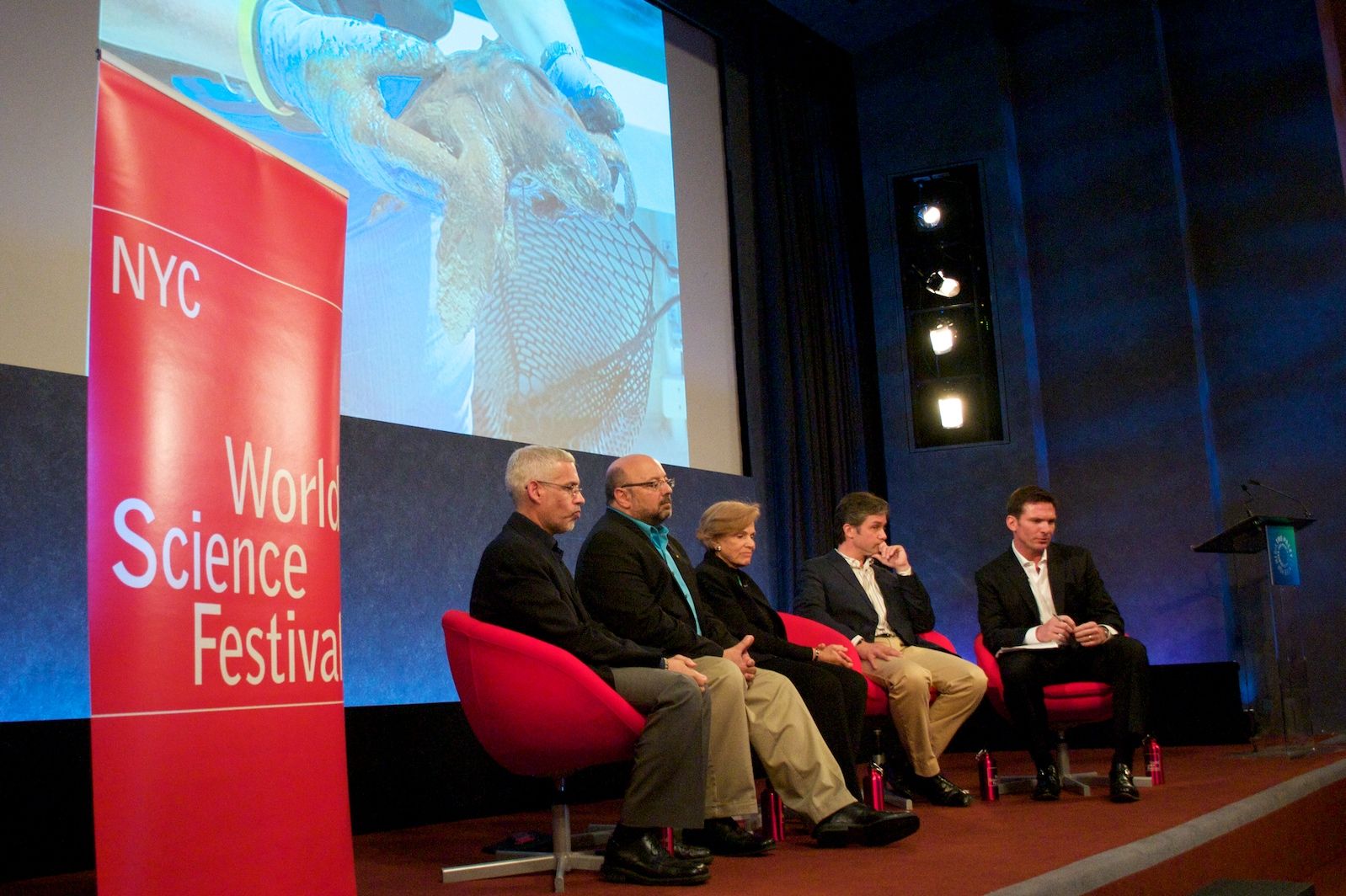
The Illuminating the Abyss panel consisting of Fabien Cousteau, David G. Gallo, Sylvia Earle, David E. Guggenheim, and moderator Bill Weir (from left to right), at the World Science Festival in New York City.
The presentation started with a tribute to Jacques Cousteau, perhaps the most famous explorer of our oceans. His films and adventures have inspired generations to take to the oceans to try to learn and preserve this most unique ecosystem. Unfortunately, this research is woefully underfunded – in the last 50 years, we’ve sent 12 men to the moon, but only 2 to the deepest reaches of the ocean. This lack of knowledge about the conditions and ecosystem in our waters is a big problem, especially given the current state of affairs in the Gulf of Mexico. As of Saturday, almost two million gallons of chemicals had been dumped in the Gulf to try to disperse the Deepwater Horizon spill. Earle called this action appalling, saying we “should not be pouring toxic chemicals into the sea without knowing the consequences.”
Guggenheim is also distraught by the spill. He studies the coral reefs in Cuba – nearly pristine reefs, with healthy ecosystems, that researchers were hoping would give us clues into why so many other coral reefs around the world are dying. Now, with the oil headed that way, they may not get the answers they’re looking for. Enough damage will be done in the Gulf alone, but if the Gulf Stream picks up the oil and circulates it down past the Cuban reefs, then up along the Atlantic coast and over to Europe, we’re looking at a problem of such magnitude that we won’t even know the full impact for many years.
Aside from the tragedy of the oil spill, we do constant damage to our waters through unsustainable fishing. Earle maintains that there is no such thing as “sustainable” commercial fishing. Guggenheim pointed out that we “manage” our fisheries as if they’re crops, like corn, that just grow each year, and we continue to harvest in greater numbers than the sea can replenish. There are proposals in the works to create AquaCulture – land based systems that could create a sustainable industry. Systems are already working in Asia, Australia, and Europe, and could be beneficial in areas like the Gulf, providing jobs and a big investment for the future to those who make their lives in the now decimated fishing industry. Aside from that, we have to start managing our oceans as an entire ecosystem, not as unrelated species that we just pluck out of the water and put on our plates. We don’t fully understand how everything is connected, but we know that if we continue to eat the large predators, like tuna and sharks, we’re creating an untenable long-term situation.
Fabien Cousteau said it best, succinctly reminding us that “There is no Planet B.”
To preserve our oceans, we must first learn more about them in-depth. To learn more, visit:
Mission Blue
Plant A Fish
Ocean Doctor
In addition to our written coverage of the 2010 World Science Festival, ScriptPhD.com took to the streets of New York City with a camera at the star-gazing event in Bryant Park last week. Dozens of amateur star-gazers gathered around the James Webb telescope on display, and we caught up with them to talk about what astronomy meant to them and why they were there. For a genuine feel of the Science Festival vibe, take a look at this video by Jessica Stuart:
Jessica Stuart is a writer, photographer and videographer living in New York City. Find her on her personal blog, and Twitter.
HIDDEN DIMENSIONS — June 5, 2010
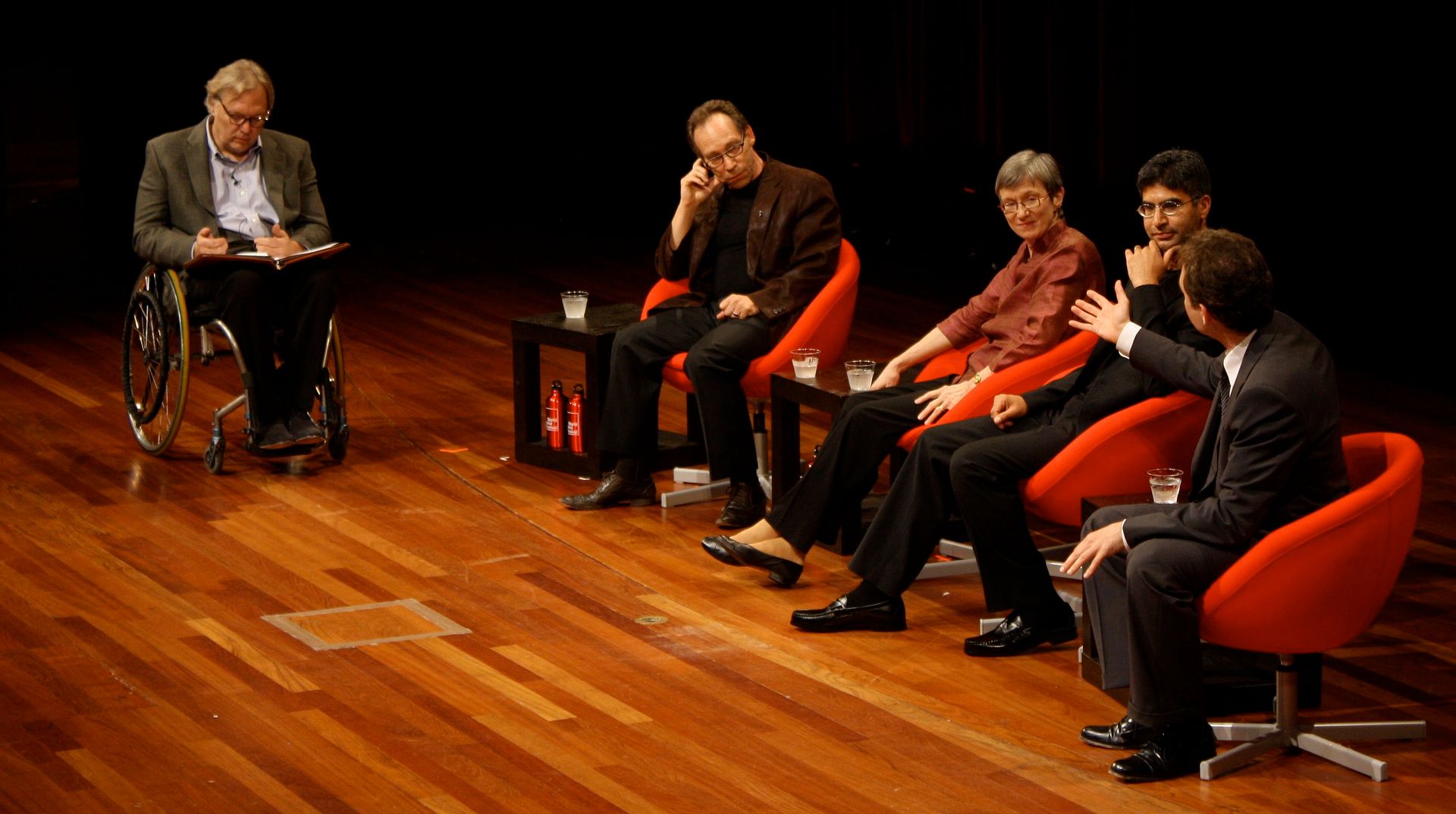
A panel of physicists, consisting of (from left to right) John Hockenberry, Lawrence Krauss, Linda Dalrymple Henderson, Shamit Kachru, and Brian Greene, explores hidden dimensions at the 2010 World Science Festival in New York City.
“This is really about going beyond our senses,” said Brian Greene from the stage at “Hidden Dimensions,” an event at the World Science Festival Saturday night. The screen behind him (picture below) showed a grid of fluorescent lines with loops sitting on top, like rings balancing on a checkered table. The grid represented all of the dimensions we are aware of—the three that make up space, plus time—and the rings represented another, theoretical dimension.
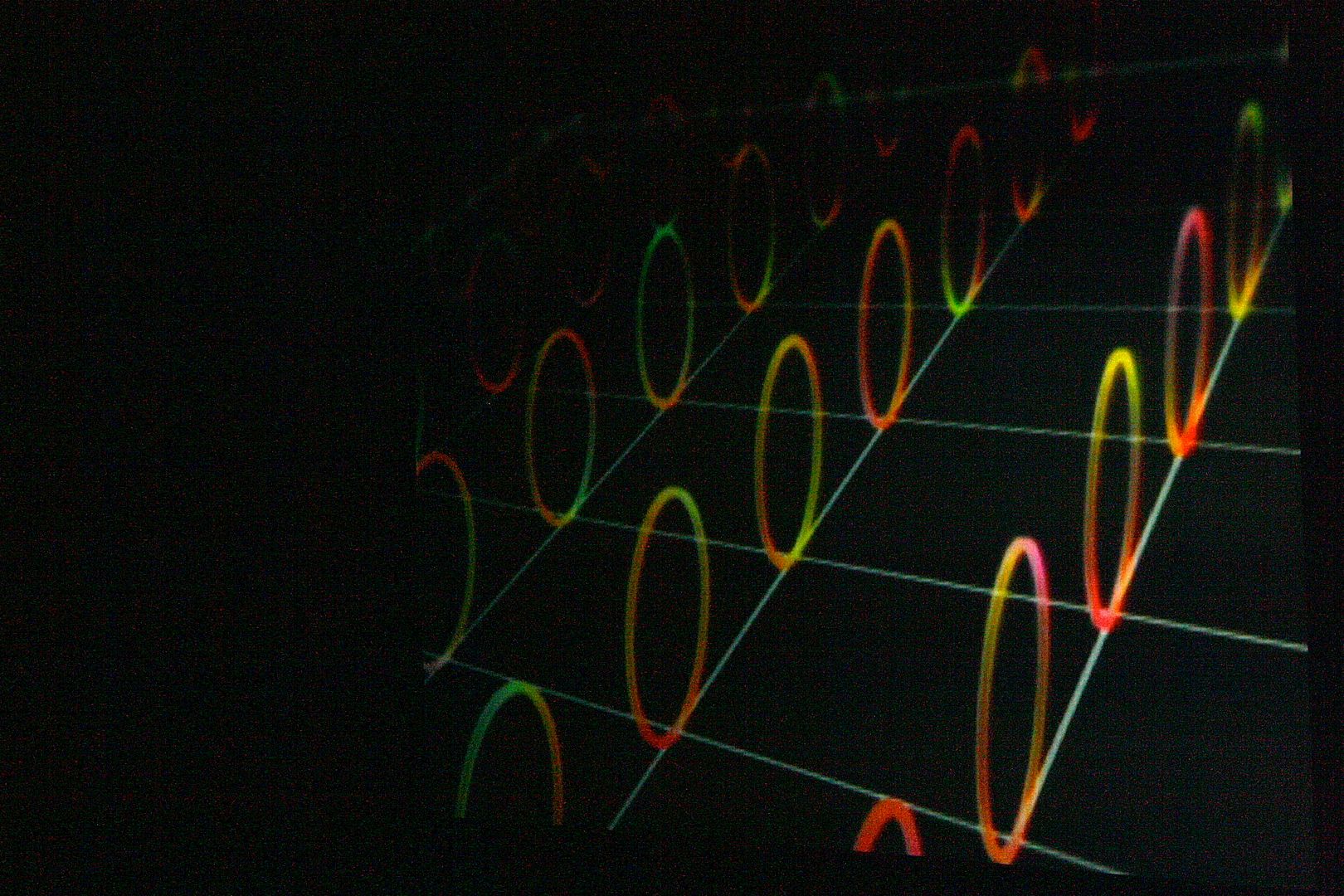
Going beyond hidden dimensions with Brian Greene at the 2010 World Science Festival in NYC.
This extra dimension is just one of six or seven that physicists like Greene think exist, though they are too small to be seen or directly detected by scientific instruments. The extra dimensions are a part of string theory, a mathematical idea that unites two conflicting branches of physics—general relativity and quantum mechanics—by proposing that the tiny particles in the universe are all part of miniscule, vibrating strings.
It sounds crazy. But then, so do a lot of things we can’t see or touch or hear. As an example, Greene showed an animation of a flat plane with a cube passing through it. If you lived only on that flat plane, you would see a shape-shifting shadow—a triangle that grows, becomes a square, and shrinks back into a triangle. It would be hard to make sense of, in a flat world, but adding another dimension—in this case, a third dimension, makes the whole picture a lot clearer. But “adding another dimension” to the way we understand the universe is not such an easy thing. Our fourth dimension, time, has been around for a while, but most of us still get a brain-ache from trying to understand what “space-time” actually refers to, or imagining the inside of a black hole.

Picasso's "Portrait of Daniel-Henry Kahnweiler," an exercise in cubism. Credit: Art Institute of Chicago.
Linda Henderson, an expert in twentieth-century art who was on the panel Saturday night, pointed out that, when this mysterious fourth dimension first came around in the late 19th century, the concept influenced movements in art and literature. Cubism, she said, is a good example of artists grappling with a new concept. Paintings like Picasso’s “Portrait of D.H. Kahnweiler” demonstrate these artistic wanderings into the new dimension. Though the painting is abstract, it represents a real idea. “It’s a painting that we can’t really say is only three dimensional,” Henderson said.
The invention of the x-ray machine, said Henderson, served as another reminder of the limits of our own senses. Displaying an early x-ray photograph on the screen, Henderson asked, “who can say there isn’t a fourth dimension, just because you can’t see it?”
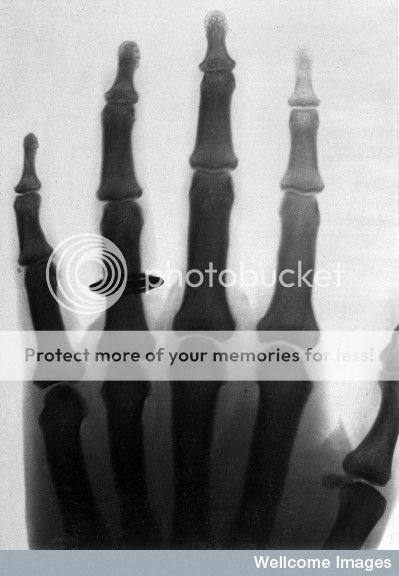
What dimension do YOU see in this X-ray?? Credit: Wellcome Images.
But Lawrence Krauss, a physicist also sitting on the panel, reminded the audience that ideas in math and art are different from science. “People want there to be more there than meets the eye,” said Krauss. While art and math can explore these ideas, Krauss noted, “there’s a huge difference between math and physics.” In other words, physics—like all science—requires theories to make testable predictions about the world, a hurdle string theory has yet to clear. Krauss recalled the words of Richard Feynman, one of the world’s most beloved physicists: “Science is imagination in a straightjacket.”
The challenge for physicists is to find a straightjacket big enough for string theory. In the meantime, we always have art.
ALL CREATURES, GREAT AND SMART — June 5, 2010
There were five panelists on stage at “All Creatures Great and Smart,” an event at the World Science Festival on Saturday afternoon, and each of them presented ideas that blur the clean lines people have tried to draw between the human and animal mind.
But it was panelists six through nine, with the help of number five, Brian Hare, who stole the show. Hare, an anthropologist, is interested in whether animals can develop theory of mind, the ability to think about what others are thinking about (otherwise known as the “I know you know that I know you know” phenomenon).
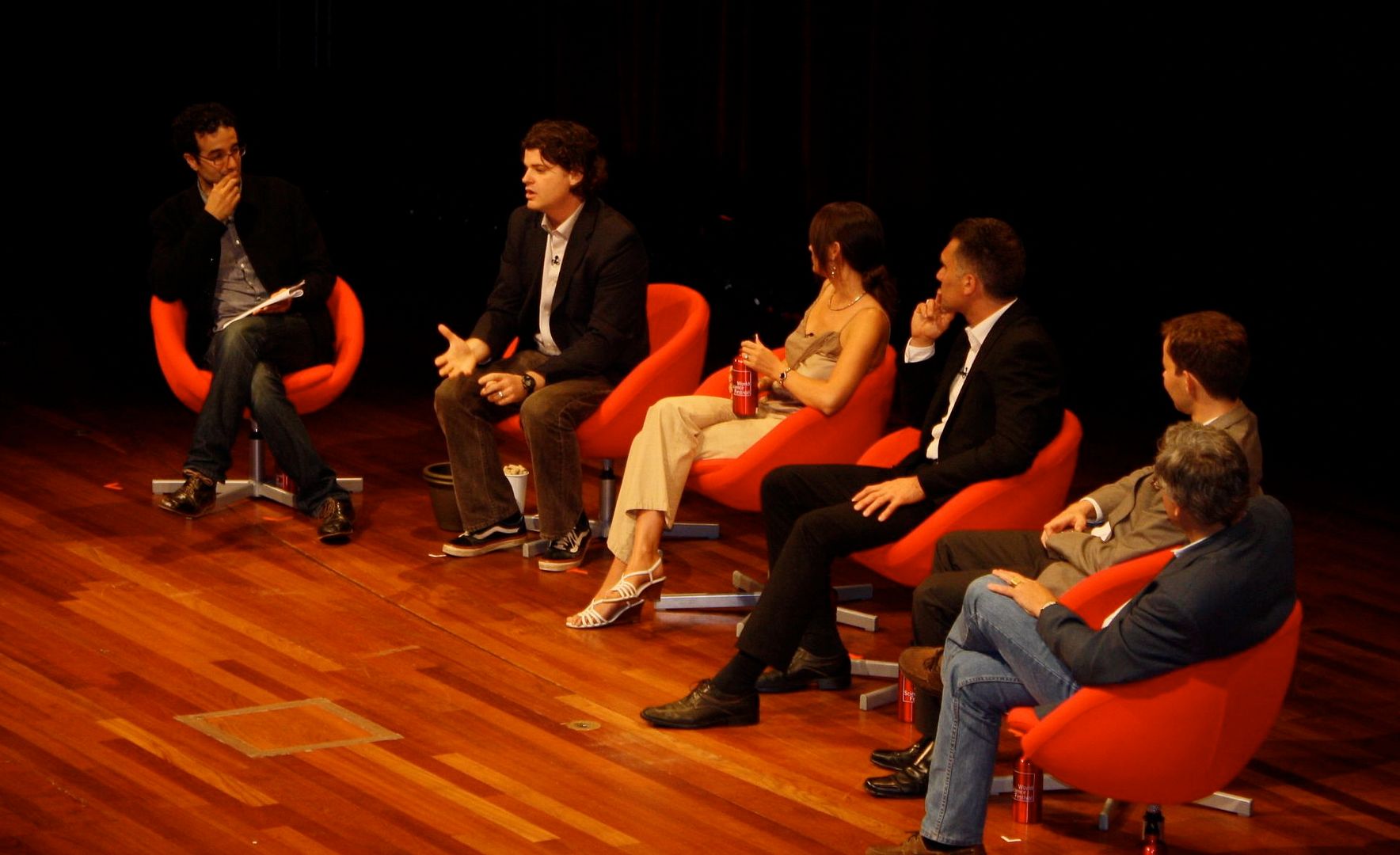
The "All Creatures Great and Smart" panel at the World Science Festival 2010 in New York: (from left to right) Jad Abumrad, Brian Hare, Vanessa Woods, Klaus Zuberbühler, Patrick R. Hof, and Jeremy Niven.
Humans aren’t born with theory of mind, but they develop it at a very young age, said Hare. “By the time your kid is four, they’re very good at deceiving you,” a clear sign that they can think about which facts you may be keen to—and which you may not be.
As a graduate student, Hare performed an experiment with chimpanzees, using the same type of test used by child psychologists. He put two containers upside-down on the floor in front of each chimp, hid food under one (children get toys), and then signaled the food’s whereabouts by pointing, standing closer to one bucket than the other, etc.
The chimps did not take the hint. They did not, it seems, have theory of mind.
Then, Hare began to think about how good his dog was at following social cues (and using them to its advantage), and decided to try the same experiment with dogs. His advisor was at first skeptical. “He said, yeah, yeah, everyone’s dog does calculus,” Hare remembered. But Hare ended up conducting his experiment, and on stage at the World Science Festival, he offered to repeat it with four volunteers. The first three dogs, Bela, Sammy, and Molly, were angelic subjects; they sat upon instruction, and awaited permission to retrieve a piece of cheese that Hare laid down a few feet away.
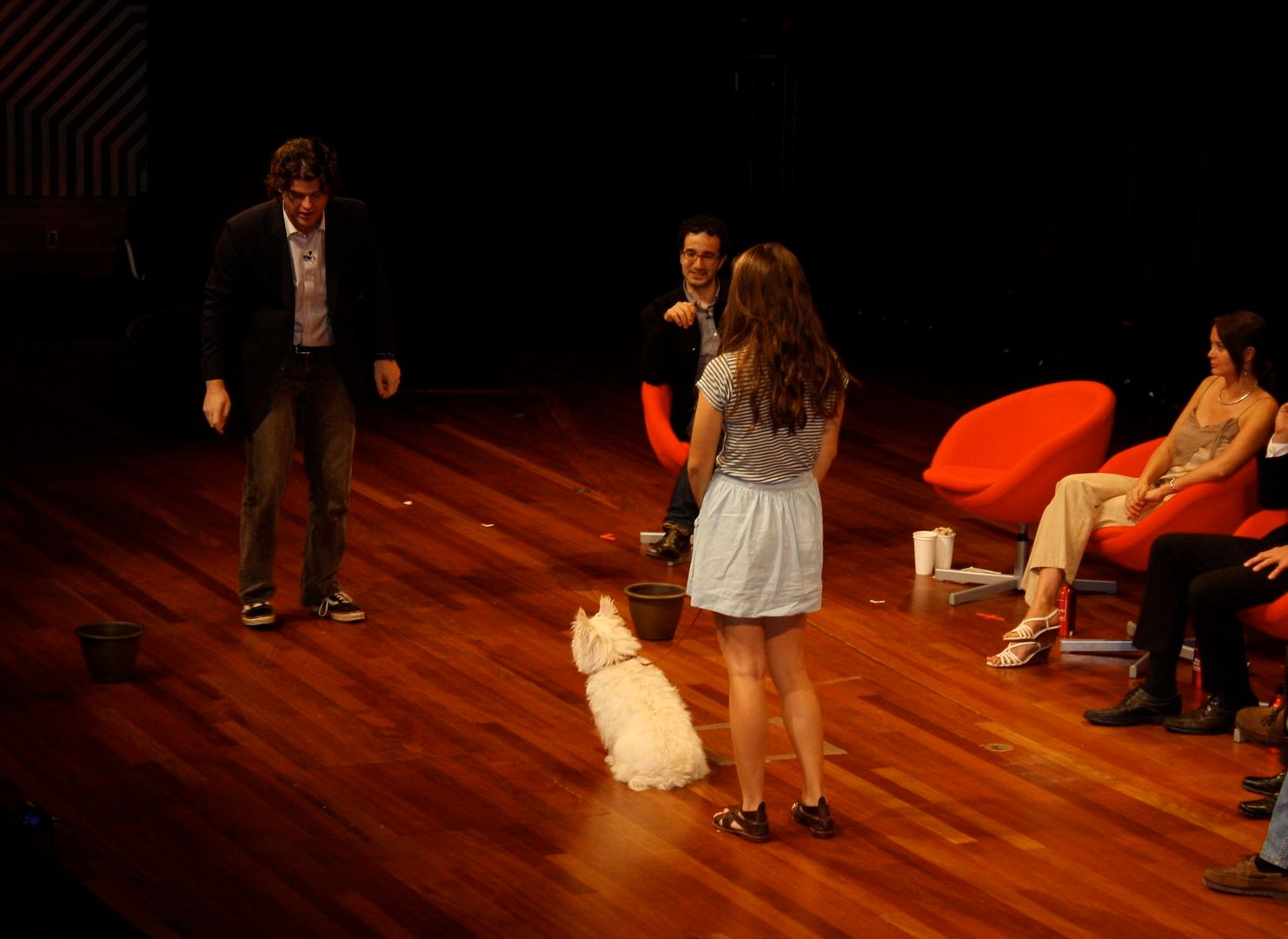
Brian Hare conducts behavioral experiments with dogs onstage at the World Science Festival in New York City.
And when Hare put a piece of cheese under one of the buckets and then pointed to it, the dogs followed the cue immediately.
This spotless confirmation of Hare’s canine-theory-of-mind was tarnished, however, by the fourth subject, a spirited Burmese Mountain dog named Georgie. It wasn’t that she couldn’t follow cues—she simply took a first-come, first-serve approach to the treats, preventing Hare from testing his hypothesis. As Georgie’s owner pulled the reluctant pet from the stage (she wanted to stay with the cheese), Hare pointed out that Georgie had gotten everything she wanted while on stage.
Which, at the end of a show about how animals are like humans, left me wondering how much humans may be like animals: are we all either blunt or clever?
Emily Elert is a freelance science writer living in New York City. Follow her on Twitter.
Follow the World Science Festival on Facebook and Twitter. All photography ©ScriptPhD.com. Please do not use without permission and credit.
*****************
ScriptPhD.com covers science and technology in entertainment, media and advertising. Hire our consulting company for creative content development.
Follow us on Twitter and our Facebook fan page. Subscribe to free email notifications of new posts on our home page.